


Posttreatment trajectories of physical activity in breast cancer survivors
- PMID: 28272835
- PMCID: PMC5498227
- DOI: 10.1002/cncr.30641
Posttreatment trajectories of physical activity in breast cancer survivors
Abstract
Background: Breast cancer survivors face a risk of disease recurrence and a higher risk of developing comorbidities such as cardiovascular disease when compared with the general population. Physical activity (PA) has been shown to reduce such risks. The current analyses sought to identify: 1) unique patterns of PA among breast cancer survivors; and 2) characteristics associated with the level of PA.
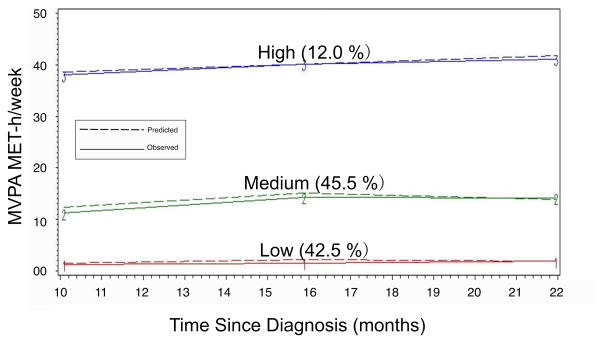
Methods: A total of 548 women reported PA and sociodemographic, health-related, and psychosocial factors at 3 time points, 6 months apart, after primary treatment of breast cancer. Cancer-related factors were obtained from chart reviews. Finite mixture modeling was used to examine trajectory groups of moderate-intensity to vigorous-intensity PA (MVPA) in the early posttreatment period. The authors then examined the characteristics associated with trajectory group membership.
Results: Three groups with distinct, stable patterns of PA were identified: the low MVPA (42.5% of patients), medium MVPA (45.5% of patients), and high MVPA (12.0% of patients) groups. In a multivariable setting, compared with more active breast cancer survivors, the least active group was found to have a higher body mass index, were less likely to report alcohol consumption, were more likely to smoke cigarettes, and had worse physical functioning and vitality scores. Cancer treatment-related factors did not significantly predict group membership.
Conclusions: A large percentage of breast cancer survivors remain physically inactive after treatment, suggesting the need for interventions to reduce morbidity and mortality in this population. Cancer 2017;123:2773-80. © 2017 American Cancer Society.
Keywords: breast cancer; health behavior; physical activity; quality of life; survivorship.
© 2017 American Cancer Society.
Conflict of interest statement
The authors have no conflicts of interest to report.
References
-
- Miller KD, Siegel RL, Lin CC, et al. Cancer treatment and survivorship statistics, 2016. CA Cancer J Clin. 2016;66(4):271–289. - PubMed
-
- Yancik R, Wesley MN, Ries LA, Havlik RJ, Edwards BK, Yates JW. Effect of age and comorbidity in postmenopausal breast cancer patients aged 55 years and older. JAMA. 2001;285(7):885–892. - PubMed
-
- Sarfati D, Koczwara B, Jackson C. The impact of comorbidity on cancer and its treatment. CA Cancer J Clin. 2016;66(4):337–350. - PubMed
-
- Speed-Andrews AE, Courneya KS. Effects of Exercise on Quality of Life and Prognosis in Cancer Survivors. Curr Sports Med Rep. 2009;8(4):176–181. - PubMed
MeSH terms
Grants and funding
LinkOut - more resources
Full Text Sources
Other Literature Sources
Medical
