. 2017 Mar 23;543(7646):538-542.
doi: 10.1038/nature21418. Epub 2017 Mar 8.

Remote site-selective C-H activation directed by a catalytic bifunctional template

Affiliations

Remote site-selective C-H activation directed by a catalytic bifunctional template

Zhipeng Zhang et al. Nature. .

Abstract

In chemical syntheses, the activation of carbon-hydrogen (C-H) bonds converts them directly into carbon-carbon or carbon-heteroatom bonds without requiring any prior functionalization. C-H activation can thus substantially reduce the number of steps involved in a synthesis. A single specific C-H bond in a substrate can be activated by using a 'directing' (usually a functional) group to obtain the desired product selectively. The applicability of such a C-H activation reaction can be severely curtailed by the distance of the C-H bond in question from the directing group, and by the shape of the substrate, but several approaches have been developed to overcome these limitations. In one such approach, an understanding of the distal and geometric relationships between the functional groups and C-H bonds of a substrate has been exploited to achieve meta-selective C-H activation by using a covalently attached, U-shaped template. However, stoichiometric installation of this template has not been feasible in the absence of an appropriate functional group on which to attach it. Here we report the design of a catalytic, bifunctional nitrile template that binds a heterocyclic substrate via a reversible coordination instead of a covalent linkage. The two metal centres coordinated to this template have different roles: one reversibly anchors substrates near the catalyst, and the other cleaves remote C-H bonds. Using this strategy, we demonstrate remote, site-selective C-H olefination of heterocyclic substrates that do not have the necessary functional groups for covalently attaching templates.


Figures
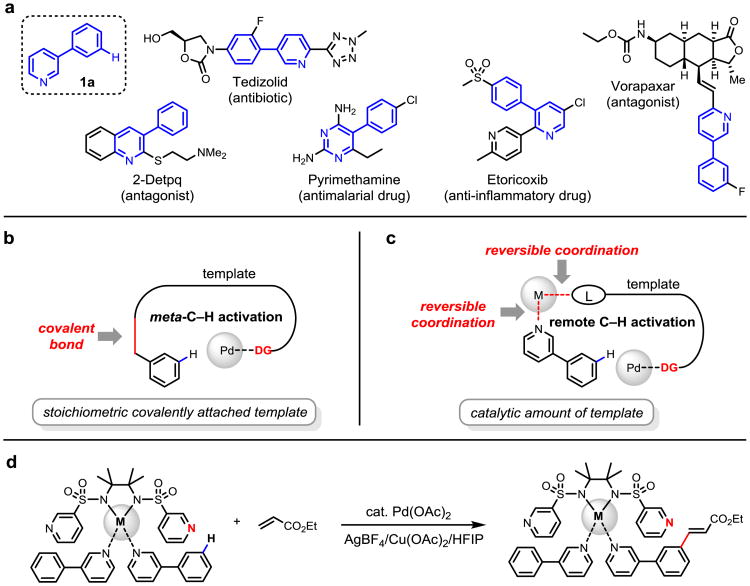
Figure 1
Figure 1. Design of a cooperative bimetallic approach for remote site-selective C–H activation
a, Model substrate 1a and structurally related pharmaceutical agents. b, Previously developed covalently attached U-shaped template strategy for meta-C-H activation. c, The bimetallic strategy for remote site-selective C–H activation. d, Remote site-selective C–H olefination. DG, directing group; M, metal ion; L, coordinating moieties. HFIP: hexafluoroisopropanol.
Figure 2
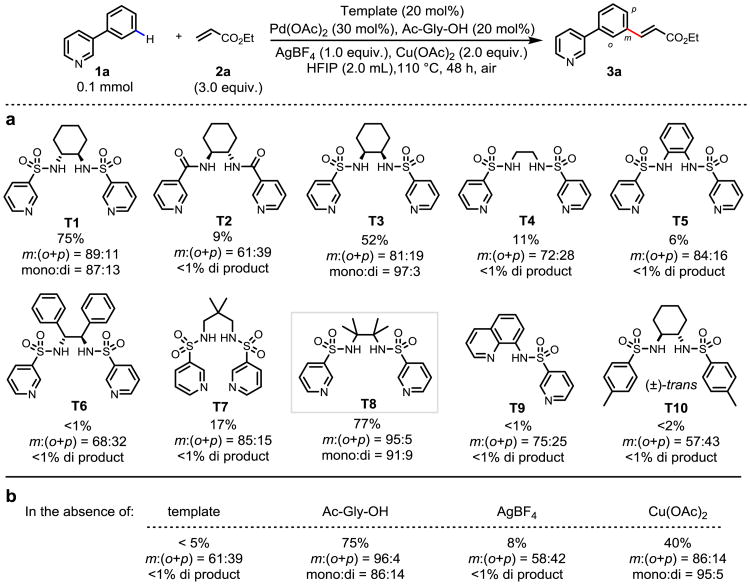
Figure 2. Discovery of a template that enables site-selective remote C–H activation
a, Template evaluation. b, Control experiments with T8 as template. The yield (percentage under each structure) of the olefinated products, the meta:(ortho + para) ratio of mono-olefinated products and ratio of mono- and di-olefinated products (mono:di) were determined by 1H NMR analysis of the unpurified reaction mixture using CH2Br2 as the internal standard (assisted with GC-MS analysis), the variance is estimated to be within 5%. Ac-Gly-OH: N-acetyl-glycine.
Figure 3
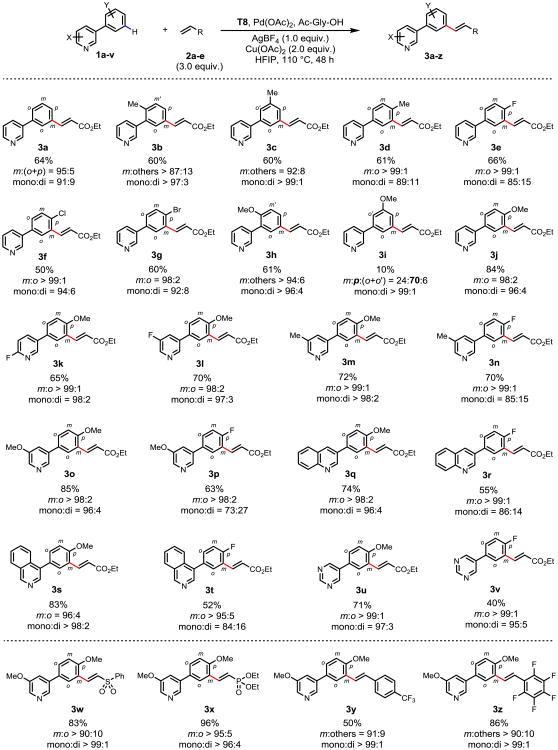
Figure 3. Remote site-selective C–H olefination of heterocycle-containing substrates using a catalytic template
The percentages under each structure indicate isolated yields of the mono-olefinated meta product. The meta-selectivity of mono-olefinated products and ratio of mono- and di-olefinated products were determined by 1H NMR analysis of the unpurified reaction mixture (assisted with GC-MS analysis), the variance is estimated to be within 5%. Reaction conditions (unless otherwise noted): 1a-v (0.1 mmol), T8 (20 mol%), Pd(OAc)2 (30 mol%), Ac-Gly-OH (20 mol%), AgBF4 (1.0 equiv.), Cu(OAc)2 (2.0 equiv.), 2a-e (3.0 equiv.), HFIP (2.0 mL), 110 °C, 48 h. For 3h-m, 3o, 3q, 3s, 3u, 3w and 3z: T8 (15 mol%), Pd(OAc)2 (20 mol%), Ac-Gly-OH (5 mol%). For 3p, 3t, 3v and 3y: 130 °C. For 3h-j and 3x: 72 h. For 3k, 3q and 3s: 24 h.
Figure 4
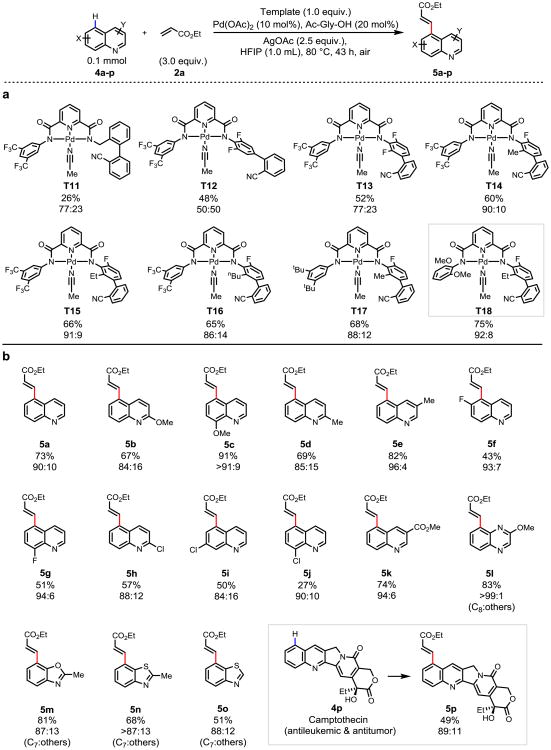
Figure 4. Remote site-selective C–H olefination of heterocycles using a non-covalent template
a, Template evaluation. b, Substrate scope. The percentages under each structure indicate the yields of the isolated olefinated products (unless otherwise noted). The ratio of the major product to other isomers (C5:others, unless otherwise noted) were determined by 1H NMR analysis of the unpurified reaction mixture (assisted with GC-MS analysis), the variance is estimated to be within 5%. For template evaluation (a): The yields were determined by 1H NMR analysis of the unpurified reaction mixture using 1,3,5-trimethoxybenzene as the internal standard. Reaction conditions for template evaluation (a): 4a (0.1 mmol), template (1.0 equiv.), Pd(OAc)2 (15 mol%), Ac-Gly-OH (20 mol%), AgOAc (2.0 equiv.), 2a (3.0 equiv.), HFIP (1.0 mL), 100 °C, 12 h. Reaction conditions for substrate scope (b), (unless otherwise noted): substrates (0.1 mmol), T18 (1.0 equiv.), Pd(OAc)2 (10 mol%), Ac-Gly-OH (20 mol%), AgOAc (2.5 equiv.), 2a (3.0 equiv.), HFIP (1.0 mL), 80 °C, 43 h. For 5b, 5d, 5h and 5p: T14 was used as template. For 5k and 5l: 22 h. For 5m: 20 h. For 5p: 48 h, AgOAc (5.0 equiv.).

References

    1. Snieckus V. Directed ortho metalation Tertiary amide and O-carbamate directors in synthetic strategies for polysubstituted aromatics. Chem Rev. 1990;90:879–933.
    1. Flemming JP, Berry MB, Brown JM. Sequential ortho-lithiations; the sulfoxide group as a relay to enable meta-substitution. Org Biomol Chem. 2008;6:1215–1221. - PubMed
    1. Daugulis O, Do HQ, Shabashov D. Palladium- and copper-catalyzed arylation of carbon–hydrogen bonds. Acc Chem Res. 2009;42:1074–1086. - PMC - PubMed
    1. Lyons TW, Sanford MS. Palladium-catalyzed ligand-directed C–H functionalization reactions. Chem Rev. 2010;110:1147–1169. - PMC - PubMed
    1. Colby DA, Bergman RG, Ellman JA. Rhodium-catalyzed C–C bond formation via heteroatom-directed C–H bond activation. Chem Rev. 2010;110:624–655. - PMC - PubMed

Publication types