A System of Care for Patients With ST-Segment Elevation Myocardial Infarction in India: The Tamil Nadu-ST-Segment Elevation Myocardial Infarction Program
- PMID: 28273293
- PMCID: PMC5814984
- DOI: 10.1001/jamacardio.2016.5977
A System of Care for Patients With ST-Segment Elevation Myocardial Infarction in India: The Tamil Nadu-ST-Segment Elevation Myocardial Infarction Program
Abstract
Importance: Challenges to improving ST-segment elevation myocardial infarction (STEMI) care are formidable in low- to middle-income countries because of several system-level factors.
Objective: To examine access to reperfusion and percutaneous coronary intervention (PCI) during STEMI using a hub-and-spoke model.
Design, setting, and participants: This multicenter, prospective, observational study of a quality improvement program studied 2420 patients 20 years or older with symptoms or signs consistent with STEMI at primary care clinics, small hospitals, and PCI hospitals in the southern state of Tamil Nadu in India. Data were collected from the 4 clusters before implementation of the program (preimplementation data). We required a minimum of 12 weeks for the preimplementation data with the period extending from August 7, 2012, through January 5, 2013. The program was then implemented in a sequential manner across the 4 clusters, and data were collected in the same manner (postimplementation data) from June 12, 2013, through June 24, 2014, for a mean 32-week period.
Exposures: Creation of an integrated, regional quality improvement program that linked the 35 spoke health care centers to the 4 large PCI hub hospitals and leveraged recent developments in public health insurance schemes, emergency medical services, and health information technology.
Main outcomes and measures: Primary outcomes focused on the proportion of patients undergoing reperfusion, timely reperfusion, and postfibrinolysis angiography and PCI. Secondary outcomes were in-hospital and 1-year mortality.
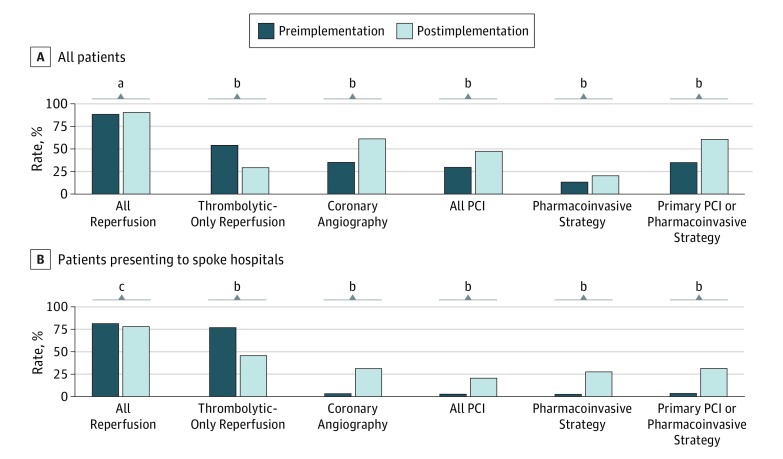
Results: A total of 2420 patients with STEMI (2034 men [84.0%] and 386 women [16.0%]; mean [SD] age, 54.7 [12.2] years) (898 in the preimplementation phase and 1522 in the postimplementation phase) were enrolled, with 1053 patients (43.5%) from the spoke health care centers. Missing data were common for systolic blood pressure (213 [8.8%]), heart rate (223 [9.2%]), and anterior MI location (279 [11.5%]). Overall reperfusion use and times to reperfusion were similar (795 [88.5%] vs 1372 [90.1%]; P = .21). Coronary angiography (314 [35.0%] vs 925 [60.8%]; P < .001) and PCI (265 [29.5%] vs 707 [46.5%]; P < .001) were more commonly performed during the postimplementation phase. In-hospital mortality was not different (52 [5.8%] vs 85 [5.6%]; P = .83), but 1-year mortality was lower in the postimplementation phase (134 [17.6%] vs 179 [14.2%]; P = .04), and this difference remained consistent after multivariable adjustment (adjusted odds ratio, 0.76; 95% CI, 0.58-0.98; P = .04).
Conclusions and relevance: A hub-and-spoke model in South India improved STEMI care through greater use of PCI and may improve 1-year mortality. This model may serve as an example for developing STEMI systems of care in other low- to middle-income countries.
Conflict of interest statement
Figures
Comment in
-
Quality Improvement in Cardiac Services in India: Quo Vadis?JAMA Cardiol. 2017 May 1;2(5):505-506. doi: 10.1001/jamacardio.2016.6008. JAMA Cardiol. 2017. PMID: 28273286 No abstract available.
-
A system of care for patients with ST-segment elevation myocardial infarction in India.Natl Med J India. 2018 Jul-Aug;31(4):222-223. doi: 10.4103/0970-258X.258223. Natl Med J India. 2018. PMID: 31134929 No abstract available.
References
-
- Nallamothu BK, Bradley EH, Krumholz HM. Time to treatment in primary percutaneous coronary intervention. N Engl J Med. 2007;357(16):1631-1638. - PubMed
-
- Kaifoszova Z, Kala P, Alexander T, et al. Stent for Life Initiative: leading example in building STEMI systems of care in emerging countries. EuroIntervention. 2014;10(suppl T):T87-T95. - PubMed
-
- Xavier D, Pais P, Devereaux PJ, et al. ; CREATE Registry Investigators . Treatment and outcomes of acute coronary syndromes in India (CREATE): a prospective analysis of registry data. Lancet. 2008;371(9622):1435-1442. - PubMed
-
- O’Gara PT, Kushner FG, Ascheim DD, et al. ; ACCF/AHA Task Force . 2013 ACCF/AHA guideline for the management of ST-elevation myocardial infarction: executive summary: a report of the American College of Cardiology Foundation/American Heart Association Task Force on Practice Guidelines. Circulation. 2013;127(4):529-555. - PubMed
Publication types
MeSH terms
LinkOut - more resources
Full Text Sources
Other Literature Sources
Miscellaneous