


Performance of the Pooled Cohort atherosclerotic cardiovascular disease risk score in hepatitis C virus-infected persons
- PMID: 28273386
- PMCID: PMC5589479
- DOI: 10.1111/jvh.12705
Performance of the Pooled Cohort atherosclerotic cardiovascular disease risk score in hepatitis C virus-infected persons
Abstract
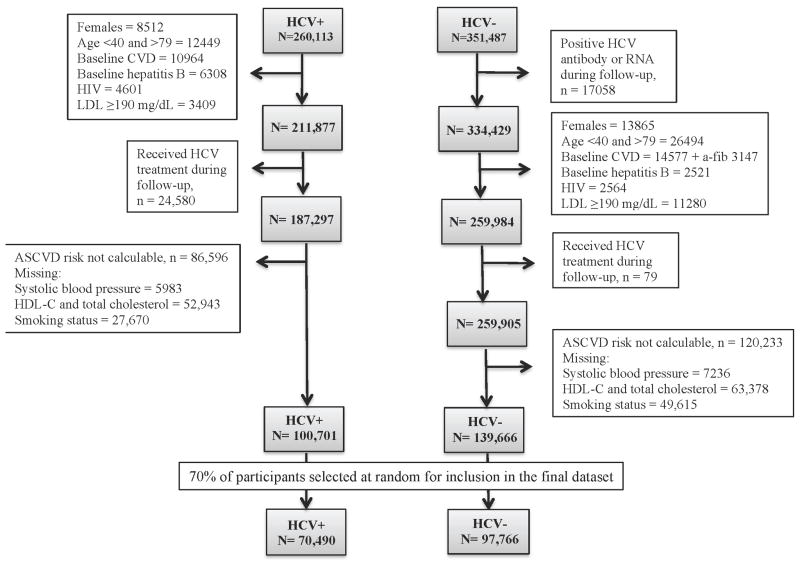
Chronic hepatitis C virus (HCV) infection has been associated with an increased risk for cardiovascular disease (CVD). The recommended Pooled Cohort atherosclerotic cardiovascular disease (ASCVD) risk equation for estimation of 10-year CVD risk has not been validated in HCV-infected populations. We examined the performance of the ASCVD risk score in HCV-infected persons, using the national Electronically Retrieved Cohort of HCV Infected Veterans to derive a cohort of HCV-infected and uninfected subjects without baseline ASCVD, hepatitis B, or HIV infection, and with low-density lipoprotein cholesterol level<190 mg/dL. Performance of the ASCVD risk equation was assessed by Cox proportional hazard regression, C-statistics and Hosmer-Lemeshow statistic. The cohort included 70 490 HCV-infected and 97 766 HCV-uninfected men with mean age of 55 years, 56% White and 29% Black. Incident CVD event rates were similar between the two groups (13.2 and 13.4 events/1000 person-years), with a higher incidence of coronary heart disease events in the HCV-uninfected group and of stroke events in the HCV-infected group. Adjusting for ASCVD risk score, HCV infection was associated with higher risk for an ASCVD event in the subgroup with baseline ASCVD risk ≥7.5% (HR: 1.19, P<.0001). C-statistics were poor in both the HCV-infected and uninfected groups (0.60 and 0.61, respectively). By Hosmer-Lemeshow test, the ASCVD risk equation overestimated risk amongst lower risk patients and underestimated risk amongst higher risk patients in both the HCV-infected and uninfected groups. Further investigation is needed to determine whether a modified equation to accurately predict ASCVD risk in HCV-infected persons is warranted.
Keywords: atherosclerotic cardiovascular disease score; cardiovascular disease; cardiovascular risk assessment; hepatitis C virus.
© 2017 John Wiley & Sons Ltd.
Conflict of interest statement
References
-
- Ishizaka N, Ishizaka Y, Takahashi E, Tooda E, Hashimoto H, Nagai R, et al. Association between hepatitis C virus seropositivity, carotid-artery plaque, and intima-media thickening. Lancet. 2002;359(9301):133–5. - PubMed
-
- Alyan O, Kacmaz F, Ozdemir O, Deveci B, Astan R, Celebi AS, et al. Hepatitis C infection is associated with increased coronary artery atherosclerosis defined by modified Reardon severity score system. Circ J. 2008;72(12):1960–5. - PubMed
-
- Petta S, Macaluso FS, Craxi A. Cardiovascular diseases and HCV infection: a simple association or more? Gut. 2014;63(3):369–75. - PubMed
-
- Adinolfi LE, Restivo L, Zampino R, Guerrera B, Lonardo A, Ruggiero L, et al. Chronic HCV infection is a risk of atherosclerosis. Role of HCV and HCV-related steatosis. Atherosclerosis. 2012;221(2):496–502. - PubMed
Publication types
MeSH terms
Grants and funding
LinkOut - more resources
Full Text Sources
Other Literature Sources
Medical
