Randomized Controlled Trial
. 2017 Dec;7(1):94.
doi: 10.1038/s41598-017-00224-6. Epub 2017 Mar 7.

Six-month efficacy of platelet-rich plasma for carpal tunnel syndrome: A prospective randomized, single-blind controlled trial

Affiliations
Randomized Controlled Trial

Six-month efficacy of platelet-rich plasma for carpal tunnel syndrome: A prospective randomized, single-blind controlled trial

Yung-Tsan Wu et al. Sci Rep. 2017 Dec.

Abstract

Recently, a few small reports with short follow-up period have shown clinical benefits of platelet-rich plasma (PRP) for peripheral neuropathy including one pilot study and one small, non-randomized trial in patients with carpal tunnel syndrome (CTS). Therefore, we conducted a randomized, single-blind, controlled trial to assess the 6-month effect of PRP in patients with CTS. Sixty patients with unilateral mild-to-moderate CTS were randomized into two groups of 30, namely the PRP and control groups. In the PRP group, patients were injected with one dose of 3 mL of PRP using ultrasound guidance and the control group received a night splint through the study period. The primary outcome measure was the visual analog scale (VAS) and secondary outcome measures included the Boston Carpal Tunnel Syndrome Questionnaire (BCTQ) score, the cross-sectional area (CSA) of the median nerve (MN), electrophysiological findings of the MN, and finger pinch strength. The evaluation was performed before treatment and at 1, 3, and 6 months post-injection. The PRP group exhibited a significant reduction in the VAS score, BCTQ score, and CSA of MN compared to the those of control group 6 months post-treatment (p < 0.05). Our study demonstrates that PRP is a safe modality that effectively relieves pain and improves disability in the patients with CTS.


Conflict of interest statement

The authors declare that they have no competing interests.

Figures

Figure 1
Figure 1
Ultrasonographic imaging. (a) Transverse view showing the median nerve (MN) peeled off from the flexor retinaculum (arrows) using 2 mL of PRP via hydrodissection (asterisk). (b) Transverse view showing the MN separated from the inferior underlying subsynovial connective tissue using an additional 1 mL of PRP via hydrodissection (asterisk). (c) Long axial view showing the distribution of PRP throughout the proximal-to-distal area of the carpal tunnel (asterisk). MN: median nerve; FPL: flexor pollicis longus; FDS: flexor digitorum superficialis; FDP: flexor digitorum profundus.
Figure 2
Figure 2
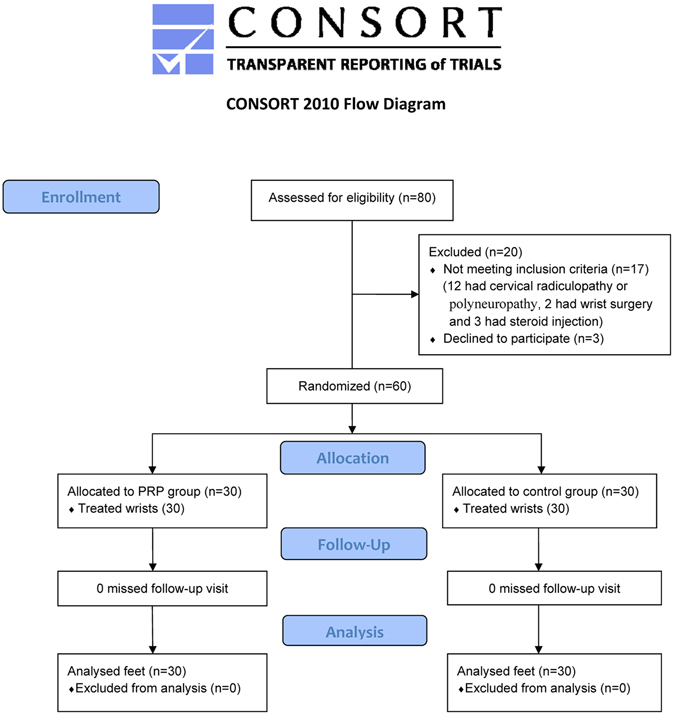
Study flow diagram.
Figure 3
Figure 3
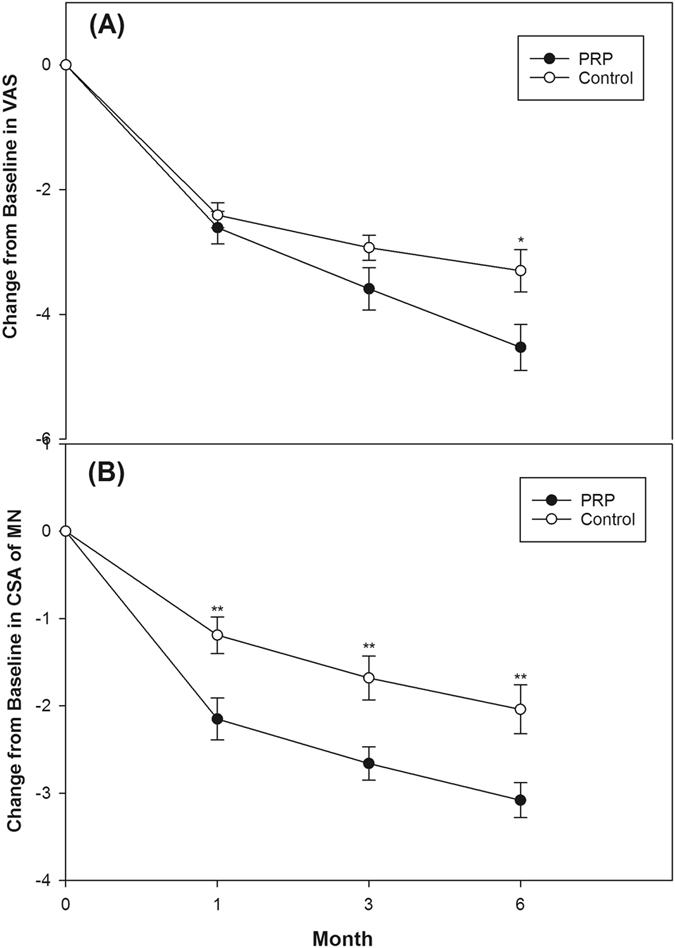
Mean change from baseline in visual analog scale (VAS) and cross-sectional area (CSA) of medain nerve (MN) in both groups (mean ± standard error). (A) PRP group had significant improvement of VAS compared with control group at 6th month (p < 0.05). (B) PRP group had significant improvement of CSA compared with control group at all follow-up assessments (p < 0.01). (*p < 0.05, **p < 0.01. Independent t-test was used).
Figure 4
Figure 4
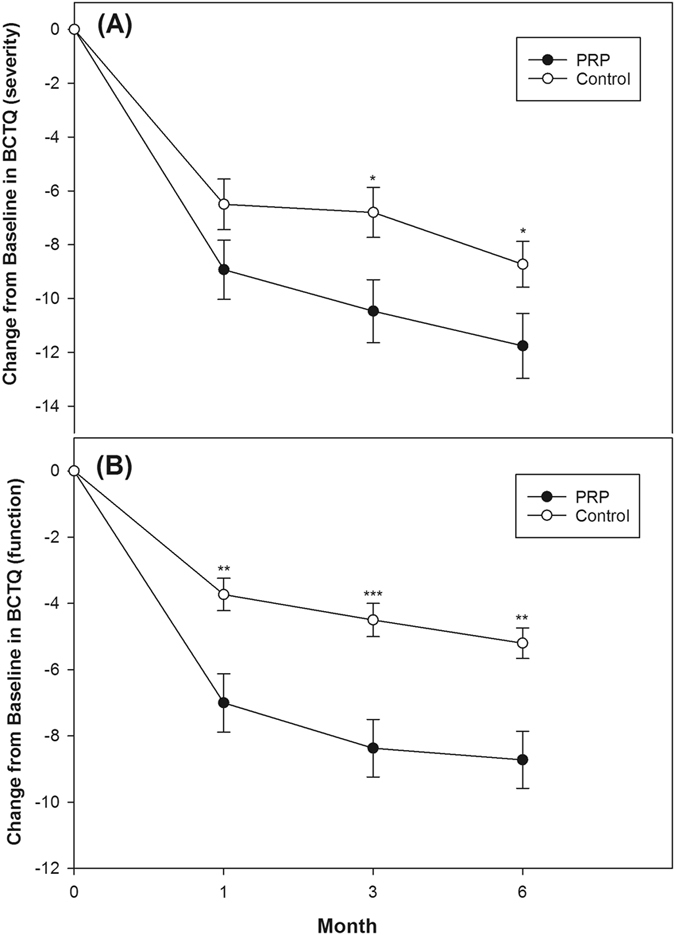
Mean change from baseline in Boston Carpal Tunnel Syndrome Questionnaire (BCTQ) in both groups (mean ± standard error). (A) PRP group had significant improvement of BCTQ (severity) compared with control group at 3rd and 6th month (p < 0.05). (B) PRP group had significant improvement of BCTQ (function) compared with control group at all follow-up assessments (p < 0.01). (*p < 0.05, **p < 0.01, ***p < 0.001. Independent t-test was used).

References

    1. Werner RA, Andary M. Carpal tunnel syndrome: Pathophysiology and clinical neurophysiology. Clin Neurophysiol. 2002;113:1373–1381. doi: 10.1016/S1388-2457(02)00169-4. - DOI - PubMed
    1. Karadas O, Tok F, Ulaş UH, Odabaşi Z. The effectiveness of triamcinolone acetonide vs. procaine hydrochloride injection in the management of carpal tunnel syndrome: a double-blind randomized clinical trial. Am J Phys Med Rehabil. 2011;90:287–292. doi: 10.1097/PHM.0b013e31820639ec. - DOI - PubMed
    1. O’Connor, D., Marshall, S. & Massy-Westropp, N. Non-surgical treatment (other than steroid injection) for carpal tunnel syndrome. Cochrane Database Syst Rev. CD003219 (2003). - PMC - PubMed
    1. Katz JN, et al. Maine carpal tunnel study: Outcomes of operative and nonoperative therapy for carpal tunnel syndrome in a community-based cohort. J Hand Surg Am. 1998;23:697–710. doi: 10.1016/S0363-5023(98)80058-0. - DOI - PubMed
    1. Gerritsen AA, et al. Splinting for carpal tunnel syndrome: Prognostic indicators of success. J Neurol Neurosurg Psychiatry. 2003;74:1342–1344. doi: 10.1136/jnnp.74.9.1342. - DOI - PMC - PubMed

Publication types