


Combined Effects of Gaze and Orientation of Faces on Person Judgments in Social Situations
- PMID: 28275364
- PMCID: PMC5319968
- DOI: 10.3389/fpsyg.2017.00259
Combined Effects of Gaze and Orientation of Faces on Person Judgments in Social Situations
Abstract
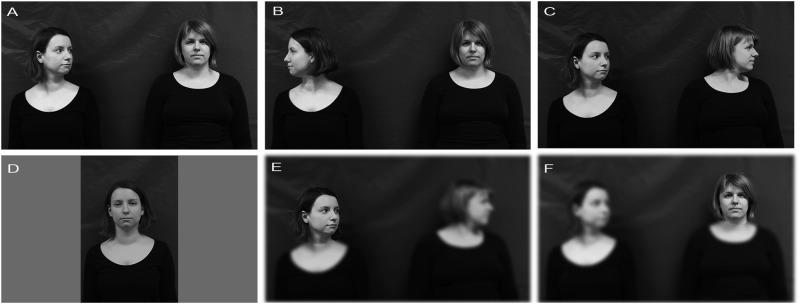
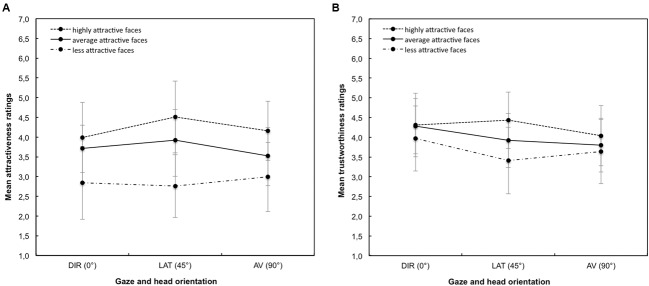
In social situations, faces of others can vary simultaneously in gaze and orientation. How these variations affect different kinds of social judgments, such as attractiveness or trustworthiness, is only partly understood. Therefore, we studied how different gaze directions, head angles, but also levels of facial attractiveness affect perceived attractiveness and trustworthiness. We always presented pairs of faces - either two average attractive faces or a highly attractive together with a less attractive face. We also varied gaze and head angles showing faces in three different orientations, front, three-quarter and profile view. In Experiment 1 (N = 62), participants rated averted gaze in three-quarter views as more attractive than in front and profile views, and evaluated faces with direct gaze in front views as most trustworthy. Moreover, faces that were being looked at by another face were seen as more attractive. Independent of the head orientation or gaze direction, highly attractive faces were rated as more attractive and more trustworthy. In Experiment 2 (N = 54), we found that the three-quarter advantage vanished when the second face was blurred during judgments, which demonstrates the importance of the presence of another person-as in a triadic social situation-as well as the importance of their visible gaze. The findings emphasize that social evaluations such as trustworthiness are unaffected by the esthetic advantage of three-quarter views of two average attractive faces, and that the effect of a faces' attractiveness is more powerful than the more subtle effects of gaze and orientations.
Keywords: attractiveness; gaze direction; person judgments; social scene; three-quarter views of faces; trustworthiness.
Figures
References
-
- Aharon I., Etcoff N., Ariely D., Chabris C. F., O’Connor E., Breiter H. C. (2001). Beautiful faces have variable reward value: fMRI and behavioral evidence. Neuron 32 537–551. - PubMed
-
- Baron-Cohen S. (1995). Mindblindness: An Essay on Autism and Theory of Mind. Cambridge, MA: MIT Press.
-
- Bayliss A. P., Paul M. A., Cannon P. R., Tipper S. P. (2006). Gaze cuing and affective judgments of objects: I like what you look at. Psychon. Bull. Rev. 13 1061–1066. - PubMed
Grants and funding
LinkOut - more resources
Full Text Sources
Other Literature Sources
