


The impact of Thailand's public health response to the HIV epidemic 1984-2015: understanding the ingredients of success
- PMID: 28275444
- PMCID: PMC5337415
- DOI: 10.1016/S2055-6640(20)31093-1
The impact of Thailand's public health response to the HIV epidemic 1984-2015: understanding the ingredients of success
Abstract
Introduction: Thailand has been heralded as a global leader in HIV prevention and treatment, and its experience with the HIV/AIDS epidemic holds valuable lessons for public health. This paper documents Thailand's response to its HIV epidemic from the late 1980s until today, and analyses its epidemiological impact (incidence and mortality). We discuss the association between the trajectory of HIV incidence and mortality rates over time, and the programmatic investments, policies and interventions that were implemented in the last three decades.
Methods: This is a review paper that draws on published literature, unpublished sources and routine behavioural and serological surveillance data since 1989. It is informed by the modelling of epidemiological impacts using the AIDS Epidemic Model. The AIDS Epidemic Model and Spectrum were used to assess the impact on incidence and mortality. Apart from epidemiological data, National AIDS Spending Assessment and programme data were also used to assess financial investments.
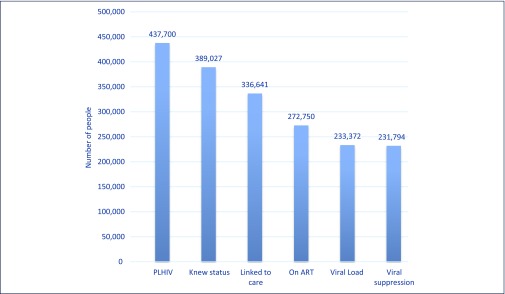
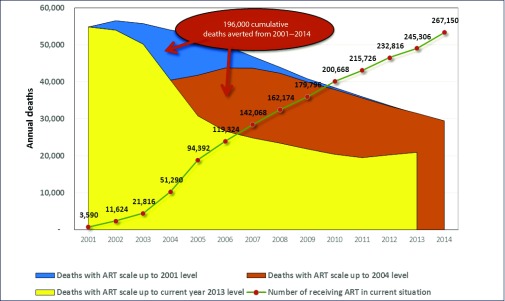
Results: Thailand is well on its way to meeting the 90-90-90 targets, the goal that by 2020, 90% of people living with HIV know their HIV status, 90% of people with diagnosed HIV infection receive sustained antiretroviral therapy, and 90% of people receiving antiretroviral therapy (ART) are virally suppressed. In Thailand, 89% of people living with HIV know their status, 72% receive ART and 82% have viral load testing - 99% of whom are suppressed. The public health response to HIV in Thailand has averted 5.7 million infections since 1991. If Thailand had not responded in 1991 to the HIV epidemic, and had there been no prevention and ART provision, the country would have experienced an estimated 158,000-225,000 deaths in the 2001-2006 period. This figure would have risen to 231,000-268,924 in the 2007-2014 period. A total of 196,000 deaths were averted between 2001 and 2014. If ART scale-up had not occurred in 2001, Thailand would have experienced between 50,000 and 55,000 deaths per year in the period 2001-2006, and 31,000-46,000 annual deaths between 2007 and 2014. The main impact in terms of deaths averted is seen from 2004 onwards, reflecting treatment scale up.
Conclusions: Thailand's AIDS response has prevented needless morbidity and mortality due to the HIV epidemic. In the context of Thailand's ageing population, it is faced with the twin challenges of maintaining life-long quality services among HIV patients and sustaining behaviour change to maintain primary prevention gains. Keeping the focus of the policy makers and health administrators on 'Ending the HIV epidemic' will require consistent advocacy, and evidence-based, innovative and efficient approaches.
Keywords: ART; HIV/AIDS; Thailand; health governance; impact; incidence; interventions; universal health.
Figures
References
-
- Weniger BG, Limpakarnjanarat K, Ungchusak K et al. . The epidemiology of HIV infection and AIDS in Thailand, AIDS 1991; 5 Suppl 2: S71– 85. - PubMed
-
- Saengwonloey O, Jiraphongsa C, Foy H.. Thailand report: HIV/AIDS surveillance 1998. J Acquir Immune DeficSyndr 2003; 32 Suppl 1: S63– 67. - PubMed
-
- Ou CY, Takebe Y, Weniger BG et al. . Independent introduction of two major HIV-1 genotypes into distinct high-risk populations in Thailand. Lancet 1993; 341: 1171– 1174. - PubMed
-
- Siraprapasiri T, Thanprasertsuk S, Rodklay A et al. . Risk factors for HIV among prostitutes in Chiangmai, Thailand. AIDS 1991; 5: 579– 582. - PubMed
-
- Sawanpanyalert P, Ungchusak K, Thanprasertsuk S, Akarasewi P.. HIV seroconversion rates among female sex workers in Chiang Mai, Thailand: a multi-cross-sectional study. AIDS 1994; 8: 825– 829. - PubMed
Publication types
Grants and funding
LinkOut - more resources
Full Text Sources