Multicenter Study
. 2017 Feb 14:14:422-432.
doi: 10.1016/j.nicl.2017.02.009. eCollection 2017.

The Global ECT-MRI Research Collaboration (GEMRIC): Establishing a multi-site investigation of the neural mechanisms underlying response to electroconvulsive therapy

Affiliations
Multicenter Study

The Global ECT-MRI Research Collaboration (GEMRIC): Establishing a multi-site investigation of the neural mechanisms underlying response to electroconvulsive therapy

Leif Oltedal et al. Neuroimage Clin. .

Abstract

Major depression, currently the world's primary cause of disability, leads to profound personal suffering and increased risk of suicide. Unfortunately, the success of antidepressant treatment varies amongst individuals and can take weeks to months in those who respond. Electroconvulsive therapy (ECT), generally prescribed for the most severely depressed and when standard treatments fail, produces a more rapid response and remains the most effective intervention for severe depression. Exploring the neurobiological effects of ECT is thus an ideal approach to better understand the mechanisms of successful therapeutic response. Though several recent neuroimaging studies show structural and functional changes associated with ECT, not all brain changes associate with clinical outcome. Larger studies that can address individual differences in clinical and treatment parameters may better target biological factors relating to or predictive of ECT-related therapeutic response. We have thus formed the Global ECT-MRI Research Collaboration (GEMRIC) that aims to combine longitudinal neuroimaging as well as clinical, behavioral and other physiological data across multiple independent sites. Here, we summarize the ECT sample characteristics from currently participating sites, and the common data-repository and standardized image analysis pipeline developed for this initiative. This includes data harmonization across sites and MRI platforms, and a method for obtaining unbiased estimates of structural change based on longitudinal measurements with serial MRI scans. The optimized analysis pipeline, together with the large and heterogeneous combined GEMRIC dataset, will provide new opportunities to elucidate the mechanisms of ECT response and the factors mediating and predictive of clinical outcomes, which may ultimately lead to more effective personalized treatment approaches.

Keywords: Electroconvulsive therapy; Longitudinal; MRI; Mega analysis; Multi-site.


Figures
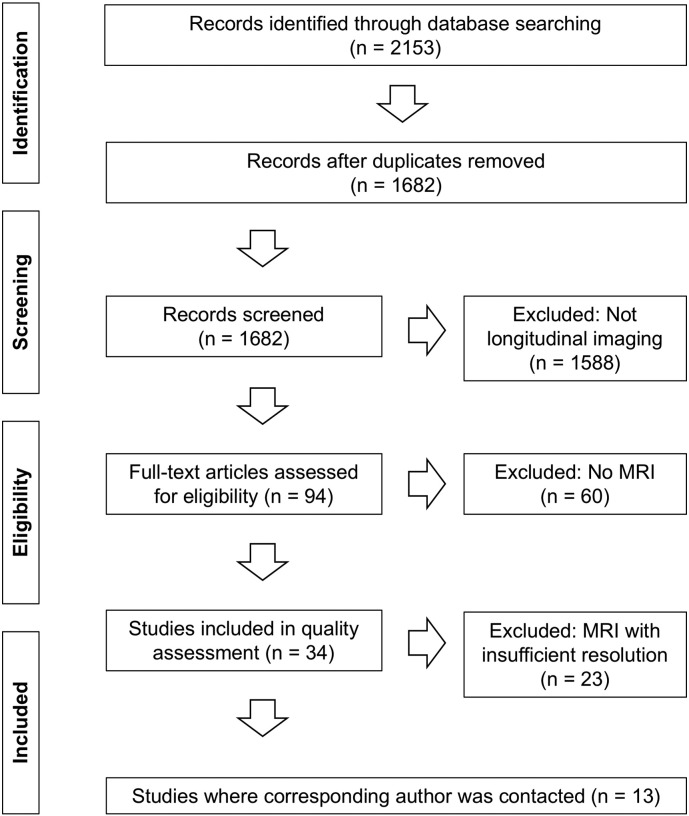
Fig. S1
Fig. S1
Flow chart of systematic search.
Fig. 1
Fig. 1
Currently 15 sites are contributing to GEMRIC and more are expected to join, in line with growing interest in neuroimaging research in ECT. The UCSD site provides the Imaging Core and is responsible for tools for image processing at the common server located in Bergen.
Fig. 2
Fig. 2
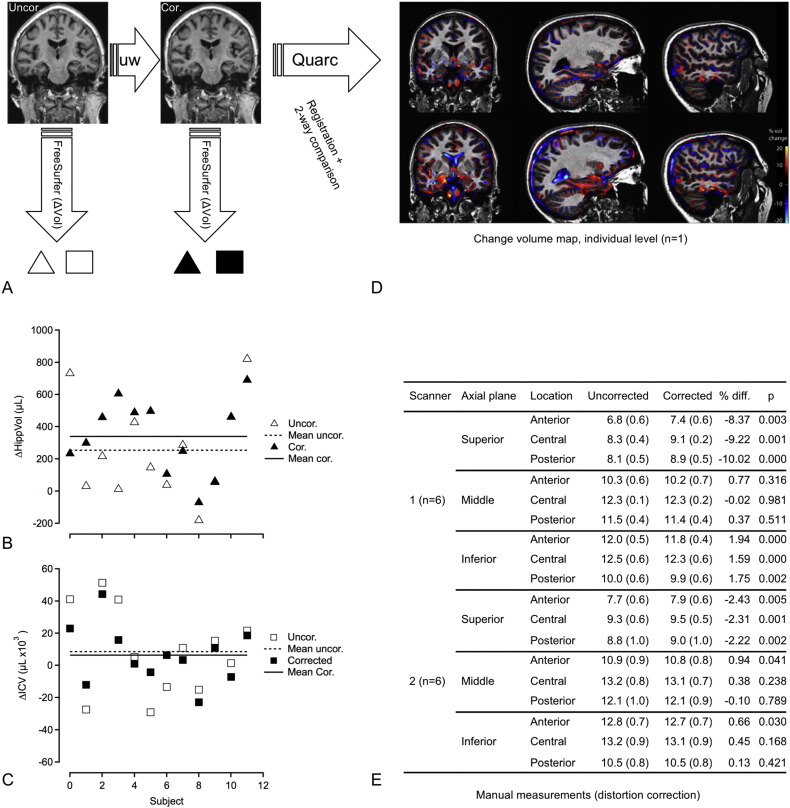
A) Coronal images before (uncorrected; left panel) and after (corrected; right panel) image processing with algorithm that corrects for gradient non-linearities (indicated by arrow “uw”), scanner 1. Change in FreeSurfer ROI (ΔVol) was calculated as the difference between ROI volume between the before- and after treatment scans for uncorrected (open symbols; △, □) and corrected data (filled symbols; ▲, ■). B) Change in hippocampal volume induced by ECT, estimated from data before- (Uncor.; △, ⋯) and after (Cor.; ▲,−) unwarping step. Notice increased mean effect size and reduced variance after distortion correction. C) Change in total intracranial volume from before to after treatment for data before- (Uncor.; □, ⋯) and after (Cor.; ■,−) unwarping step. There was no statistically significant change. Notice a tendency to reduced variance after corrections. D) Example of voxel based method (Quarc) showing areas of compression (blue) or expansion (red) between MRI time points. Upper panel; MRI ~ 2 h before and ~ 2 h after first ECT treatment (single session). Lower panel; MRI ~ 2 h before first ECT treatment and 7–14 days after ended treatment (multiple sessions). Notice larger changes after ended treatment (lower panel) with increased volume of the medial temporal lobe and reduced volume of the ventricles. E) Manual measurements done in Osirix MD from the axial plane at three different levels. The levels were: Inferior: The apex of pons. Middle: Ventral part of the genu corpus callosum. Superior: Halfway between the apex of the dura mater and the middle level. These levels were determined from the sagittal series. Then, the three levels were further divided by three lines which were used for the measurements. One halfway between the anterior and posterior boundaries of the dura mater. The two other lines halfway between the middle line and the anterior or posterior boundaries respectively. The lines were measured in cm. Significance (P-value) assessed by two-tailed t-test. [Fig. 2D is adapted from conference poster ISMRM 2015 abstract 705 (Oltedal et al., 2015b)].
Fig. 3
Fig. 3
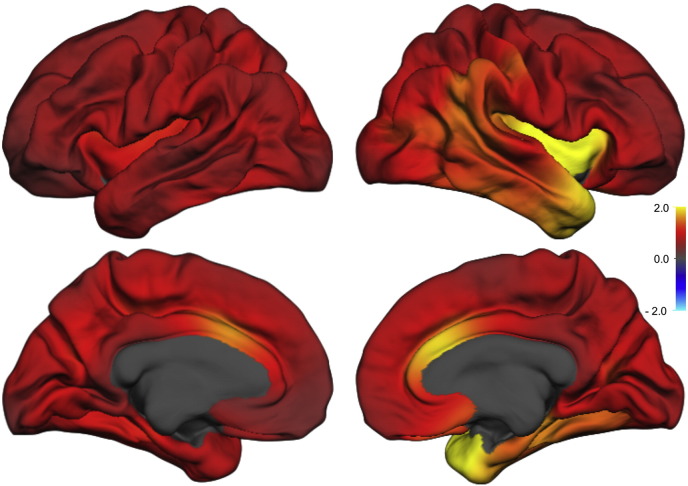
Volumetric change map (Quarc; mean of n = 19) for lateral (upper row) and medial (lower row) aspect of left (left) and right (right) hemispheres. Scale bar represents Cohen's d effect size.

References

    1. Abbott C.C., Jones T., Lemke N.T., Gallegos P., McClintock S.M., Mayer A.R., Bustillo J., Calhoun V.D. Hippocampal structural and functional changes associated with electroconvulsive therapy response. Transl. Psychiatry. 2014;4 - PMC - PubMed
    1. Abbott C.C., Loo D., Sui J. Determining electroconvulsive therapy response with machine learning. JAMA Psychiatry. 2016;73:545–546. - PMC - PubMed
    1. Aoki Y., Yamaguchi S., Ando S., Sasaki N., Bernick P.J., Akiyama T. The experience of electroconvulsive therapy and its impact on associated stigma: a meta-analysis. Int. J. Soc. Psychiatry. 2016;62:708–718. - PubMed
    1. APA . Recommendations for Treatment, Training, and Privileging (A Task Force Report of the American Psychiatric Association) 2 ed. American Psychiatric Association; Washington, DC: 2001. The practice of electroconvulsive therapy.
    1. Argyelan M., Lencz T., Kaliora S., Sarpal D.K., Weissman N., Kingsley P.B., Malhotra A.K., Petrides G. Subgenual cingulate cortical activity predicts the efficacy of electroconvulsive therapy. Transl. Psychiatry. 2016;6 - PMC - PubMed

Publication types

MeSH terms