


The Effects of Race and Racial Concordance on Patient-Physician Communication: A Systematic Review of the Literature
- PMID: 28275996
- PMCID: PMC5591056
- DOI: 10.1007/s40615-017-0350-4
The Effects of Race and Racial Concordance on Patient-Physician Communication: A Systematic Review of the Literature
Abstract
Objective: Racial disparities exist in health care, even when controlling for relevant sociodemographic variables. Recent data suggest disparities in patient-physician communication may also contribute to racial disparities in health care. This study aimed to systematically review studies examining the effect of black race and racial concordance on patient-physician communication.
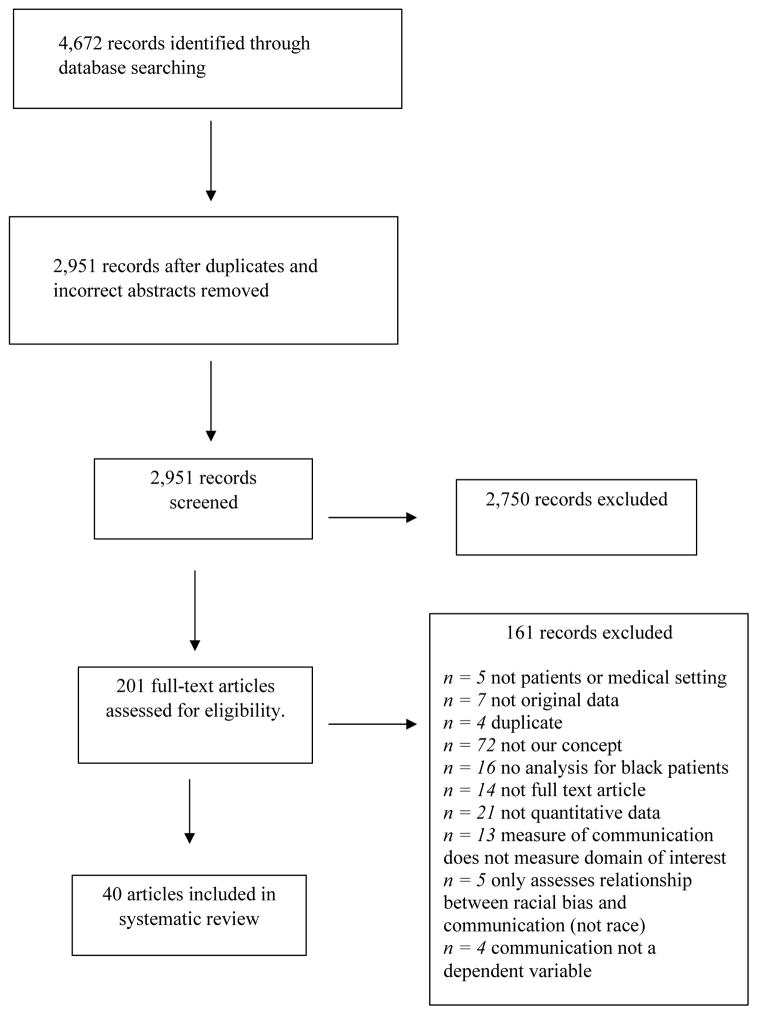
Methods: A comprehensive search using the PRISMA guidelines was conducted across seven online databases between 1995 and 2016. The search resulted in 4672 records for review and 40 articles for final inclusion in the review. Studies were included when the sample consisted of black patients in healthcare contexts and the communication measure was observational or patient-reported. Data were extracted by pairs of authors who independently coded articles and reconciled discrepancies. Results were synthesized according to predictor (race or racial concordance) and communication domain.
Results: Studies were heterogeneous in health contexts and communication measures. Results indicated that black patients consistently experienced poorer communication quality, information-giving, patient participation, and participatory decision-making than white patients. Results were mixed for satisfaction, partnership building, length of visit, and talk-time ratio. Racial concordance was more clearly associated with better communication across all domains except quality, for which there was no effect.
Conclusions: Despite mixed results due to measurement heterogeneity, results of the present review highlight the importance of training physicians and patients to engage in higher quality communication with black and racially discordant patients by focusing on improving patient-centeredness, information-giving, partnership building, and patient engagement in communication processes.
Keywords: Disparities; Patient-physician communication; Race; Racial concordance.
References
-
- Institute of Medicine. Unequal treatment: Confronting racial and ethnic disparities in healthcare. Washington DC: 2003.
-
- Kahn KL, et al. Health care for black and poor hospitalized Medicare patients. JAMA. 1994;271(15):1169–1174. - PubMed
-
- Fiscella K, et al. Inequality in quality: addressing socioeconomic, racial, and ethnic disparities in health care. JAMA. 2000;283(19):2579–2584. - PubMed
-
- National Center for Health Statistics. Available from: www.cdc.gov/nchs/fastats/lcod.htm.
Publication types
MeSH terms
Grants and funding
LinkOut - more resources
Full Text Sources
Other Literature Sources
Medical