


Regional changes in psychotropic use among Finnish persons with newly diagnosed Alzheimer's disease in 2005-2011
- PMID: 28278245
- PMCID: PMC5344395
- DOI: 10.1371/journal.pone.0173450
Regional changes in psychotropic use among Finnish persons with newly diagnosed Alzheimer's disease in 2005-2011
Abstract
Objectives: To describe and compare temporal changes in prevalence and incidence of psychotropic use (antipsychotics, antidepressants and benzodiazepines and related drugs; BZDRs) in persons with newly diagnosed Alzheimer's disease (AD) between university hospital districts of Finland during 2005-2011.
Methods: The MEDALZ study includes all community-dwellers of Finland who received a clinically verified AD diagnosis in 2005-2011 (N = 70,718). Prevalent and incident use of psychotropics among those who had received AD diagnosis less than one year ago were compared in 2005-2011.
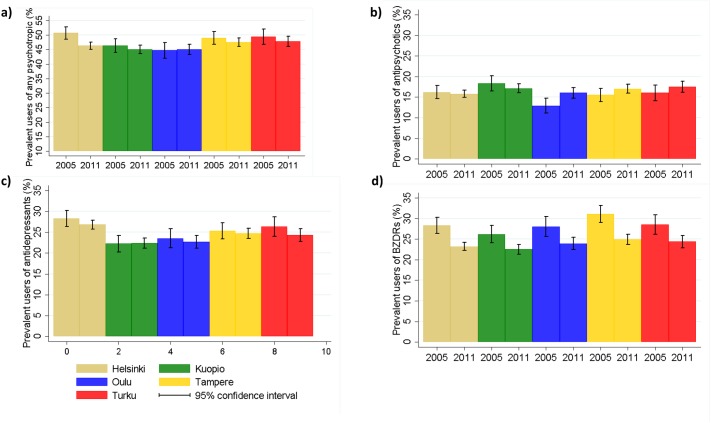
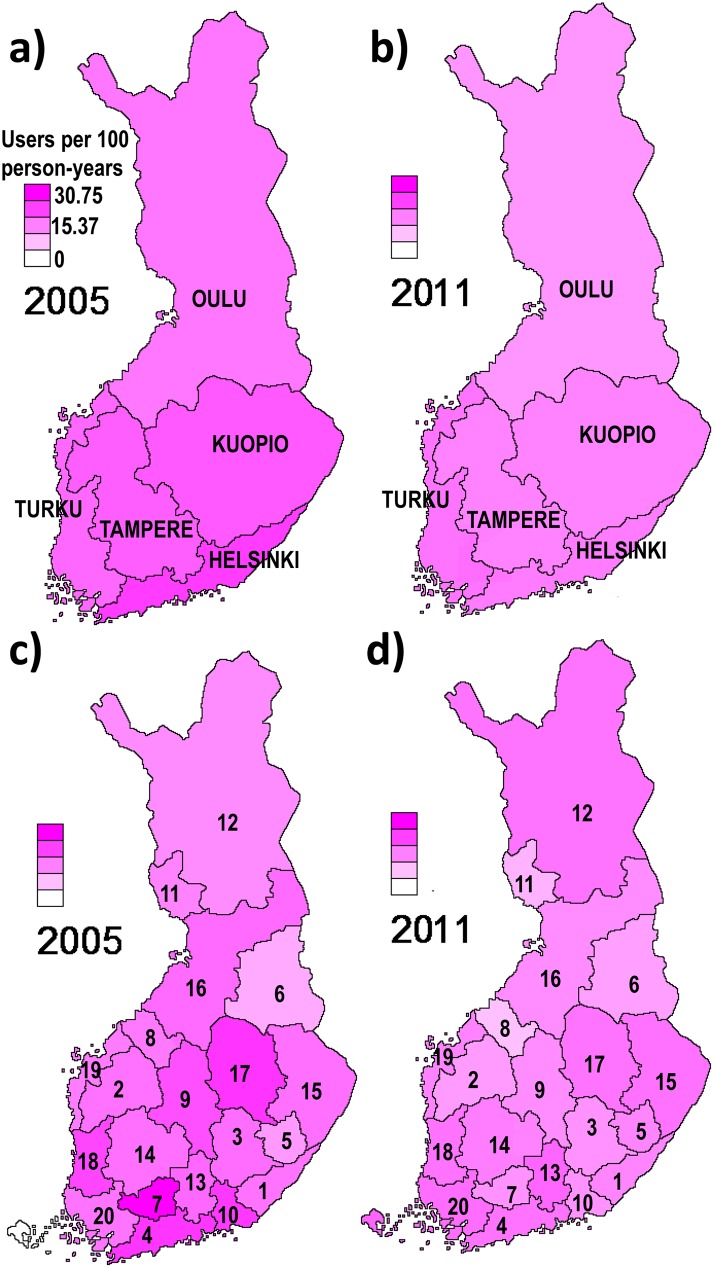
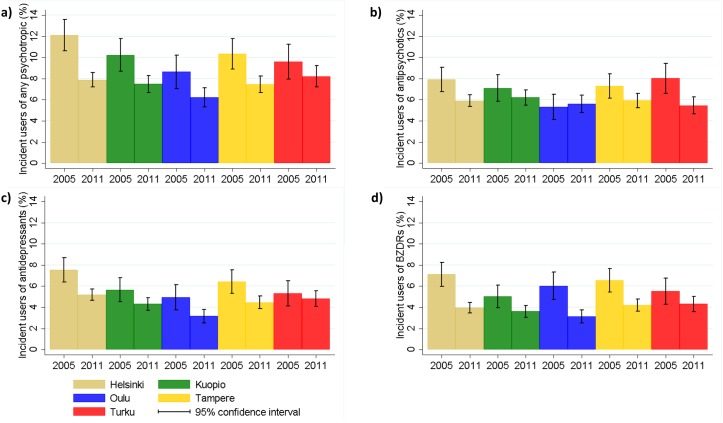
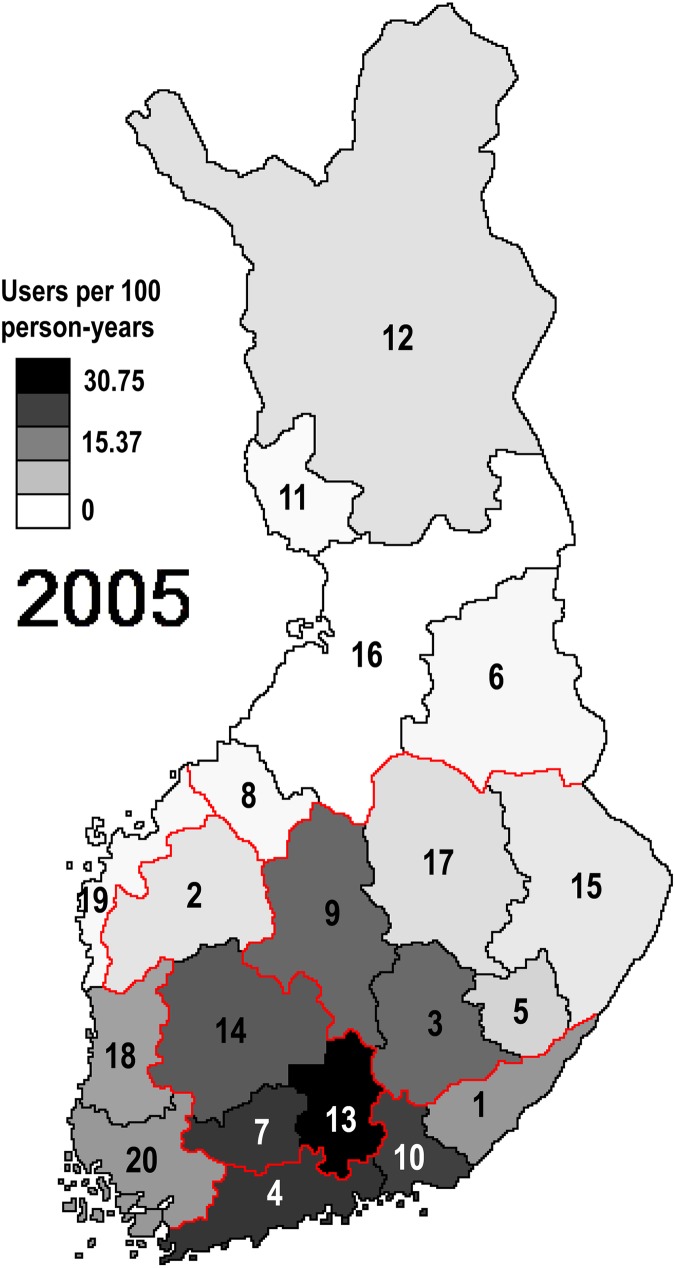
Results: Regional differences in psychotropic use between university hospital districts were more evident in 2005 than 2011 for prevalent use of any psychotropic, antipsychotic and BZDRs and incident use of any psychotropic and antipsychotics. Regional differences in prevalent antidepressant use and incident BZDR use remained similar during the follow-up, while differences in incident antidepressant use increased during the follow-up. The prevalence of any psychotropic use in 2005 varied between 44.7-50.7% and between 45.0-47.9% in 2011. Incidence of any psychotropic use in 2005 was between 8.6-12.1% and 6.2-8.2% in 2011. In 2005, the distribution of incident psychotropic use followed a large scale spatial variation that, however, did not correspond to university hospital districts. During the study period from 2005 to 2011 the cyclic spatial variation disappeared. No sign of adjacent hospital districts being more or less closely related to each other compared to hospital districts in general was detected.
Conclusions: Except for antidepressants, regional differences in psychotropic use have mainly diminished between 2005 and 2011. Our findings highlight the importance of acknowledging regional differences in a country with relatively homogeneous healthcare system and conducting future studies assessing the reasons behind these differences.
Conflict of interest statement
Figures
References
-
- Suhonen J, Pirttila T, Erkinjuntti T, Koponen H, Makkonen M, Puurunen M, et al. Update on current care guidelines. The diagnosis and medical treatment of memory disorders. Duodecim 2010;126(18):2167–2168. - PubMed
-
- Franchi C, Tettamanti M, Marengoni A, Bonometti F, Pasina L, Cortesi L, et al. Changes in trend of antipsychotics prescription in patients treated with cholinesterase inhibitors after warnings from Italian Medicines Agency. Results from the EPIFARM-Elderly Project. Eur Neuropsychopharmacol 2012. August;22(8):569–577. 10.1016/j.euroneuro.2011.12.009 - DOI - PubMed
-
- Martinez C, Jones RW, Rietbrock S. Trends in the prevalence of antipsychotic drug use among patients with Alzheimer's disease and other dementias including those treated with antidementia drugs in the community in the UK: a cohort study. BMJ Open 2013. January 7;3(1):10.1136/bmjopen-2012-002080. - PMC - PubMed
-
- Taipale H, Koponen M, Tanskanen A, Tolppanen AM, Tiihonen J, Hartikainen S. High prevalence of psychotropic drug use among persons with and without Alzheimer's disease in Finnish nationwide cohort. Eur Neuropsychopharmacol 2014. November;24(11):1729–1737. 10.1016/j.euroneuro.2014.10.004 - DOI - PubMed
-
- Schulze J, van den Bussche H, Glaeske G, Kaduszkiewicz H, Wiese B, Hoffmann F. Impact of safety warnings on antipsychotic prescriptions in dementia: nothing has changed but the years and the substances. Eur Neuropsychopharmacol 2013. September;23(9):1034–1042. 10.1016/j.euroneuro.2013.02.001 - DOI - PubMed
MeSH terms
Substances
LinkOut - more resources
Full Text Sources
Other Literature Sources
Medical
