. 2017 Mar 9;17(1):201.
doi: 10.1186/s12879-017-2300-5.

ICARES: a real-time automated detection tool for clusters of infectious diseases in the Netherlands

Affiliations

ICARES: a real-time automated detection tool for clusters of infectious diseases in the Netherlands

Geert H Groeneveld et al. BMC Infect Dis. .

Abstract

Background: Clusters of infectious diseases are frequently detected late. Real-time, detailed information about an evolving cluster and possible associated conditions is essential for local policy makers, travelers planning to visit the area, and the local population. This is currently illustrated in the Zika virus outbreak.

Methods: In the Netherlands, ICARES (Integrated Crisis Alert and Response System) has been developed and tested on three syndromes as an automated, real-time tool for early detection of clusters of infectious diseases. From local general practices, General Practice Out-of-Hours services and a hospital, the numbers of routinely used syndrome codes for three piloted tracts i.e., respiratory tract infection, hepatitis and encephalitis/meningitis, are sent on a daily basis to a central unit of infectious disease control. Historic data combined with information about patients' syndromes, age cohort, gender and postal code area have been used to detect clusters of cases.

Results: During the first 2 years, two out of eight alerts appeared to be a real cluster. The first was part of the seasonal increase in Enterovirus encephalitis and the second was a remarkably long lasting influenza season with high peak incidence.

Conclusions: This tool is believed to be the first flexible automated, real-time cluster detection system for infectious diseases, based on physician information from both general practitioners and hospitals. ICARES is able to detect and follow small regional clusters in real time and can handle any diseases entity that is regularly registered by first line physicians. Its value will be improved when more health care institutions agree to link up with ICARES thus improving further the signal-to-noise ratio.

Keywords: Automated; Cluster detection; Hepatitis; Meningoencephalitis; Real-time; Respiratory tract infection.


Figures
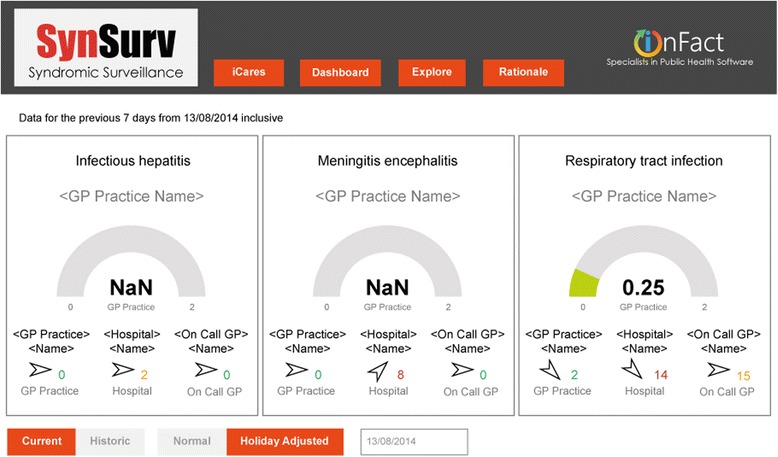
Fig. 1
Fig. 1
Dashboard on 13 August 2014 during meningoencephalitis outbreak. Dial numbers are incident ratios: the ratio between the observed previous 7 days incident rate with the equivalent historic incident rate. Rates are calculated as the numbers of incidents per 100,000 as based upon the GP practice’s population data. The dial color is set as green for an incident ratio of less than 0.75, orange for between 0.75 and 1.40 and red for greater than 1.40. Dials are limited to GP practices as these are the only ones where population data is available. Colored numbers are absolute incident counts for the last 7 days for a given institution. The institution that is displayed, is the one with the largest incident ratio. This is the ratio between observed and historic using rate values if available, otherwise absolute counts. The color is determined in a similar manner to the dial color. Trend arrows are determined from the ratio between the current week’s (previous 7 days) observed incident rate (or observed absolute incident count if rate not available) and the same value as calculated for the previous week. The trend arrow reflects current week versus previous week. A rising trend is shown for ratios greater than 1.1, stable for between 0.9 and 1.1, and falling for less than 0.9. NaN = Not a Number. NaN is displayed when the equivalent historic 7 day period has zero cases. A ratio would result in a divide by zero error
Fig. 2
Fig. 2
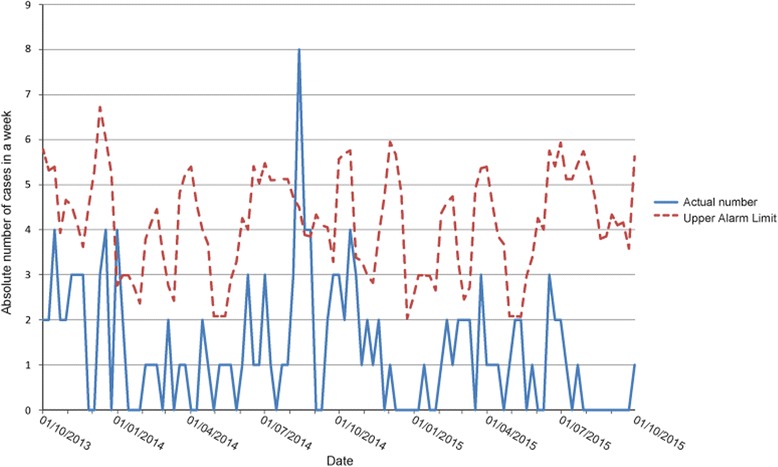
Hospital cases of meningoencephalitis 1/10/2013–1/10/2015
Fig. 3
Fig. 3
Hospital cases of respiratory tract infections 1/10/2013–1/10/2015
Fig. 4
Fig. 4
Hospital cases of hepatitis 1/10/2013–1/10/2015

References

    1. Smith KF, Goldberg M, Rosenthal S, Carlson L, Chen J, Chen C, et al. Global rise in human infectious disease outbreaks. J R Soc Interface. 2014;11(101):20140950. doi: 10.1098/rsif.2014.0950. - DOI - PMC - PubMed
    1. Den Boer J, Yzerman E, Schellekens J, Lettinga K, Boshuizen H, Van Steenbergen J. A large outbreak of Legionnaires’ disease at a flower show, the Netherlands, 1999. Emerg Infect Dis. 2001;8(1):37–43. doi: 10.3201/eid0801.010176. - DOI - PMC - PubMed
    1. Lettinga KD, Verbon A, Weverling GJ, Schellekens JF, Den Boer JW, Yzerman EP, et al. Legionnaires’ disease at a Dutch flower show: prognostic factors and impact of therapy. Emerg Infect Dis. 2002;8(12):1448–54. doi: 10.3201/eid0812.020035. - DOI - PMC - PubMed
    1. Frank C, Werber D, Cramer JP, Askar M, Faber M, An Der HM, et al. Epidemic profile of Shiga-toxin-producing Escherichia coli O104:H4 outbreak in Germany. N Engl J Med. 2011;365(19):1771–80. doi: 10.1056/NEJMoa1106483. - DOI - PubMed
    1. Altmann M, Spode A, Altmann D, Wadl M, Benzler J, Eckmanns T, et al. Timeliness of surveillance during outbreak of Shiga Toxin-producing Escherichia coli infection, Germany, 2011. Emerg Infect Dis. 2011;17(10):1906–9. doi: 10.3201/eid1710.111027. - DOI - PMC - PubMed