Review
. 2017 Jun;23(6):882-896.
doi: 10.1016/j.bbmt.2017.03.006. Epub 2017 Mar 6.

Optimal Practices in Unrelated Donor Cord Blood Transplantation for Hematologic Malignancies

Affiliations
Review

Optimal Practices in Unrelated Donor Cord Blood Transplantation for Hematologic Malignancies

Juliet N Barker et al. Biol Blood Marrow Transplant. 2017 Jun.

Abstract

Unrelated donor cord blood transplantation (CBT) results in disease-free survival comparable to that of unrelated adult donor transplantation in patients with hematologic malignancies. Extension of allograft access to racial and ethnic minorities, rapid graft availability, flexibility of transplantation date, and low risks of disabling chronic graft-versus-host disease (GVHD) and relapse are significant advantages of CBT, and multiple series have reported a low risk of late transplantation-related mortality (TRM) post-transplantation. Nonetheless, early post-transplantation morbidity and TRM and the requirement for intensive early post-transplantation management have slowed the adoption of CBT. Targeted care strategies in CBT recipients can mitigate early transplantation complications and reduce transplantation costs. Herein we provide a practical "how to" guide to CBT for hematologic malignancies on behalf of the National Marrow Donor Program and the American Society of Blood and Marrow Transplantation's Cord Blood Special Interest Group. It shares the best practices of 6 experienced US transplantation centers with a special interest in the use of cord blood as a hematopoietic stem cell source. We address donor search and unit selection, unit thaw and infusion, conditioning regimens, immune suppression, management of GVHD, opportunistic infections, and other factors in supportive care appropriate for CBT. Meticulous attention to such details has improved CBT outcomes and will facilitate the success of CBT as a platform for future graft manipulations.

Keywords: Allogeneic transplantation; Alternative donor; Cord blood transplantation.


Conflict of interest statement

Conflict of Interest. All authors have no financial conflicts of interest to disclose. J.K. and E.J.S. and are medical directors of CB banks.

Figures

Figure 1
Figure 1. Comparison of survival after CBT compared to URD transplant recipients
Figure 1A compares acute leukemia/MDS survival at FHCRC after unmodified adult donor allografts and CBT. The hazard ratio (HR) for death in HLA-matched versus CB transplant recipients was 1.12 (95%CI: 0.77–1.63, p = 0.57), and the HR in HLA-mismatched versus CB transplant recipients was 1.91 (95%CI: 1.23–2.98, p = 0.004). The HR for relapse in HLA-matched versus CB transplant recipients was 1.95 (95%CI: 1.16–3.27, p = 0.01), and the HR in the HLA-mismatched versus CB transplant recipients was 1.97 (95%CI: 1.04–3.73, p = 0.04). Figure 1B is a MSKCC analysis demonstrating DFS in adult acute leukemia patients (dCBT compared to T-cell depleted unrelated donor allografts). In this analysis, CBT recipients had significantly higher DFS than HLA-mismatched URD recipients.
Figure 2
Figure 2. 1-year survival after pediatric myeloablative single versus double unit CBT
The survival in this BMT CTN randomized trial was no different in single versus double unit CBT recipients.
Figure 3
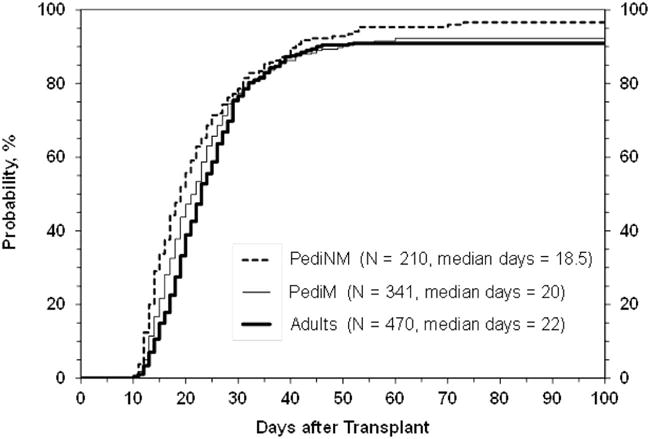
Figure 3. Neutrophil engraftment after myeloablative CBT in patients treated on the National Marrow Donor Program Cord Blood Access Protocol (10-CBA, ClinicalTrials.gov NCT01351545) with unlicensed units
This figure demonstrates neutrophil engraftment in 1,021 patients transplanted between October 2011 and December 2014 with either single or double unit 4–6/6 HLA-matched CB grafts. The cumulative incidence of engraftment at 42 days was 89% (95%CI: 86–91) in adults with malignancy, 88% (95%CI: 84–91) in children with malignancy, and 92% (95%CI: 88–95) in children with non-malignant disorders.
Figure 4
Figure 4. 2-year PFS by rDRI and aaHCT-CI (n = 110)
2-year PFS in adult CB recipients (median age 51 years) transplanted with cyclophosphamide 50 mg/kg, fludarabine 150 mg/m2, thiotepa 5–10 mg/kg, 400 cGy TBI and CSA/MMF for the treatment of acute leukemia/MDS or myeloproliferative disease (≤ 10% blasts pre-CBT), B-cell NHL or Hodgkin lymphoma (J. Barker, unpublished 2016).
Figure 5
Figure 5. Demonstration of the extent of mismatch at 8 HLA-alleles of CB units that are selected based on 4–6/6 HLA-A,-B antigen,-DRB1 allele donor-recipient HLA-match (n = 377)
The 4–6/6 HLA-A,-B antigen, -DRB1 allele donor-recipient match to the patient is shown. At high-resolution the median donor-recipient HLA-match at HLA-A,-B,-C,-DRB1 alleles was 5/8 (range 2–8/8). While 6/6 matched units (n = 10) were at least 5/8 HLA-allele matched, 5/6 units (n = 94) were as low as 3/8 matched, and 4/6 units (n = 96) were as low as 2/8 allele matched to the recipient.
Figure 6
Figure 6. Example of a CB Search Summary Report
Patient demographics, the best available URD, the date that the search was most recently run, and the patient’s current weight are indicated. The details of units of interest including the bank of origin, the unit volume (to reflect processing type and RBC depletion), collection date, TNC dose, CD34+ cell dose (listed here as × 103/kg), traditional 4–6/6 HLA-match, and 8 allele HLA-match are listed. ABO/Rh group and donor gender are listed for future reference. The loci of mismatch are shown (lower case indicates HLA-allele mismatch only and upper case indicates a full HLA-antigen mismatch). All listed mismatches are bidirectional unless otherwise indicated. The Bank Netcord-FACT accreditation, licensure, problems with unit availability (e.g. reserved on another patient’s search), or other issues making the unit ineligible (and therefore requiring a Declaration of Urgent Medical Need in the U.S.) are listed under “comments”. When all information is available, the unit rank is assigned in the first column (unit 1 if a single unit graft, or 1a and 1b if a double unit graft). Back-up units are reserved at domestic bank(s).
Figure 7
Figure 7
Summary of the current measures to optimize the practice of CBT in patients with hematologic malignancies. The emphasis is on patient and unit selection, conditioning intensity, GVHD prophylaxis, transplant day management, and early post-transplant care.

References

    1. Gragert L, Eapen M, Williams E, et al. HLA match likelihoods for hematopoietic stem-cell grafts in the U.S. registry. N Engl J Med. 2014;371(4):339–348. - PMC - PubMed
    1. Barker JN, Byam CE, Kernan NA, et al. Availability of cord blood extends allogeneic hematopoietic stem cell transplant access to racial and ethnic minorities. Biol Blood Marrow Transplant. 2010;16(11):1541–1548. - PMC - PubMed
    1. Iori AP, Valle V, Piciocchi A, et al. Concurrent search for unrelated cord and volunteer donor in high-risk acute lymphoblastic leukemia. Ann Hematol. 2012;91(6):941–948. - PubMed
    1. Brunstein CG, Gutman JA, Weisdorf DJ, et al. Allogeneic hematopoietic cell transplantation for hematological malignancy: relative risks and benefits of double umbilical cord blood. Blood. 2010;116(22):4693–4699. - PMC - PubMed
    1. Brunstein CG, Eapen M, Ahn KW, et al. Reduced-intensity conditioning transplantation in acute leukemia: the effect of source of unrelated donor stem cells on outcomes. Blood. 2012;119(23):5591–5598. - PMC - PubMed

MeSH terms

LinkOut - more resources