Review
. 2017 May;34(5):549-562.
doi: 10.1007/s10815-017-0895-5. Epub 2017 Mar 9.

Role of DNA methylation in imprinting disorders: an updated review

Affiliations
Review

Role of DNA methylation in imprinting disorders: an updated review

Amr Rafat Elhamamsy. J Assist Reprod Genet. 2017 May.

Abstract

Genomic imprinting is a complex epigenetic process that contributes substantially to embryogenesis, reproduction, and gametogenesis. Only small fraction of genes within the whole genome undergoes imprinting. Imprinted genes are expressed in a monoallelic parent-of-origin-specific manner, which means that only one of the two inherited alleles is expressed either from the paternal or maternal side. Imprinted genes are typically arranged in clusters controlled by differentially methylated regions or imprinting control regions. Any defect or relaxation in imprinting process can cause loss of imprinting in the key imprinted loci. Loss of imprinting in most cases has a harmful effect on fetal development and can result in neurological, developmental, and metabolic disorders. Since DNA methylation and histone modifications play a key role in the process of imprinting. This review focuses on the role of DNA methylation in imprinting process and describes DNA methylation aberrations in different imprinting disorders.

Keywords: Beckwith–Wiedemann syndrome; DNA methylation; Genomic imprinting; Prader–Willi syndrome; Silver–Russell syndrome; Type Ib pseudohypoparathyroidism.


Figures

Fig. 1
Fig. 1
Imprinting at the PLAGL1 locus. a PLAGL1 is composed of 12 exons with four different promoters; PLAGL1 transcripts from promoter 1 (ICR/P1) are only expressed paternally. In contrast, PLAGL1 transcripts from P2, P3, and P4 are biallelically expressed in most tissues. HYMAI is one-exon gene encoding a long non-coding RNA (lncRNA). HYMAI exon is also expressed paternally due to sharing promoter 1 (ICR/P1) with PLAGL1. Typically, HYMAI and ICR/P1 transcripts of PLAGL1 are silenced on the maternal allele due to the methylated ICR/P1. On the other hand, the paternal ICR/P1 is unmethylated allowing HYMAI and ICR/P1 transcripts of PLAGL1 to be expressed. b In transient neonatal diabetes mellitus (TNDM1), ICR/P1 transcripts of PLAGL1 and HYMAI are biallelically expressed due to loss of methylation in the maternal allele or duplication of 6q24 on the paternal allele or paternal UPD6
Fig. 2
Fig. 2
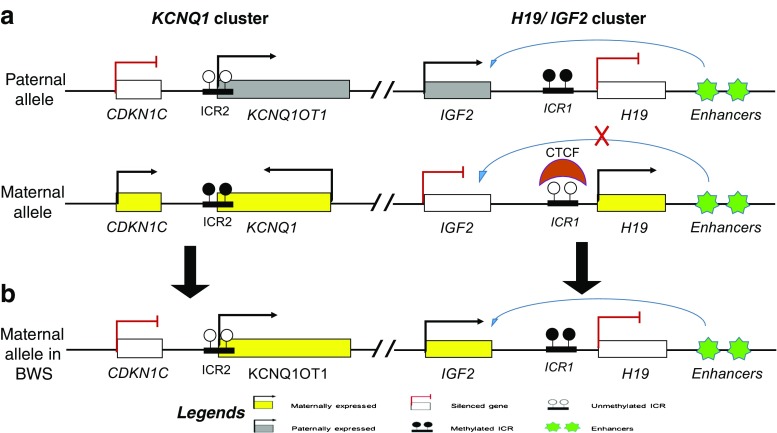
Imprinting at the H19–IGF2 locus and the CDKN1C/KCNQ1 locus. a On maternal allele, ICR1 is unmethylated while ICR2 is methylated. Therefore, H19, KCNQ1, and CDKN1C are maternally expressed, whereas IGF2 and KCNQ1OT1 are silenced. In contrast, ICR1 is methylated and ICR2 is unmethylated on the paternal allele. Therefore, IGF2 and KCNQ1OT1 are paternally expressed while other genes are silenced. b Beckwith–Wiedemann syndrome (BWS) occurs due to paternal UPD11 and epimutations of ICR1 or ICR2. Hence, the maternal allele act as the paternal allele with subsequent IGF2 overexpression or loss of CDKN1C expression
Fig. 3
Fig. 3
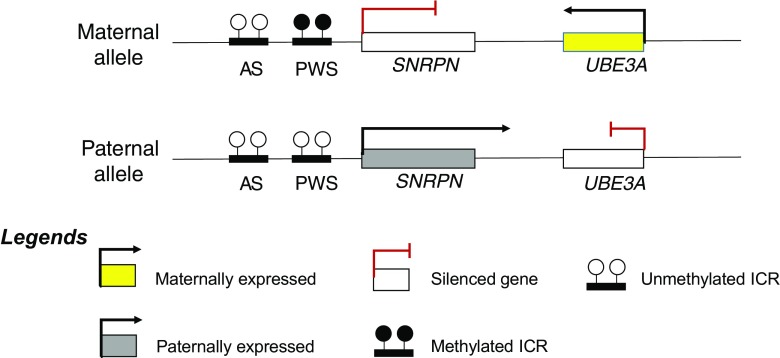
Imprinting at the SNURF/SNRPN cluster. AS/PWS ICRs regulate imprinting in SNURF/SNRPN cluster. In most tissues, UBE3A is biallelically expressed, whereas UBE3A in the brain is only expressed from the maternal side. Typically, PWS ICR is methylated on the maternal allele while it is unmethylated on the paternal allele. Chromosomal deletions, UPD, UBE3A mutations, and aberrant DNA methylation at AS/PWS ICRs are the major mechanisms behind developing Angelman syndrome (AS) and Prader–Willi syndrome (PWS)
Fig. 4
Fig. 4
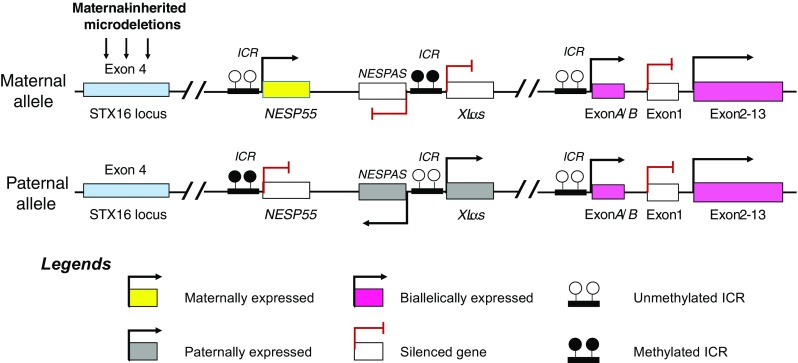
Imprinting at the GNAS locus. Gs-alpha is only expressed from the maternal allele in the renal tubules while it is biallelically expressed from most tissues
Fig. 5
Fig. 5
Loss of imprinting at the GNAS locus resulting in pseudohypoparathyroidism type 1b (PHP1b). In addition, maternally inherited microdeletions at the STX16 locus are associated with phenotypic PHP1b

References

    1. Feil R, Berger F. Convergent evolution of genomic imprinting in plants and mammals. Trends Genet. 2007;23(4):192–199. doi: 10.1016/j.tig.2007.02.004. - DOI - PubMed
    1. Chao W. Genomic imprinting. Handb Epigenetics. 2011; p. 353–79.
    1. Mcewen KR, Ferguson-smith AC. Genomic imprinting—a model for roles of histone modifications in epigenetic control. Epigenomics. 2009; p. 235–58. Available from: http://www.springerlink.com/index/10.1007/978-1-4020-9187-2 - DOI
    1. Maupetit-Méhouas S, Montibus B, Nury D, Tayama C, Wassef M, Kota SK, et al. Imprinting control regions (ICRs) are marked by mono-allelic bivalent chromatin when transcriptionally inactive. Nucleic Acids Res. 2016;44:621–635. doi: 10.1093/nar/gkv960. - DOI - PMC - PubMed
    1. Renfree MB, Suzuki S, Kaneko-Ishino T. The origin and evolution of genomic imprinting and viviparity in mammals. Philos Trans R Soc Lond B Biol Sci. [Internet]. 2013;368:20120151. Available from: http://europepmc.org/articles/PMC3539366 - PMC - PubMed

LinkOut - more resources