


History of Solitary Confinement Is Associated with Post-Traumatic Stress Disorder Symptoms among Individuals Recently Released from Prison
- PMID: 28281161
- PMCID: PMC5906377
- DOI: 10.1007/s11524-017-0138-1
History of Solitary Confinement Is Associated with Post-Traumatic Stress Disorder Symptoms among Individuals Recently Released from Prison
Abstract
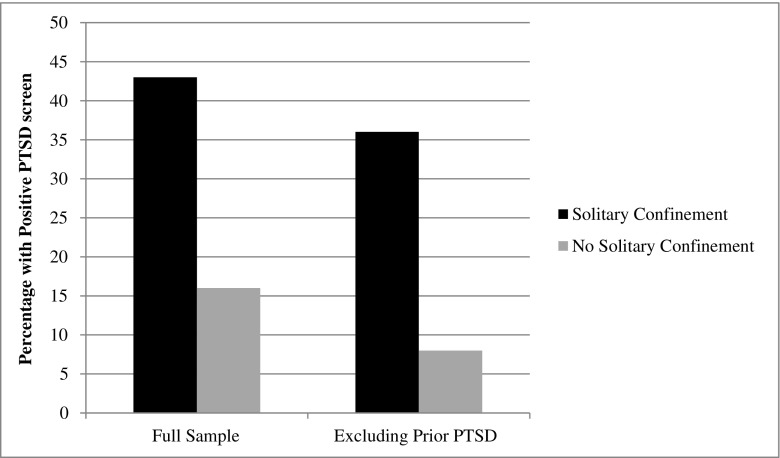
This study assessed the relationship between solitary confinement and post-traumatic stress disorder (PTSD) symptoms in a cohort of recently released former prisoners. The cross-sectional design utilized baseline data from the Transitions Clinic Network, a multi-site prospective longitudinal cohort study of post-incarceration medical care. Our main independent variable was self-reported solitary confinement during the participants' most recent incarceration; the dependent variable was the presence of PTSD symptoms determined by primary care (PC)-PTSD screening when participants initiated primary care in the community. We used multivariable logistic regression to adjust for potential confounders, such as prior mental health conditions, age, and gender. Among 119 participants, 43% had a history of solitary confinement and 28% screened positive for PTSD symptoms. Those who reported a history of solitary confinement were more likely to report PTSD symptoms than those without solitary confinement (43 vs. 16%, p < 0.01). In multivariable logistic regression, a history of solitary confinement (OR = 3.93, 95% CI 1.57-9.83) and chronic mental health conditions (OR = 4.04, 95% CI 1.52-10.68) were significantly associated with a positive PTSD screen after adjustment for the potential confounders. Experiencing solitary confinement was significantly associated with PTSD symptoms among individuals accessing primary care following release from prison. Larger studies should confirm these findings.
Keywords: Incarceration; Post-traumatic stress disorder; Post-traumatic stress disorder screening; Solitary confinement.
Figures
References
-
- Glaze E, Kaeble D. Correctional populations in the United States, 2013. US Department of Justice, Bureau of Justice Statistics; December 2014, NCJ 248479.https://www.bjs.gov/content/pub/pdf/cpus13.pdf.
-
- Beck AJ. Use of restrictive housing in US prisons and jails, 2011–12. Washington DC: Department of Justice, Office of Justice Programs, Bureau of Justice Statistics; 2015.
Publication types
MeSH terms
Grants and funding
LinkOut - more resources
Full Text Sources
Other Literature Sources
Medical
