


Infectious prions and proteinopathies
- PMID: 28281925
- PMCID: PMC5360137
- DOI: 10.1080/19336896.2017.1283464
Infectious prions and proteinopathies
Abstract
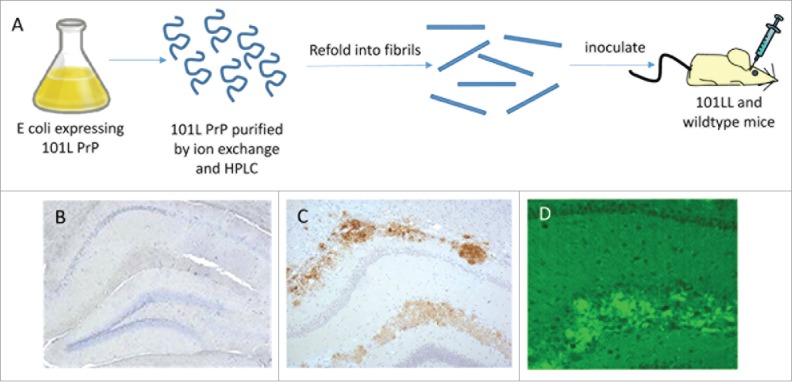
Transmissible spongiform encephalopathies (TSEs) are caused by an infectious agent that is thought to consist of only misfolded and aggregated prion protein (PrP). Unlike conventional micro-organisms, the agent spreads and propagates by binding to and converting normal host PrP into the abnormal conformer, increasing the infectious titre. Synthetic prions, composed of refolded fibrillar forms of recombinant PrP (rec-PrP) have been generated to address whether PrP aggregates alone are indeed infectious prions. In several reports, the development of TSE disease has been described following inoculation and passage of rec-PrP fibrils in transgenic mice and hamsters. However in studies described here we show that inoculation of rec-PrP fibrils does not always cause clinical TSE disease or increased infectious titre, but can seed the formation of PrP amyloid plaques in PrP-P101L knock-in transgenic mice (101LL). These data are reminiscent of the "prion-like" spread of misfolded protein in other models of neurodegenerative disease following inoculation of transgenic mice with pre-formed amyloid seeds. Protein misfolding, even when the protein is PrP, does not inevitably lead to the development of an infectious TSE disease. It is possible that most in vivo and in vitro produced misfolded PrP is not infectious and that only a specific subpopulation is associated with infectivity and neurotoxicity.
Keywords: TSE; amyloid; prion; prion-like; synthetic prions.
Figures
Comment on
- Extra View to: Barron RM, King D, Jeffrey M, McGovern G, Agarwal S, Gill AC, Piccardo P. PrP aggregation can be seeded by pre-formed recombinant PrP amyloid fibrils without the replication of infectious prions. Acta Neuropathologica 2016; 132:611–624. doi: 10.1007/s00401-016-1594-5
References
-
- Prusiner S. Novel proteinaceous infectious particles cause scrapie. Science 1982; 216(4542):136-144; PMID:6801762; http://dx.doi.org/ 10.1126/science.6801762 - DOI - PubMed
-
- Bolton DC, McKinley MP, Prusiner SB. Identification of a protein that purifies with the scrapie prion. Science 1982; 218(4579):1309-11; PMID:6815801; http://dx.doi.org/ 10.1126/science.6815801 - DOI - PubMed
-
- Safar J, Wille H, Itrri V, Groth D, Serban H, Torchia M, Cohen F.E, Prusiner SB. Eight prion strains have PrPSc molecules with different conformations. Nat Med 1998; 4(10):1157-65; PMID:9771749; http://dx.doi.org/ 10.1038/2654 - DOI - PubMed
-
- McKinley MP, Bolton DC, Prusiner S.B. A protease-resistant protein is a structural component of the scrapie prion. Cell 1983; 35(1):57-62; PMID:6414721; http://dx.doi.org/ 10.1016/0092-8674(83)90207-6 - DOI - PubMed
-
- Barron RM, Campbell SL, King D, Bellon A, Chapman KE, Williamson RA, Manson JC. High titres of TSE infectivity associated with extremely low levels of PrPSc in vivo. J Biol Chem 2007; 282:35878-886; PMID:17923484; http://dx.doi.org/ 10.1074/jbc.M704329200 - DOI - PubMed
Publication types
MeSH terms
Substances
Grants and funding
- BB/E002900/3/BB_/Biotechnology and Biological Sciences Research Council/United Kingdom
- BBS/E/D/20251967/BB_/Biotechnology and Biological Sciences Research Council/United Kingdom
- BBS/E/D/20251968/BB_/Biotechnology and Biological Sciences Research Council/United Kingdom
- BB/J004332/1/BB_/Biotechnology and Biological Sciences Research Council/United Kingdom
LinkOut - more resources
Full Text Sources
Other Literature Sources
Research Materials
