Review
. 2017 Apr:37:115-121.
doi: 10.1016/j.cbpa.2017.02.021. Epub 2017 Mar 7.

Catalytic promiscuity and heme-dependent redox regulation of H2S synthesis

Affiliations
Review

Catalytic promiscuity and heme-dependent redox regulation of H2S synthesis

Ruma Banerjee. Curr Opin Chem Biol. 2017 Apr.

Abstract

The view of enzymes as punctilious catalysts has been shifting as examples of their promiscuous behavior increase. However, unlike a number of cases where the physiological relevance of breached substrate specificity is questionable, the very synthesis of H2S relies on substrate and reaction promiscuity, which presents the enzymes with a multitude of substrate and reaction choices. The transsulfuration pathway, a major source of H2S, is inherently substrate-ambiguous. A heme-regulated switch embedded in the first enzyme in the pathway can help avert the stochastic production of cysteine versus H2S and control switching between metabolic tracks to meet cellular needs. This review discusses the dominant role of enzyme promiscuity in pathways that double as sulfur catabolic and H2S synthetic tracks.


Figures

Figure 1
Figure 1
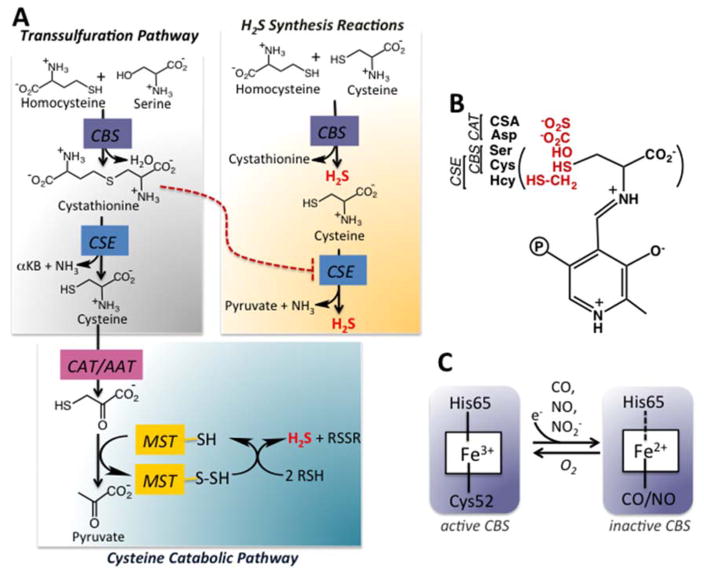
Overview of H2S synthesizing reactions. A. H2S can be synthesized by the transsulfuration pathway enzymes, CBS and CSE or by the cysteine catabolism pathway enzymes, CAT/AAT and MST. The canonical transsulfuration reactions catalyzed by CBS and CSE results in the conversion of serine and homocysteine to cysteine. However, these enzymes can also utilize cysteine and homocysteine to generate H2S. Cystathionine, an intermediate in the canonical transsulfuration pathway competes with cysteine for binding to CSE, thus inhibiting H2S synthesis (red dotted line). MST is a sulfurtransferase, which catalyzes the transfer of the sulfur atom from mercaptopyruvate to an active site cysteine thiol to form a cysteine persulfide. The latter, in the presence of reductants can release H2S. αKB denotes α-ketobytyrate. B. The first step in the reactions catalyzed by CBS, CSE and CAT/AAT is the formation of an external aldimine via a Schiff base linkage between PLP and the amino acid. CBS can bind either serine or cysteine, CSE can bind cysteine or homocysteine, while CAT/AAT can bind aspartate or cysteine sulfinic acid (CSA) in addition to cysteine at this position. C. CBS has a regulatory heme cofactor that is ligated by His65 and Cys52 (human protein numbering). One electron reduction to the ferrous state promotes binding of exogenous ligands such as CO or NO leading to inactive enzyme. The heme harbors nitrite reductase activity and forms nitrosyl heme, which is 5-coordinate. The broken line to His65 indicates that this residue serves as a ligand when CO but not when NO is bound. The ferrous nitrosyl and ferrous carbonyl forms of CBS are readily converted to the ferric state in the presence of O2.
Figure 2
Figure 2
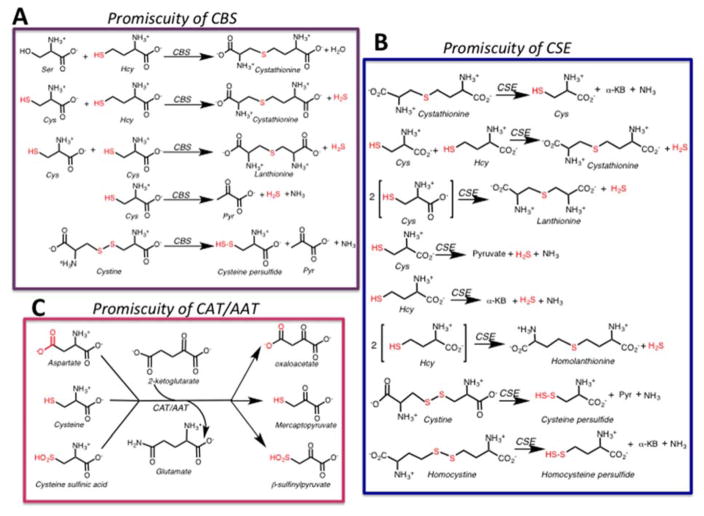
Promiscuity of PLP enzymes involved in H2S synthesis. H2S and persulfide-generating reactions catalyzed by the transsulfuration pathway enzymes CBS (A) and CSE (B). Reactions catalyzed by CAT/AAT (C). Pyr and α-KB denote pyruvate and α-ketobutyrate respectively.
Figure 3
Figure 3
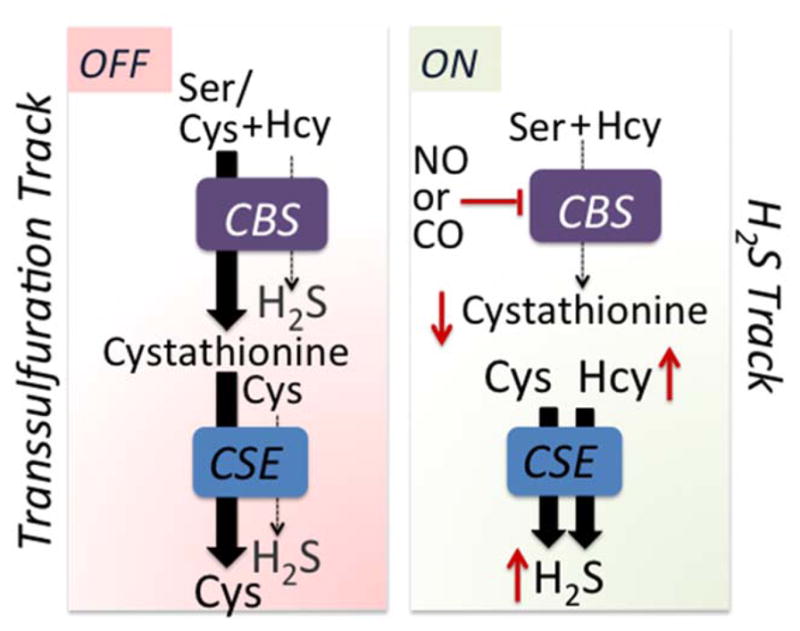
Heme-dependent metabolic track switching. The canonical transsulfuration track operates when the heme in CBS is coordinated by its endogenous ligands and serine, which is more abundant than cysteine and binds with higher affinity, competes effectively for the active site. The product, cystathionine, is then converted by CSE to cysteine. The enzymes switch metabolic tracks when ferrous CBS binds either NO or CO, inhibiting activity, which leads to an increase in homocysteine and a decrease in cystathionine. Under these conditions, H2S synthesis from cysteine, which is catalyzed by CSE, is promoted. The red up and down arrows denote changes in metabolite levels.

References

    1. Jensen RA. Enzyme recruitment in evolution of new function. Annu Rev Microbiol. 1976;30:409–425. - PubMed
    1. Yang K, Metcalf WW. A new activity for an old enzyme: Escherichia coli bacterial alkaline phosphatase is a phosphite-dependent hydrogenase. Proc Natl Acad Sci U S A. 2004;101(21):7919–7924. - PMC - PubMed
    1. Bridgham JT, Carroll SM, Thornton JW. Evolution of hormone-receptor complexity by molecular exploitation. Science. 2006;312(5770):97–101. - PubMed
    1. Aharoni A, Gaidukov L, Khersonsky O, Mc QGS, Roodveldt C, Tawfik DS. The ‘evolvability’ of promiscuous protein functions. Nat Genet. 2005;37(1):73–76. - PubMed
    1. D’Ari R, Casadesus J. Underground metabolism. Bioessays. 1998;20(2):181–186. - PubMed

LinkOut - more resources