


Blood storage alters mechanical stress responses of erythrocytes
- PMID: 28282803
- PMCID: PMC5523916
- DOI: 10.3233/CH-160219
Blood storage alters mechanical stress responses of erythrocytes
Abstract
Background: Erythrocytes undergo irreversible morphological and biochemical changes during storage. Reduced levels of deformability have been reported for stored erythrocytes. Erythrocyte deformability is essential for healthy microcirculation.
Objective: The aim of this study is to evaluate shear stress (SS) induced improvements of erythrocyte deformability in stored blood.
Methods: Deformability changes were evaluated by applying physiological levels of SS (5 and 10 Pa) in metabolically depleted blood for 48 hours and stored blood for 35 days with citrate phosphate dextrose adenine-1 (CPDA-1). Laser diffractometry was used to measure erythrocyte deformability before and after application of SS.
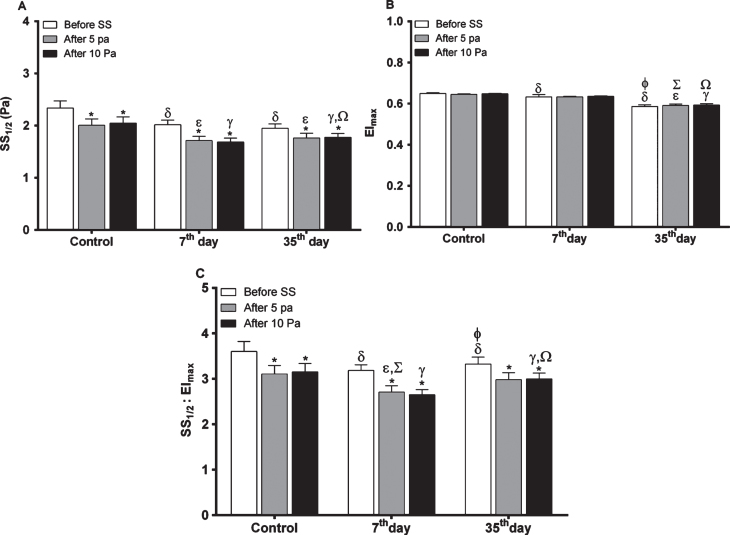
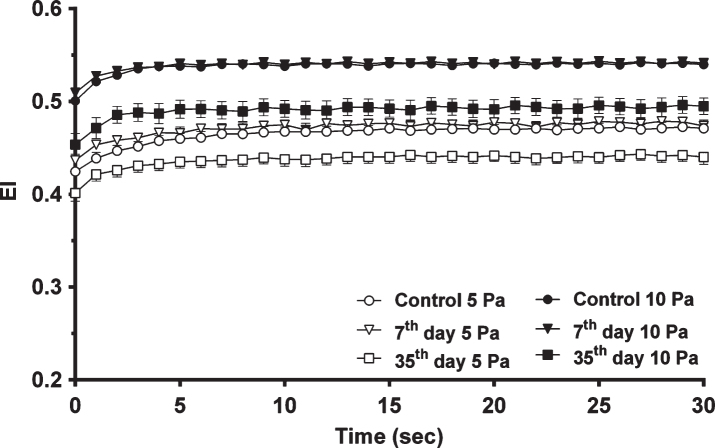
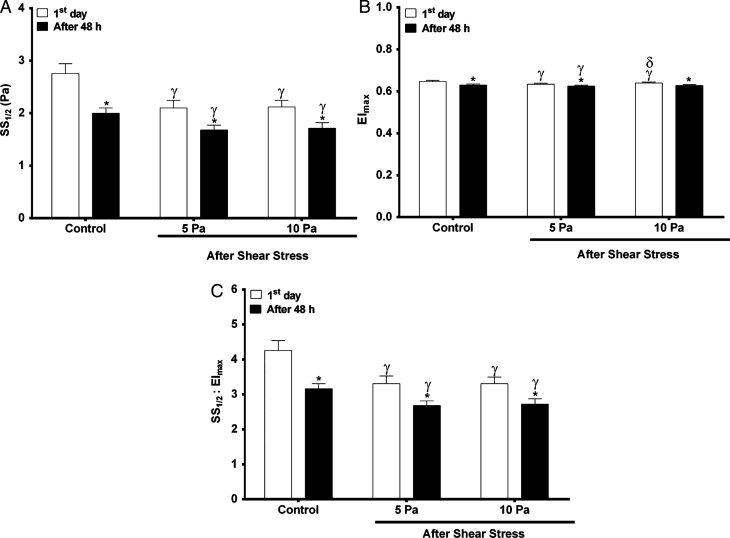
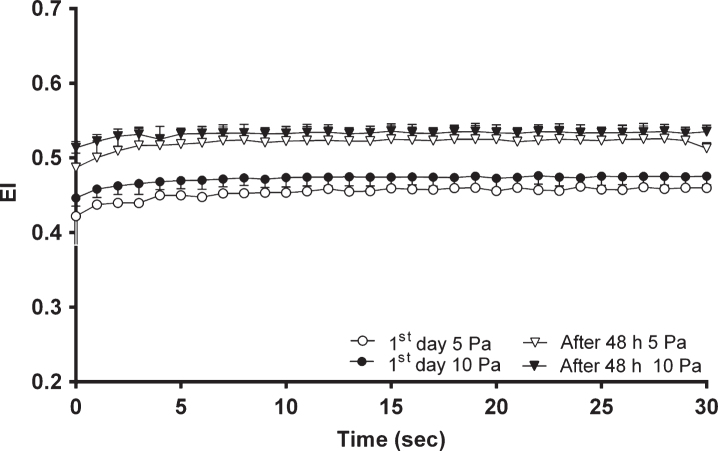
Results: Erythrocyte deformability, as a response to continuous SS, was significantly improved in metabolically depleted blood, whereas it was significantly impaired in the blood stored for 35 days with CPDA-1 (p≤0.05). The SS-induced improvements of deformability were deteriorated due to storage and relatively impaired according to the storage time. However, deformability of stored blood after exposure to mechanical stress tends to increase at low levels of shear while decreasing at high SS levels.
Conclusion: Impairment of erythrocyte deformability after storage may contribute to impairments in the recipient's microcirculation after blood transfusion. The period of the storage should be considered to prevent microcirculatory problems and insufficient oxygen delivery to the tissues.
Keywords: CPDA-1; Erythrocyte deformability; blood storage; metabolic depletion; shear stress.
Figures
References
-
- Baskurt O.K. and Meiselman H.J., Blood rheology and hemodynamics, Semin Thromb Hemost 29(5) (2003), 435–450. - PubMed
-
- Bosman G.J., Cluitmans J.C., Groenen Y.A., Werre J.M., Willekens F.L. and Novotny V.M., Susceptibility to hyperosmotic stress-induced phosphatidylserine exposure increases during red blood cell storage, Transfusion 51(5) (2011), 1072–1078. - PubMed
-
- Barshtein G., Manny N. and Yedgar S., Circulatory risk in the transfusion of red blood cells with impaired flow properties induced by storage, Transfus Med Rev 25(1) (2011), 24–35. - PubMed
-
- Tinmouth A., Fergusson D., Yee I.C., Hebert P.C. and A. Investigators and G. Canadian Critical Care Trials, Clinical consequences of red cell storage in the critically ill, Transfusion 46(11) (2006), 2014–2027. - PubMed
-
- Blasi B., D’Alessandro A., Ramundo N. and Zolla L., Red blood cell storage and cell morphology, Transfus Med 22(2) (2012), 90–96. - PubMed
MeSH terms
LinkOut - more resources
Full Text Sources
Other Literature Sources
