Review
. 2017 Mar 8;9(3):246.
doi: 10.3390/nu9030246.

Genetic Variations Associated with Vitamin A Status and Vitamin A Bioavailability

Affiliations
Review

Genetic Variations Associated with Vitamin A Status and Vitamin A Bioavailability

Patrick Borel et al. Nutrients. .

Abstract

Blood concentration of vitamin A (VA), which is present as different molecules, i.e., mainly retinol and provitamin A carotenoids, plus retinyl esters in the postprandial period after a VA-containing meal, is affected by numerous factors: dietary VA intake, VA absorption efficiency, efficiency of provitamin A carotenoid conversion to VA, VA tissue uptake, etc. Most of these factors are in turn modulated by genetic variations in genes encoding proteins involved in VA metabolism. Genome-wide association studies (GWAS) and candidate gene association studies have identified single nucleotide polymorphisms (SNPs) associated with blood concentrations of retinol and β-carotene, as well as with β-carotene bioavailability. These genetic variations likely explain, at least in part, interindividual variability in VA status and in VA bioavailability. However, much work remains to be done to identify all of the SNPs involved in VA status and bioavailability and to assess the possible involvement of other kinds of genetic variations, e.g., copy number variants and insertions/deletions, in these phenotypes. Yet, the potential usefulness of this area of research is exciting regarding the proposition of more personalized dietary recommendations in VA, particularly in populations at risk of VA deficiency.

Keywords: absorption; bioavailability; blood concentration; carotenoids; genetic polymorphisms; nutrigenetics; postprandial; provitamin A; retinol; retinyl palmitate; α-carotene; β-carotene; β-cryptoxanthin.


Conflict of interest statement

The authors declare no conflict of interest.

Figures
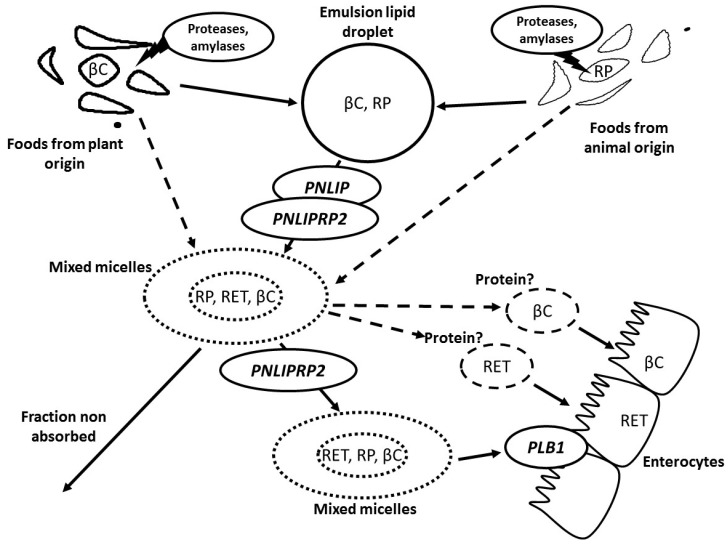
Figure 1
Figure 1
Proteins involved, or hypothesized to be involved, in vitamin A (VA) metabolism within the lumen of the upper gastrointestinal tract. βC: β-carotene and all other provitamin A carotenoids; PLB1: phospholipase B; PNLIP: pancreatic lipase; PNLIPRP2: pancreatic lipase-related protein 2; RET: retinol; RP: retinyl palmitate and all other retinyl esters. Proteins followed by a question mark have been hypothesized to be involved because RET and βC are not soluble in water, and thus, non-micellarized VA is assumed to be associated with proteins. A dotted arrow means the pathway is suspected to exist, but there is no evidence thereof yet.
Figure 2
Figure 2
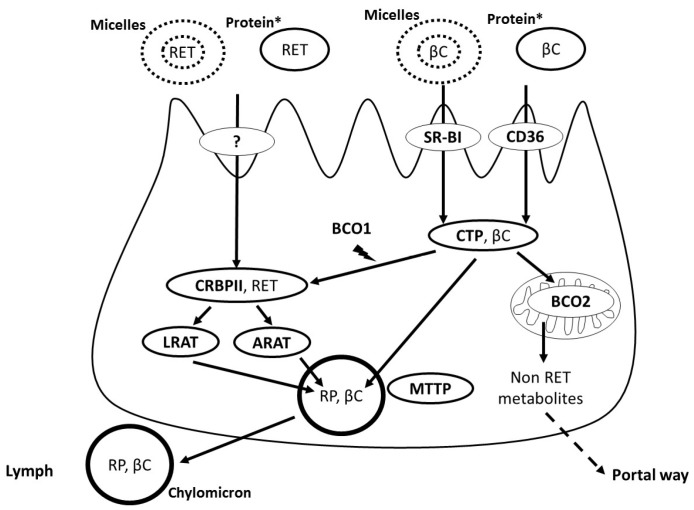
Proteins involved in vitamin A metabolism within the enterocyte. ARAT: acyl-CoA:retinol acyltransferases; βC: β-carotene and all other provitamin A carotenoids; BCO1: β-carotene oxygenase 1; BCO2: β-carotene oxygenase 2; CD36: cluster determinant 36; CRBPII: cellular retinol binding protein II; CTP: cellular transport protein (BCO1 and L-FABP are candidates); LRAT: lecithin retinol acyltransferase; MTTP: microsomal triglyceride transfer protein; RET: retinol; RP: retinyl palmitate and all other retinyl esters; SR-BI: scavenger receptor class B type I. It is assumed that there is an apical transporter of RET, but since it has not been identified, a question mark has been added.
Figure 3
Figure 3
Proteins involved in the liver metabolism of vitamin A. ATGL: adipose triglyceride lipase; βC: β-carotene and all other provitamin A carotenoids; BCO1: β-carotene oxygenase 1; BCO2: β-carotene oxygenase 2; CD36: cluster determinant 36; CRBPI: cellular retinol binding protein I; LDLR: LDL receptor; LRAT: lecithin retinol acyltransferase; PNPLA3: patatin-like phospholipase domain-containing 3; RBPR2: RBP4 receptor-2; RBP4: serum retinol-binding protein; RBPR: RBP receptor (encoded by STRA6); RET: retinol; RP: retinyl palmitate and all other retinyl esters; TTR: transthyretin. The liver is the hub of vitamin A metabolism: it is the main organ that stores VA and distributes it to the peripheral tissues. VA reaches the liver mainly as retinyl esters, mainly RP, and provitamin A carotenoids, mainly βC, incorporated in chylomicrons following VA absorption. VA is then mostly stored in hepatic stellate cells. This figure shows the main proteins involved in the mobilization of the liver stores of VA and in the distribution of liver VA to peripheral tissues.

References

    1. Rucker R.B., Suttie J.W., McCormick D.B., Machlin L.J. Handbook of Vitamins. 3rd ed. Marcel Dekker, Inc.; New York, NY, USA: Basel, Switzerland: 2001.
    1. Dowling J.E. George wald (1906-97)—Biologist who discovered the role of vitamin A in vision—Obituary. Nature. 1997;387:356. doi: 10.1038/387356a0. - DOI - PubMed
    1. Viewpoint A.P., Maumenee A.E. The history of vitamin A and its ophthalmic implications. Arch. Aphthalmol. 1993;111:547–550. - PubMed
    1. Rando R.R. The chemistry of vitamin A and vision. Angew. Chem. Int. Ed. Engl. 1990;29:461–480. doi: 10.1002/anie.199004611. - DOI
    1. Wright C.B., Redmond T.M., Nickerson J.M. A history of the classical visual cycle. Prog. Mol. Biol. Transl. Sci. 2015;134:433–448. - PubMed