Review
. 2017 Mar 8;17(3):540.
doi: 10.3390/s17030540.

Label-Free Biological and Chemical Sensing Using Whispering Gallery Mode Optical Resonators: Past, Present, and Future

Affiliations
Review

Label-Free Biological and Chemical Sensing Using Whispering Gallery Mode Optical Resonators: Past, Present, and Future

Judith Su. Sensors (Basel). .

Abstract

Sensitive and rapid label-free biological and chemical sensors are needed for a wide variety of applications including early disease diagnosis and prognosis, the monitoring of food and water quality, as well as the detection of bacteria and viruses for public health concerns and chemical threat sensing. Whispering gallery mode optical resonator based sensing is a rapidly developing field due to the high sensitivity and speed of these devices as well as their label-free nature. Here, we describe the history of whispering gallery mode optical resonator sensors, the principles behind detection, the latest developments in the fields of biological and chemical sensing, current challenges toward widespread adoption of these devices, and an outlook for the future. In addition, we evaluate the performance capabilities of these sensors across three key parameters: sensitivity, selectivity, and speed.

Keywords: biosensing; chemical sensing; label-free; microcavity; optical resonator; single molecule; whispering gallery mode.


Conflict of interest statement

The author declares no conflict of interest.

Figures
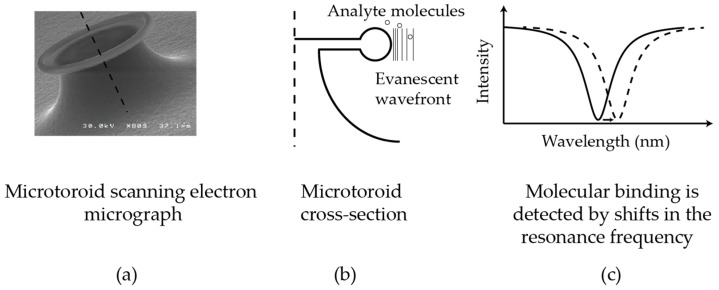
Figure 1
Figure 1
The microtoroid is an example of a whispering gallery mode optical resonator: (a) a scanning electron micrograph of a microtoroid; (b) a schematic of the evanescent wavefront interacting with molecules near the microtoroid (not to scale); and (c) molecules binding to the toroid’s surface changes the resonant frequency of the device. Whispering gallery mode resonators provide enhanced sensitivity as light interacts with the analyte molecules multiple times.
Figure 2
Figure 2
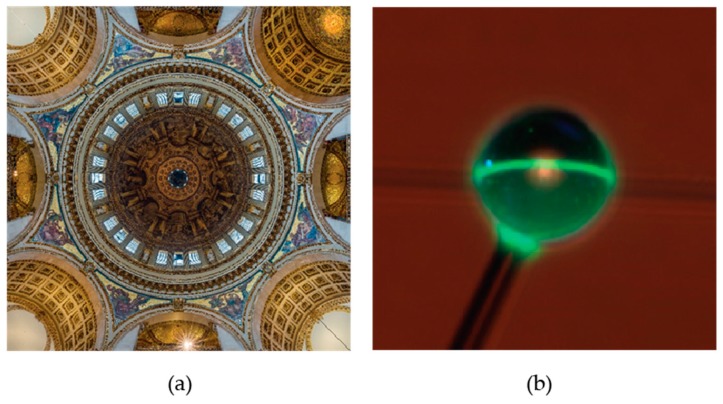
(a) A view from underneath the dome of St. Paul’s Cathedral in London. The gallery underneath the dome is an example of an acoustic whispering gallery. Whispering gallery mode optical resonators were named after the acoustic whispering galleries as follows a similar principle, but with electromagnetic instead of acoustic waves. Photo by David Iliff. License: CC BY-SA3.0. (b) Photograph of light orbiting within a microsphere optical resonator. The sphere has been doped with erbium and is approximately 70 µm in diameter. Light has been evanescently coupled into the microsphere using an optical fiber. Reprinted by permission from Macmillan Publishers Ltd.: [7], copyright (2003).
Figure 3
Figure 3
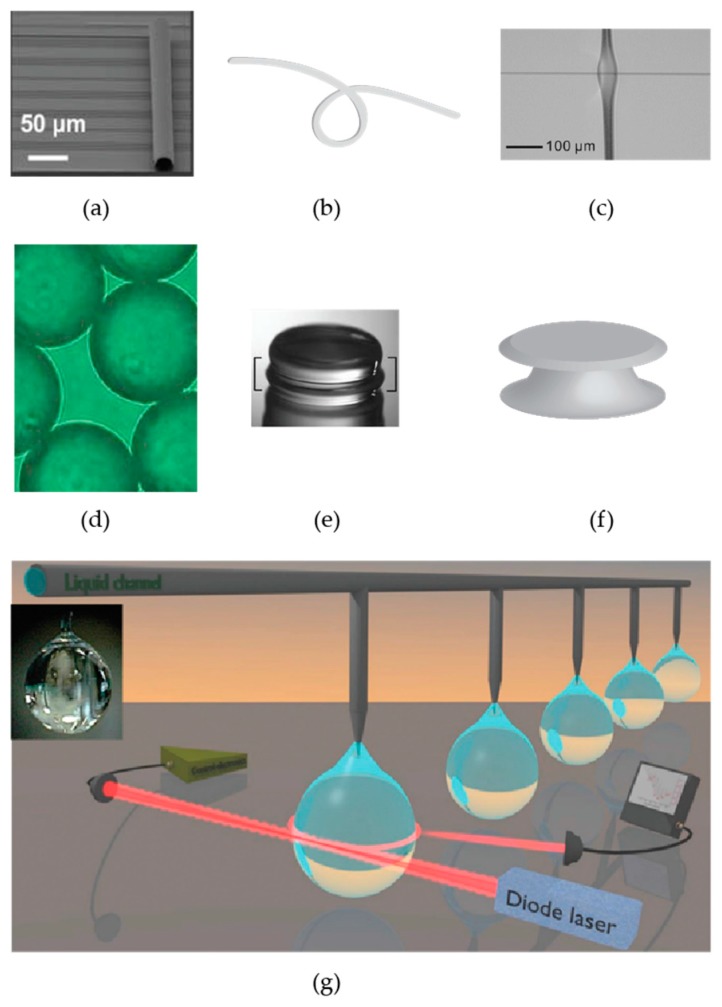
Some examples of different optical microcavities. (a) Vertical optical ring resonators. Adapted from [46]; (b) Knot resonators; (c) Microbubble resonators. Reprinted from [47], with the permission of AIP Publishing; (d) Polystyrene microsphere resonators. These resonators are an inexpensive way to perform many experiments in parallel. Reprinted from [48], with the permission of AIP Publishing; (e) Crystalline CaF2 cavities. The resonator is shown in the area between the white brackets and is ~5.5 mm in diameter. Reprinted from [54]; (f) Microdisk resonators; and (g) Liquid droplet resonators. The inset is of a liquid paraffin oil drop. Adapted from [44]. Copyright Wiley-VCH Verlag GmbH & Co. KGaA.
Figure 4
Figure 4
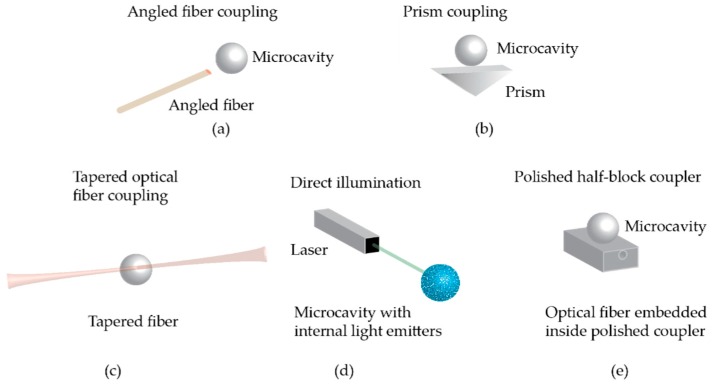
Schematic of different ways to couple light into a symmetric optical microcavity: (a) Angled fiber coupling; (b) Prism coupling. While robust, prism coupling is difficult to achieve for on-chip devices; (c) Tapered optical fiber coupling. The waist of the fiber has been thinned to typically ~500–2000 nm in diameter; (d) Direct illumination in the case where the resonator has internal light emitters such as quantum dots. This enables remote sensing; and (e) Polished half-block coupler. In a half block coupling system, an optical fiber is embedded in a transparent block and mechanically polished until part of the fiber cladding is removed such that light evanesces out.
Figure 5
Figure 5
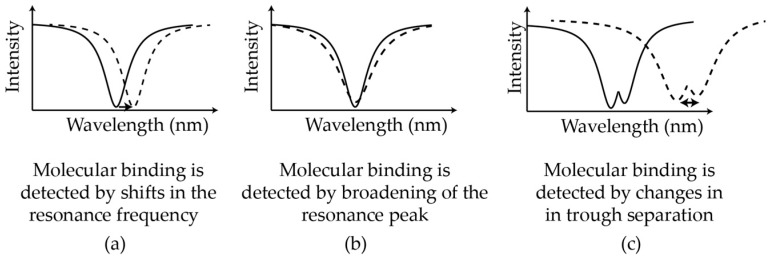
Summary of different sensing modalities: (a) particle binding events are detected by measuring shifts in the resonance frequency of the optical cavity; (b) binding events are detected by broadening of the resonance peak, reflecting a drop in the quality factor of the cavity due to scattering; and (c) particle binding is sensed by measuring changes in trough separation of a resonance doublet. These doublets are created by scattering caused, for example, by the deposition of a nanoparticle on the resonator surface.
Figure 6
Figure 6
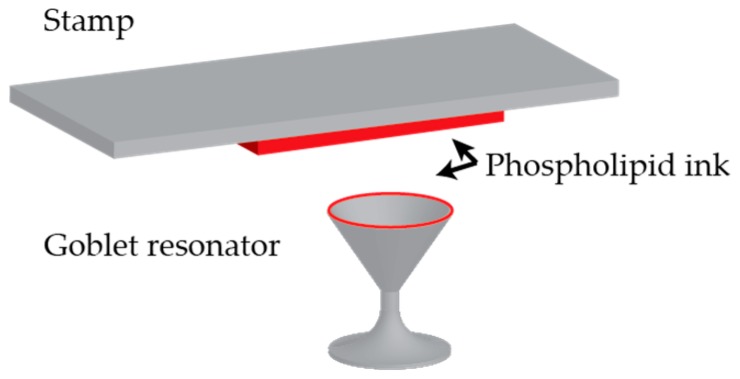
Goblet resonators are functionalized with a phospholipid “ink” using a stamping procedure which allows for each resonator in to be functionalized with a different capture agent in a parallel fashion.
Figure 7
Figure 7
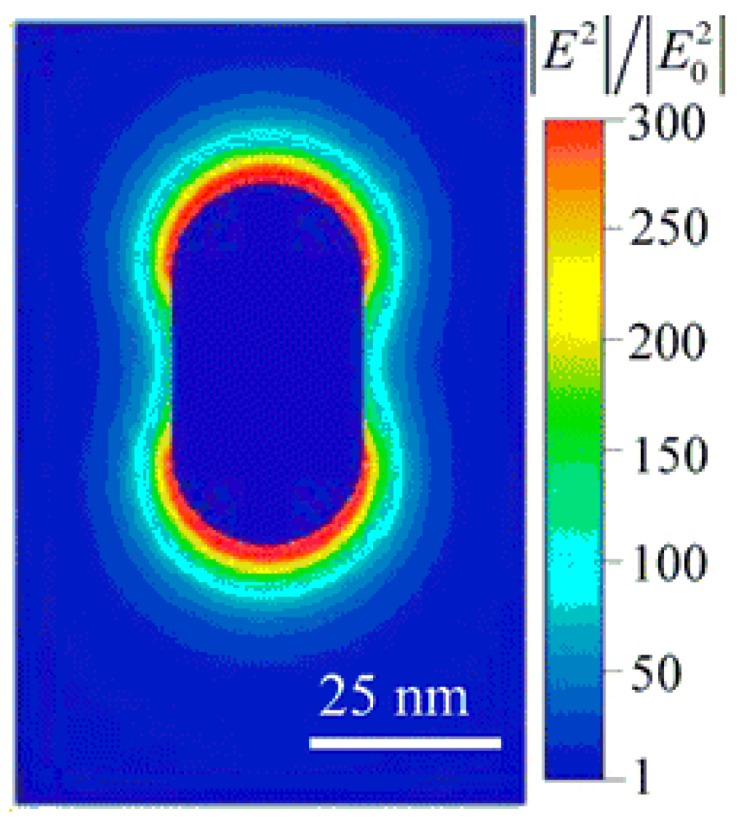
Finite element simulation of the intensity enhancement due to localized surface plasmon resonance of a gold nanorod. E0 represents the field from the incident light and E represents the local field in the vicinity of the nanorod. Reprinted by permission from Macmillan Publishers Ltd.: Nature Nanotechnology [94]), copyright (2012).
Figure 8
Figure 8
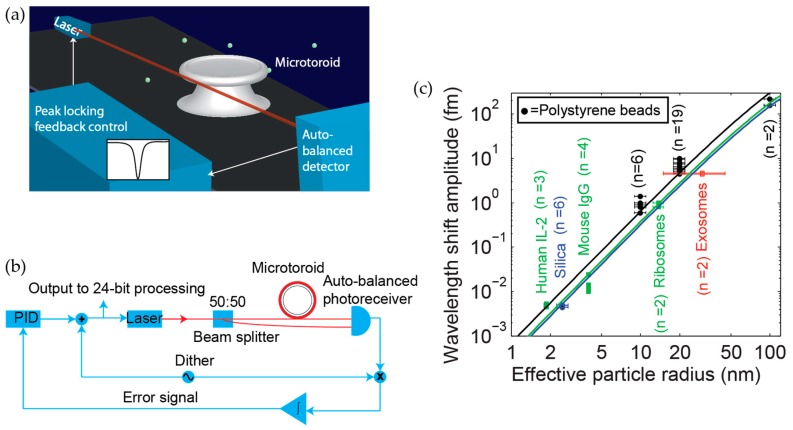
Overview of FLOWER and summary of particle detection data (a) FLOWER schematic. Frequency locking in combination with auto-balanced detection and data processing techniques have been used to improve the signal-to-noise ratio of microtoroid optical resonators to the extent that single macromolecule detection is possible. Reprinted (adapted) with permission from [16]. Copyright 2015 American Chemical Society; (b) Block diagram of FLOWER. Reproduced from [1]; and (c) Summary of particle detection data acquired using FLOWER. The different colored solid lines are theoretical predictions corresponding to different particle dielectric constants. Reproduced from [1].
Figure 9
Figure 9
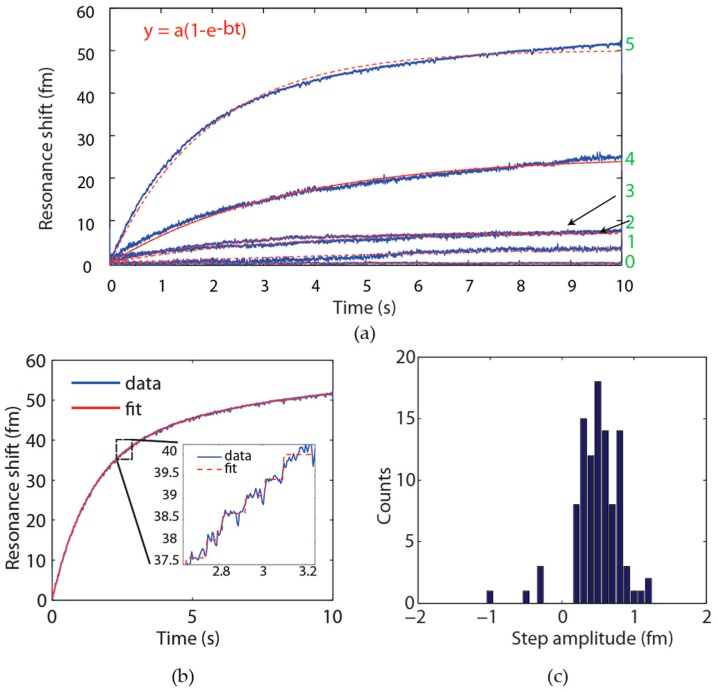
Exosome detection data obtained using FLOWER (a) Exosome binding curves. Mice were implanted with human Burkitt’s lymphoma tumor cells, and each week blood serum samples were taken and later analyzed all together using FLOWER. The curves shown here are from a single mouse. For each week we see an increase in the response from the sensor corresponding to increasing exosome levels. Weeks are indicated in green. No significant signal was obtained from Week 0. The data traces are fit with a simple exponential (dashed red line) corresponding to first-order kinetics. (b) Zoom-in of Week 5 and corresponding step-fit (red) and (c) histogram of step heights. Individual steps corresponding to the binding of individual exosomes may be seen. Negative step amplitudes represent unbinding events. Reprinted (adapted) with permission from [16]. Copyright 2015 American Chemical Society.
Figure 10
Figure 10
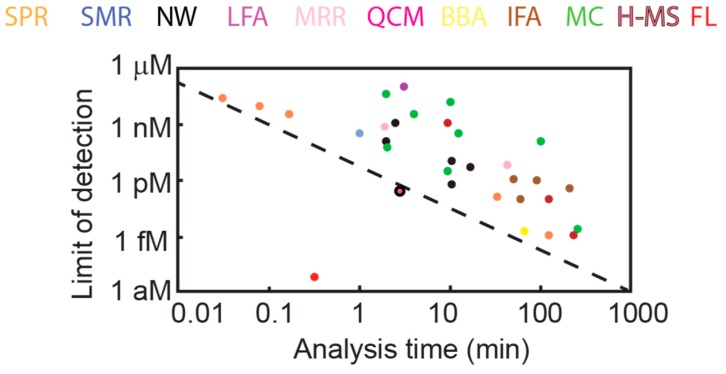
A comparison of biosensing techniques for protein sensing. SPR = Surface Plasmon Resonance; SMR = Suspended Microchannel Resonators; NW = Nanowires; LFA = Lateral Flow Assay; MRR = Microring Resonator; QCM = Quartz Crystal Microbalance; BBA = BioBarcode Assay; IFA = Immunofluorescence Assay; MC = Microcantilever; H-MS = Hybrid-Microsphere [18]; FL = FLOWER. The dashed line represents the present state of the art, not including recent advances in WGM sensing. For cases where the limit of detection is determined by analyte mass, a molecular weight of 34 kDa is assumed (Partially adapted from [11]).

References

    1. Su J., Goldberg A.F.G., Stoltz B.M. Label-free detection of single nanoparticles and biological molecules using microtoroid optical resonators. Light Sci. Appl. 2016;5:e16001. doi: 10.1038/lsa.2016.1. - DOI - PMC - PubMed
    1. Johnsson B., Lofas S., Lindquist G. Immobilization of Proteins to a Carboxymethyldextran-Modified Gold Surface for Biospecific Interaction Analysis in Surface-Plasmon Resonance Sensors. Anal. Biochem. 1991;198:268–277. doi: 10.1016/0003-2697(91)90424-R. - DOI - PubMed
    1. Kersey A.D., Jackson D.A., Corke M. A Simple Fiber Fabry-Perot Sensor. Opt. Commun. 1983;45:71–74. doi: 10.1016/0030-4018(83)90047-0. - DOI
    1. Baker J.E., Sriram R., Miller B.L. Two-dimensional photonic crystals for sensitive microscale chemical and biochemical sensing. Lab Chip. 2015;15:971–990. doi: 10.1039/C4LC01208A. - DOI - PMC - PubMed
    1. Quan Q.M., Loncar M. Deterministic design of wavelength scale, ultra-high Q photonic crystal nanobeam cavities. Opt. Express. 2011;19:18529–18542. doi: 10.1364/OE.19.018529. - DOI - PubMed

LinkOut - more resources