. 2017 Mar 9;18(3):596.
doi: 10.3390/ijms18030596.

Zebrafish Embryo as an In Vivo Model for Behavioral and Pharmacological Characterization of Methylxanthine Drugs

Affiliations

Zebrafish Embryo as an In Vivo Model for Behavioral and Pharmacological Characterization of Methylxanthine Drugs

Ram Manohar Basnet et al. Int J Mol Sci. .

Abstract

Zebrafish embryo is emerging as an important tool for behavior analysis as well as toxicity testing. In this study, we compared the effect of nine different methylxanthine drugs using zebrafish embryo as a model. We performed behavioral analysis, biochemical assay and Fish Embryo Toxicity (FET) test in zebrafish embryos after treatment with methylxanthines. Each drug appeared to behave in different ways and showed a distinct pattern of results. Embryos treated with seven out of nine methylxanthines exhibited epileptic-like pattern of movements, the severity of which varied with drugs and doses used. Cyclic AMP measurement showed that, despite of a significant increase in cAMP with some compounds, it was unrelated to the observed movement behavior changes. FET test showed a different pattern of toxicity with different methylxanthines. Each drug could be distinguished from the other based on its effect on mortality, morphological defects and teratogenic effects. In addition, there was a strong positive correlation between the toxic doses (TC50) calculated in zebrafish embryos and lethal doses (LD50) in rodents obtained from TOXNET database. Taken together, all these findings elucidate the potentiality of zebrafish embryos as an in vivo model for behavioral and toxicity testing of methylxanthines and other related compounds.

Keywords: Fish Embryo Toxicity test; behavior; cyclic AMP; methylxanthine; movement; zebrafish embryos.


Conflict of interest statement

The authors declare no conflict of interest. The founding sponsors had no role in the design of the study; in the collection, analyses, or interpretation of data; in the writing of the manuscript, and in the decision to publish the results.

Figures
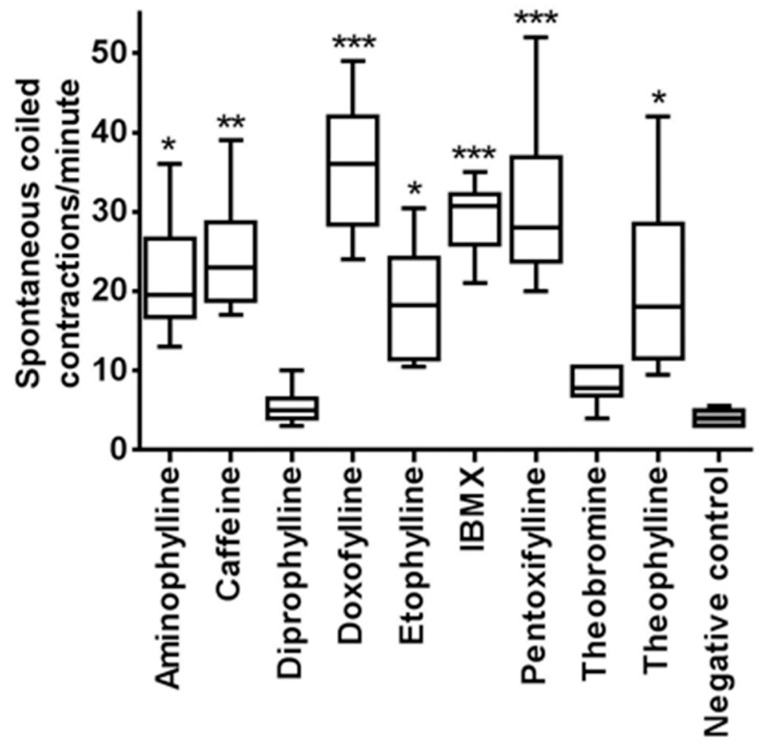
Figure 1
Figure 1
Spontaneous movement quantification at 24 hpf. The following doses of methylxanthine were used: aminophylline 500 mg/L, caffeine 150 mg/L, diprophylline 5000 mg/L, doxofylline 1000 mg/L, etofylline 600 mg/L, IBMX 50 mg/L, pentoxifylline 200 mg/L, theobromine 200 mg/L, and theophylline 200 mg/L. Negative controls were treated with dilution water without any drugs. Data are the mean ± S.D. of three independent experiments. Asterisks indicate statistically significant increase of spontaneous movements compared to negative controls. Significance was determined using ordinary one-way ANOVA, followed by Dunnett’s multiple comparisons test. * p < 0.05; ** p < 0.005; *** p < 0.0001. White columns: methylxanthine treated embryos; grey column: negative controls.
Figure 2
Figure 2
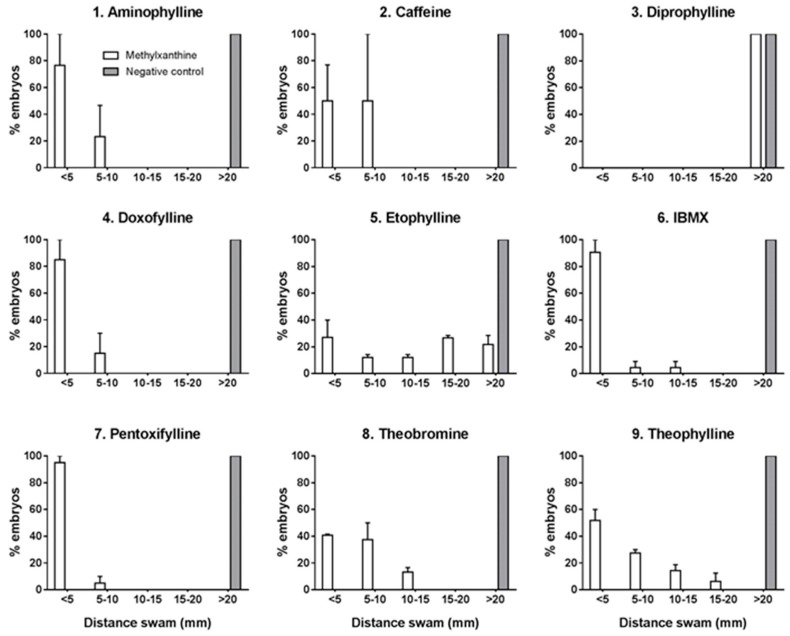
Touch-and-response test performed at 72 hpf. X-axis shows the distance swam by the embryos, Y-axis shows the percentage of embryos that swam different distances. The following doses of methylxanthine were used: aminophylline 500 mg/L, caffeine 150 mg/L, diprophylline 5000 mg/L, doxofylline 1000 mg/L, etofylline 600 mg/L, IBMX 50 mg/L, pentoxifylline 200 mg/L, theobromine 200 mg/L, and theophylline 200 mg/L. Negative controls were treated with dilution water without any drugs. Data are the mean ± S.D. of three independent experiments. White columns: methylxanthine treated embryos; grey columns: negative controls.
Figure 3
Figure 3
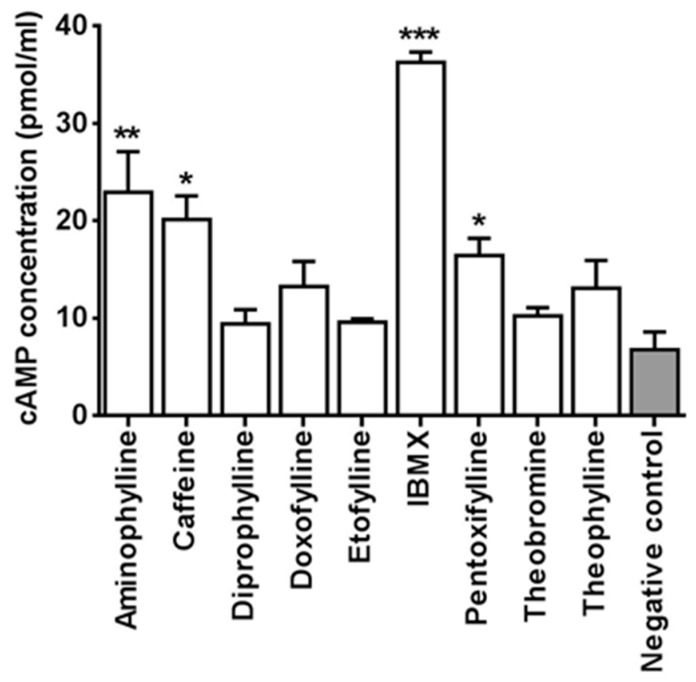
Cyclic AMP level in whole zebrafish embryos extract. The following doses of methylxanthine were used: aminophylline 500 mg/L, caffeine 150 mg/L, diprophylline 5000 mg/L, doxofylline 1000 mg/L, etofylline 600 mg/L, IBMX 50 mg/L, pentoxifylline 200 mg/L, theobromine 200 mg/L, and theophylline 200 mg/L. Negative controls were treated with dilution water without any drugs. Data are the mean ± S.D. of three independent experiments. Asterisks indicate statistically significant increase of cAMP compared to negative controls. Significance was determined using ordinary one-way ANOVA, followed by Dunnett’s multiple comparisons test. * p < 0.05; ** p < 0.005; *** p < 0.0001. White columns: methylxanthine treated embryos; grey column: negative controls.
Figure 4
Figure 4
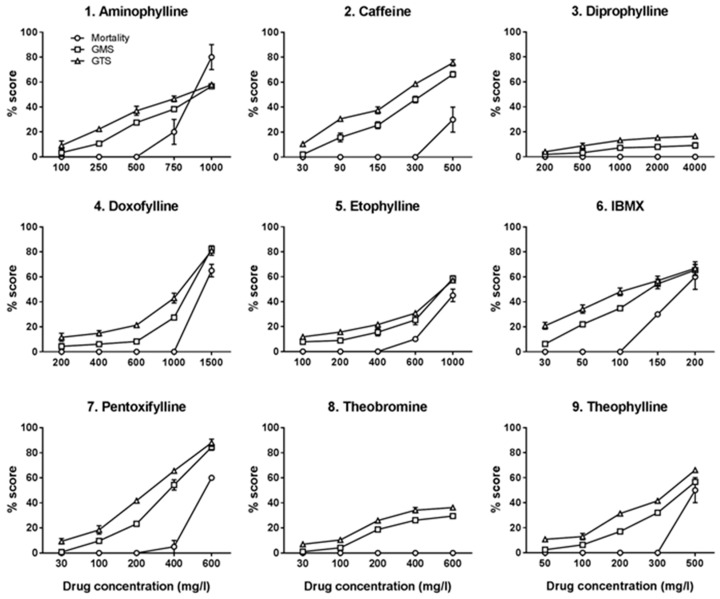
Effect of nine methylxanthine compounds on zebrafish embryos development. X-axis shows the five increasing concentrations of each methylxanthine drug used in the FET test. Data are the mean ± S.D. of three independent experiments. (GMS) General Morphological defects Score; (GTS) General Teratogenicity Score. White circles: mortality rate; white squares: GMS; white triangles: GTS.
Figure 5
Figure 5
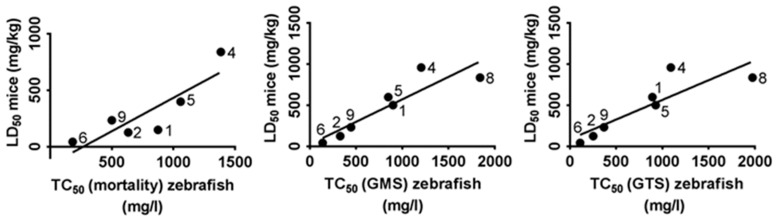
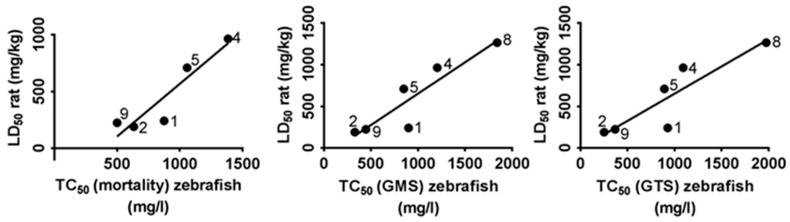
Correlation between TC50 (Toxic Concentration, 50%) of zebrafish (X-axis) and LD50 (Lethal Dose, 50%) of mice (Y-axis). The analysis included seven of the nine tested methylxanthines: diprophylline was excluded because the value was too large and pentoxifylline because it was an outlier. Numbers linked to each dot correspond to a methylxanthine compound, as reported in Table 2.
Figure 6
Figure 6
Correlation between TC50 (Toxic Concentration, 50%) of zebrafish (X-axis) and LD50 (Lethal Dose, 50%) of rat (Y-axis). The analysis included six of the nine tested methylxanthines: diprophylline was excluded because the value was too large and pentoxifylline because it was an outlier; no data were available about IBMX toxicity in rat. Numbers linked to each dot correspond to a methylxanthine compound, as reported in Table 2.

References

    1. Talik P., Krzek J., Ekiert R.J. Analytical techniques used for determination of methylxanthines and their analogues—Recent advances. Sep. Purif. Rev. 2012;41:1–61. doi: 10.1080/15422119.2011.569047. - DOI
    1. Monteiro J., Alves M., Oliveira P., Silva B. Structure-bioactivity relationships of methylxanthines: Trying to make sense of all the promises and the drawbacks. Molecules. 2016;21:974. doi: 10.3390/molecules21080974. - DOI - PMC - PubMed
    1. Oñatibia-Astibia A., Martínez-Pinilla E., Franco R. The potential of methylxanthine-based therapies in pediatric respiratory tract diseases. Respir. Med. 2016;112:1–9. doi: 10.1016/j.rmed.2016.01.022. - DOI - PubMed
    1. Frary C.D., Johnson R.K., Wang M.Q. Food sources and intakes of caffeine in the diets of persons in the United States. J. Am. Diet. Assoc. 2005;105:110–113. doi: 10.1016/j.jada.2004.10.027. - DOI - PubMed
    1. US Department of Agriculture Economic Research Service. Food Contributions of Nonalcoholic Beverages to the U.S. Diet. [(accessed on 27 February 2017)]; Available online: https://www.ers.usda.gov/publications/pub-details/?pubid=44713.