


Quantitative analysis of rutin, quercetin, naringenin, and gallic acid by validated RP- and NP-HPTLC methods for quality control of anti-HBV active extract of Guiera senegalensis
- PMID: 28283004
- PMCID: PMC6130481
- DOI: 10.1080/13880209.2017.1300175
Quantitative analysis of rutin, quercetin, naringenin, and gallic acid by validated RP- and NP-HPTLC methods for quality control of anti-HBV active extract of Guiera senegalensis
Abstract
Context: Guiera senegalensis J.F. Gmel (Combretaceae) is a folk medicinal plant used in various metabolic and infectious diseases. In addition to its antiviral activities against herpes and fowlpox, the anti-HBV efficacy is very recently reported.
Objective: To develop and validate simple, sensitive RP-/NP-HPTLC methods for quantitative determination of biomarkers rutin, quercetin, naringenin, and gallic acid in the anti-HBV active G. senegalensis leaves ethanol-extract.
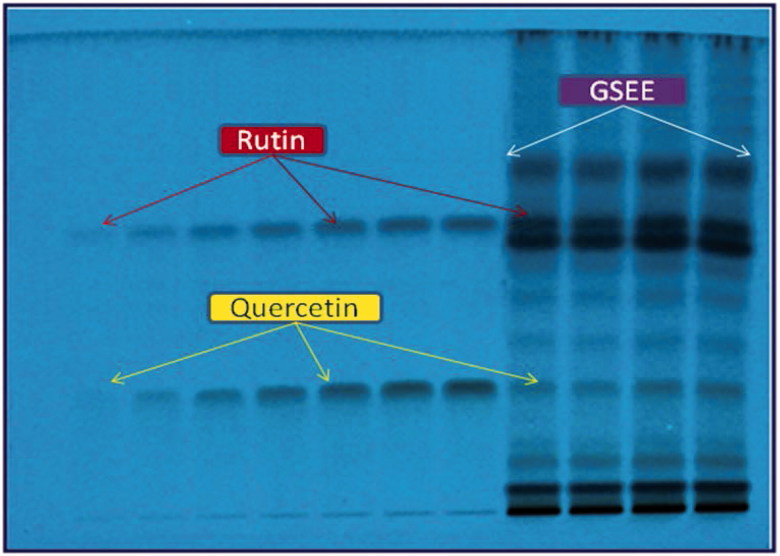
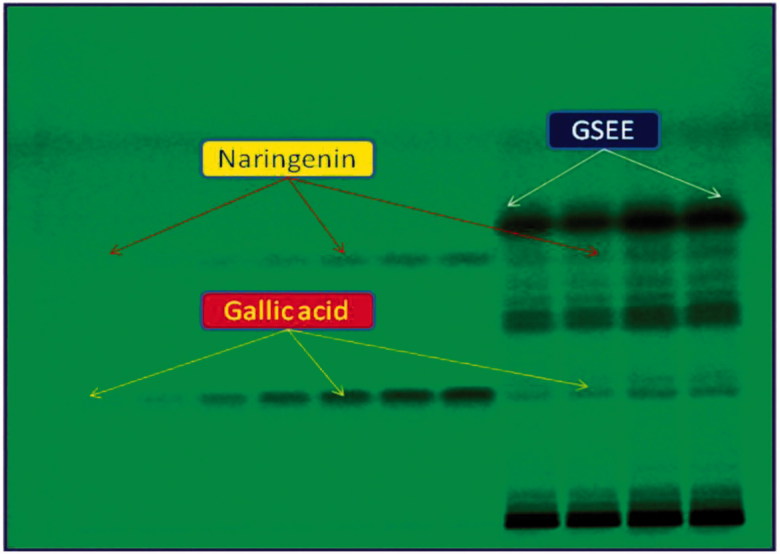
Materials and methods: RP-HPTLC (rutin & quercetin; phase- acetonitrile:water, 4:6) and NP-HPTLC (naringenin & gallic acid; phase- toluene:ethyl acetate:formic acid, 6:4:0.8) were performed on glass-backed silica gel plates 60F254-RP18 and 60F254, respectively. The methods were validated according to the ICH guidelines.
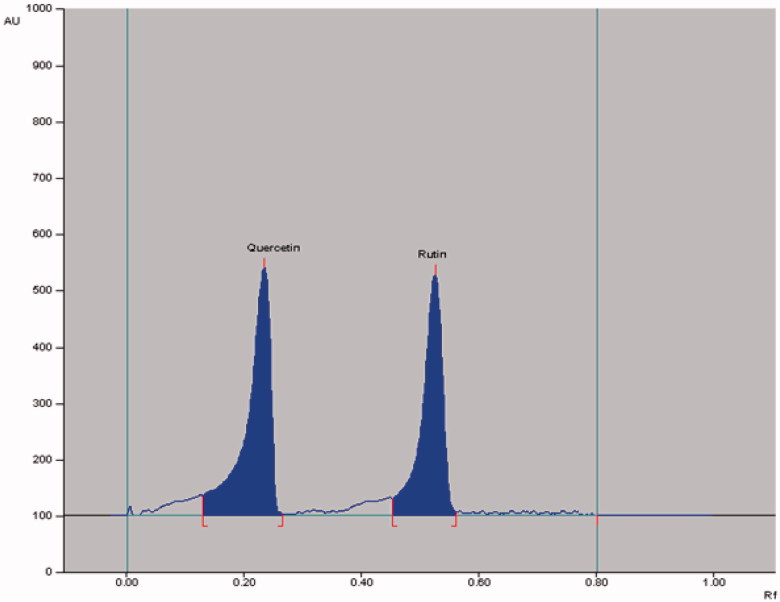
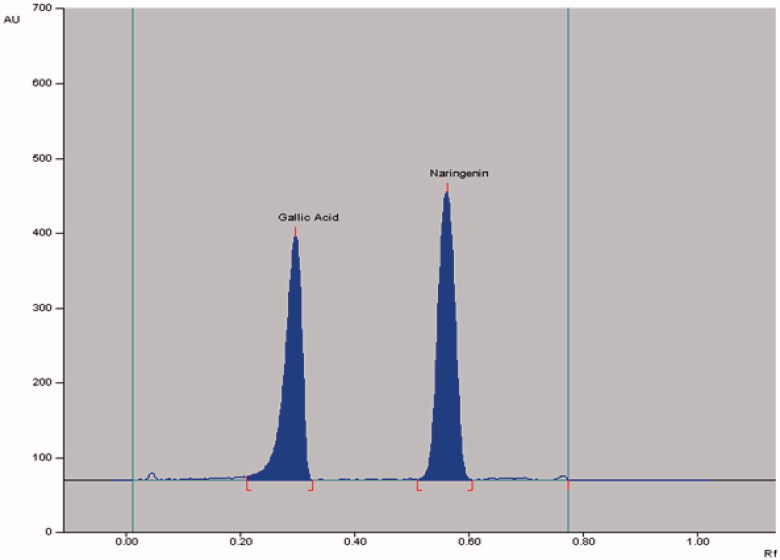
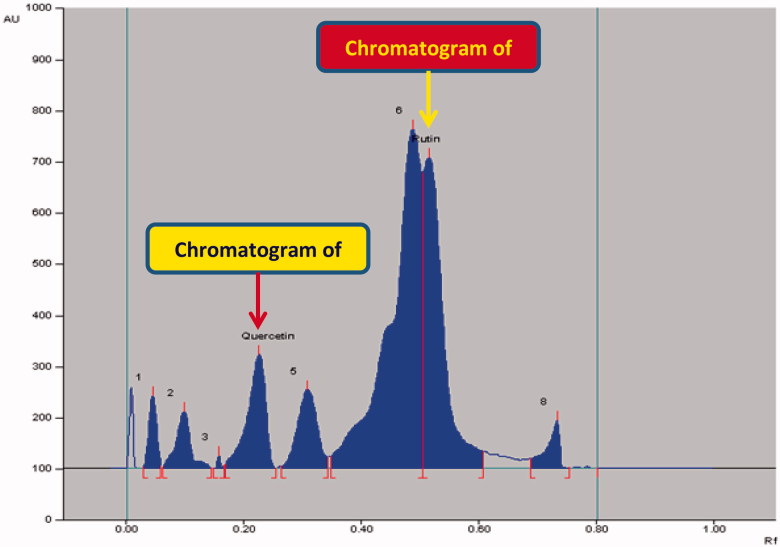
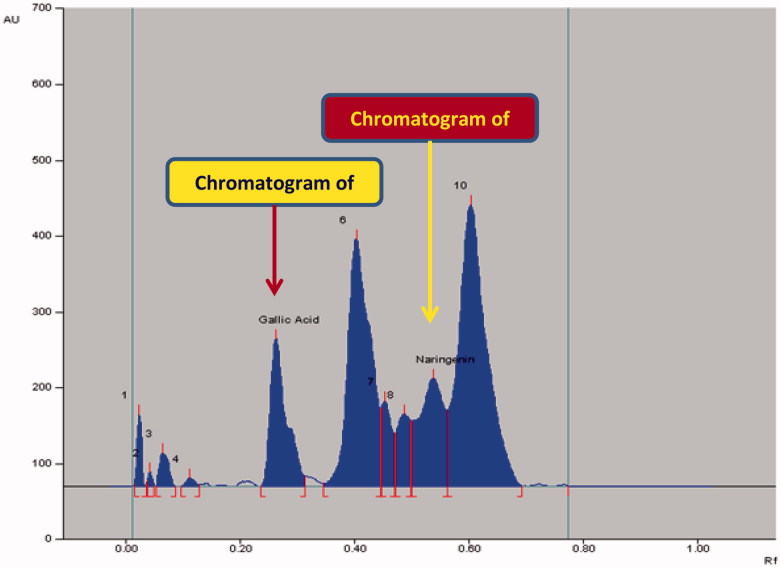
Results: Well-separated and compact spots (Rf) of rutin (0.52 ± 0.006), quercetin (0.23 ± 0.005), naringenin (0.56 ± 0.009) and gallic acid (0.28 ± 0.006) were detected. The regression equations (Y) were 12.434x + 443.49, 10.08x + 216.85, 11.253x + 973.52 and 11.082x + 446.41 whereas the coefficient correlations (r2) were 0.997 ± 0.0004, 0.9982 ± 0.0001, 0.9974 ± 0.0004 and 0.9981 ± 0.0001, respectively. The linearity ranges (ng/spot) were 200-1400 (RP-HPTLC) and 100-1200 (NP-HPTLC). The LOD/LOQ (ng/band) were 33.03/100.1 (rutin), 9.67/29.31 (quercetin), 35.574/107.8 (naringenin), and 12.32/37.35 (gallic acid). Gallic acid (7.01 μg/mg) was the most abundant biomarker compared to rutin (2.42 μg/mg), quercetin (1.53 μg/mg) and naringenin (0.14 μg/mg) in the extract.
Conclusion: The validated NP-/RP-HPTLC methods were simple, accurate, and sensitive for separating and quantifying antiviral biomarkers in G. senegalensis, and endorsed its anti-HBV activity. The developed methods could be further employed in the standardization and quality-control of herbal formulations.
Keywords: Natural products; antiviral; combretaceae; flavonoids; plant extract; polyphenols.
Figures
References
-
- Abubakar MS, Sule MI, Pateh UU, Abdurahman EM, Haruna AK, Jahun BM.. 2000. In vitro snake venom detoxifying action of the leaf extract of Guiera senegalensis. J Ethnopharmacol. 69:253–257. - PubMed
-
- Akuodor GC, Essien AD, David-Oku E, Chilaka KC, Akpan JL, Ezeokpo B, Ezeonwumelu JOC.. 2013. Gastroprotective effect of the aqueous leaf extract of Guiera senegalensis in Albino rats. Asian Pac J Trop Med. 6:771–775. - PubMed
-
- Aniagu SO, Binda LG, Nwinyi FC, Orisadipe A, Amos S, Wambebe C, Gamaniel K.. 2005. Anti-diarrhoeal and ulcer-protective effects of the aqueous root extract of Guiera senegalensis in rodents. J Ethnopharmacol. 97:549–554. - PubMed
-
- Alam P, Siddiqui NA, Al-Rehaily AJ, Alajmi MF, Basudan OA, Khan TH. 2014. Stability-indicating densitometric high-performance thinlayer chromatographic method for the quantitative analysis of biomarker naringin in the leaves and stems of Rumex vesicarius L. J Planar Chromatogr. 27:204–209.
-
- Alajmi MF, Alam P, Shakeel F.. 2013. Quantification of bioactive marker b-amyrin by validated high-performance thin-layer chromatographic densitometric method in different species of Maytenus grown in Kingdom of Saudi Arabia. J Planar Chromatogr. 26:475–479.
MeSH terms
Substances
LinkOut - more resources
Full Text Sources
Other Literature Sources
Miscellaneous
