


Genome analysis following a national increase in Scarlet Fever in England 2014
- PMID: 28283023
- PMCID: PMC5345146
- DOI: 10.1186/s12864-017-3603-z
Genome analysis following a national increase in Scarlet Fever in England 2014
Abstract
Background: During a substantial elevation in scarlet fever (SF) notifications in 2014 a national genomic study was undertaken of Streptococcus pyogenes (Group A Streptococci, GAS) isolates from patients with SF with comparison to isolates from patients with invasive disease (iGAS) to test the hypotheses that the increase in SF was due to either the introduction of one or more new/emerging strains in the population in England or the transmission of a known genetic element through the population of GAS by horizontal gene transfer (HGT) resulting in infections with an increased likelihood of causing SF. Isolates were collected to provide geographical representation, for approximately 5% SF isolates from each region from 1st April 2014 to 18th June 2014. Contemporaneous iGAS isolates for which genomic data were available were included for comparison. Data were analysed in order to determine emm gene sequence type, phylogenetic lineage and genomic clade representation, the presence of known prophage elements and the presence of genes known to confer pathogenicity and resistance to antibiotics.
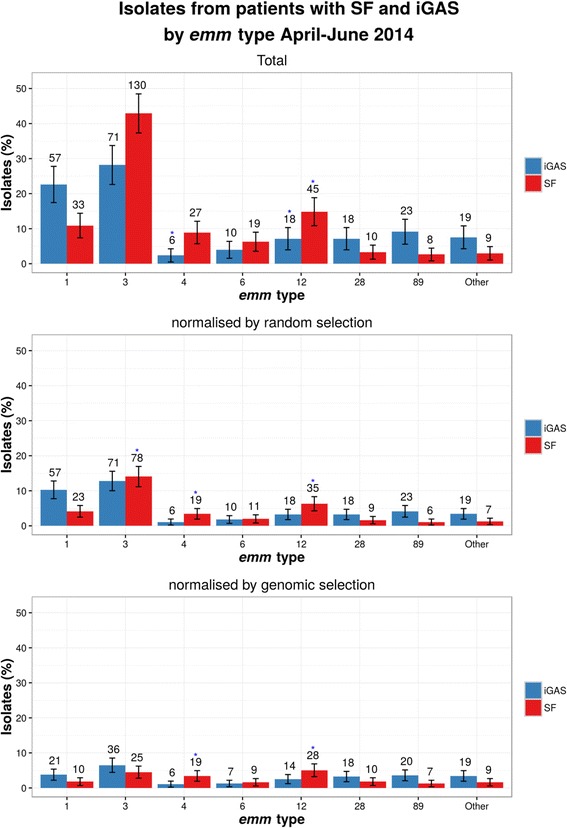
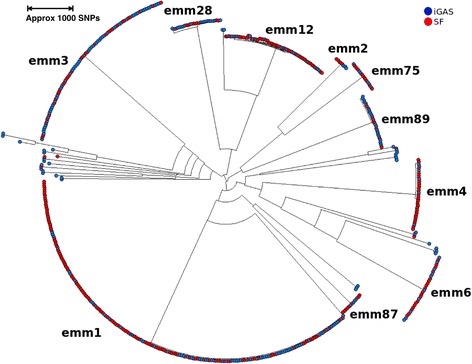
Results: 555 isolates were analysed, 303 from patients with SF and 252 from patients with iGAS. Isolates from patients with SF were of multiple distinct emm sequence types and phylogenetic lineages. Prior to data normalisation, emm3 was the predominant type (accounting for 42.9% of SF isolates, 130/303 95%CI 37.5-48.5; 14.7% higher than the percentage of emm3 isolates found in the iGAS isolates). Post-normalisation emm types, 4 and 12, were found to be over-represented in patients with SF versus iGAS (p < 0.001). A single gene, ssa, was over-represented in isolates from patients with SF. No single phage was found to be over represented in SF vs iGAS. However, a "meta-ssa" phage defined by the presence of :315.2, SPsP6, MGAS10750.3 or HK360ssa, was found to be over represented. The HKU360.vir phage was not detected yet the HKU360.ssa phage was present in 43/63 emm12 isolates but not found to be over-represented in isolates from patients with SF.
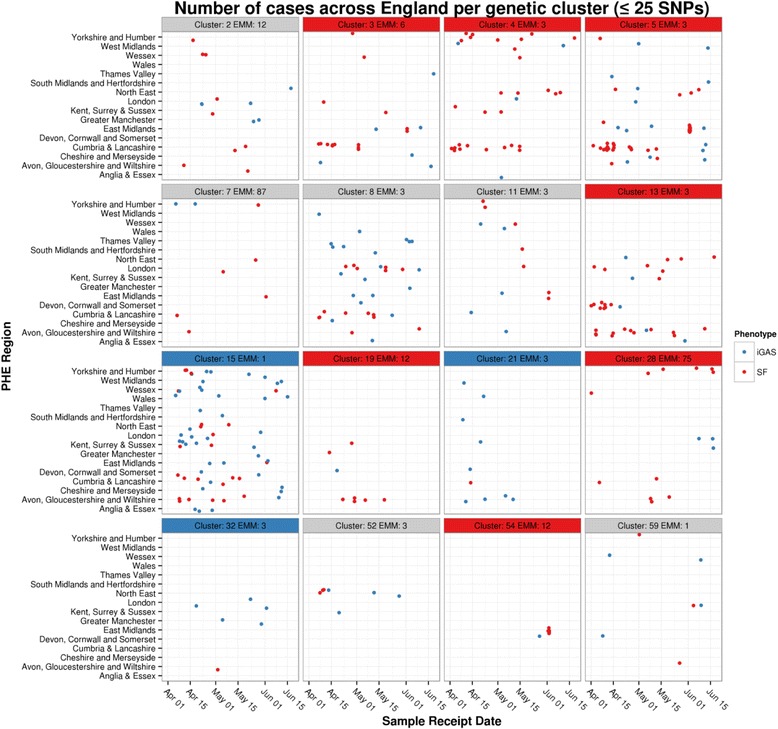
Conclusions: There is no evidence that the increased number of SF cases was a strain-specific or known mobile element specific phenomenon, as the increase in SF cases was associated with multiple lineages of GAS.
Keywords: Genomics; Invasive GAS; Scarlet Fever; Streptococcus pyogenes; iGAS.
Figures
References
-
- Lamagni TL, Efstratiou A, Dennis J, Nair P, Kearney J, George R, national incident management t: Increase in invasive group A streptococcal infections in England, Wales and Northern Ireland, 2008–9. Euro Surveill. 2009;14(5):1-2. - PubMed
-
- Lamagni T DJ, George R, Efstratiou A. Analysis of epidemiological patterns during a century of scarlet fever. In: Proceedings of the European Scientific Conference on Applied Infectious Disease Epidemiology; Berlin, Germany 2008.
-
- England PH Public Health England, Health Protection Report. Published on: Group A streptococcal infections: second update on activity during the 2015 to 2016 season. 2016;10:10-11. https://www.gov.uk/government/uploads/system/uploads/attachment_data/fil....
Publication types
MeSH terms
Substances
LinkOut - more resources
Full Text Sources
Other Literature Sources
Research Materials
Miscellaneous
