


Quality of clinical practice guidelines in delirium: a systematic appraisal
- PMID: 28283488
- PMCID: PMC5353343
- DOI: 10.1136/bmjopen-2016-013809
Quality of clinical practice guidelines in delirium: a systematic appraisal
Abstract
Objective: To determine the accessibility and currency of delirium guidelines, guideline summary papers and evaluation studies, and critically appraise guideline quality.
Design: Systematic literature search for formal guidelines (in English or French) with focus on delirium assessment and/or management in adults (≥18 years), guideline summary papers and evaluation studies.Full appraisal of delirium guidelines published between 2008 and 2013 and obtaining a 'Rigour of Development' domain screening score cut-off of >40% using the Appraisal of Guidelines for Research and Evaluation (AGREE II) instrument.
Data sources: Multiple bibliographic databases, guideline organisation databases, complemented by a grey literature search.
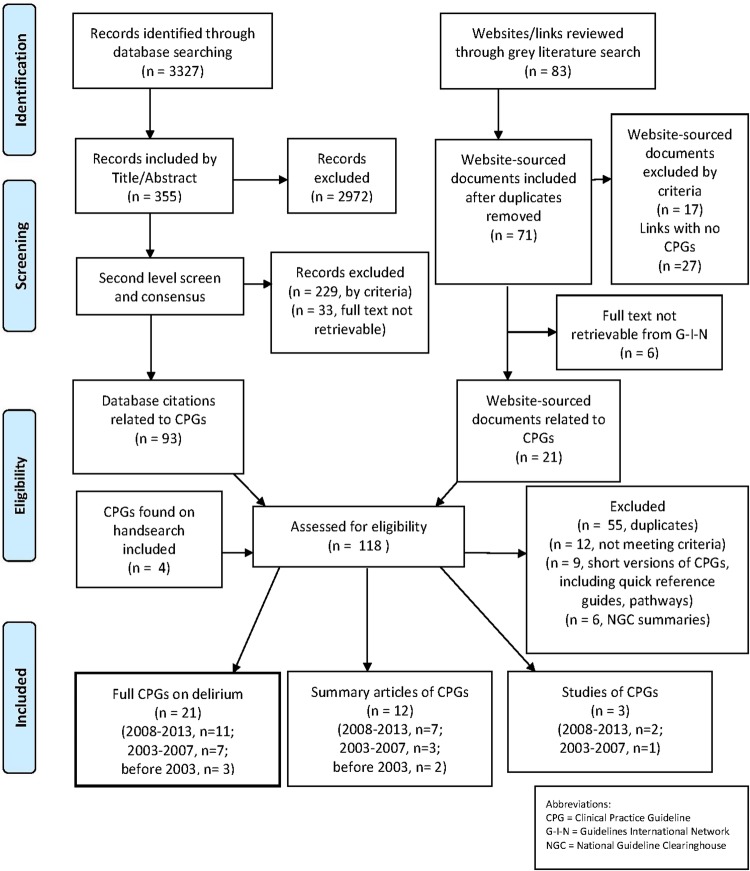
Results: 3327 database citations and 83 grey literature links were identified. A total of 118 retrieved delirium guidelines and related documents underwent full-text screening. A final 21 delirium guidelines (with 10 being >5 years old), 12 guideline summary papers and 3 evaluation studies were included. For 11 delirium guidelines published between 2008 and 2013, the screening AGREE II 'Rigour' scores ranged from 3% to 91%, with seven meeting the cut-off score of >40%. Overall, the highest rating AGREE II domains were 'Scope and Purpose' (mean 80.1%, range 64-100%) and 'Clarity and Presentation' (mean 76.7%, range 38-97%). The lowest rating domains were 'Applicability' (mean 48.7%, range 8-81%) and 'Editorial Independence' (mean 53%, range 2-90%). The three highest rating guidelines in the 'Applicability' domain incorporated monitoring criteria or audit and costing templates, and/or implementation strategies.
Conclusions: Delirium guidelines are best sourced by a systematic grey literature search. Delirium guideline quality varied across all six AGREE II domains, demonstrating the importance of using a formal appraisal tool prior to guideline adaptation and implementation into clinical settings. Adding more knowledge translation resources to guidelines may improve their practical application and effective monitoring. More delirium guideline evaluation studies are needed to determine their effect on clinical practice.
Keywords: Appraisal of Guideline Research and Evaluation (AGREE II) instrument; Clinical practice guidelines; delirium; quality.
Published by the BMJ Publishing Group Limited. For permission to use (where not already granted under a licence) please go to http://www.bmj.com/company/products-services/rights-and-licensing/.
Conflict of interest statement
Figures
References
-
- American Psychiatric Association. Diagnostic and Statistical Manual of Mental Disorders: DSM-5. Arlington, VA: American Psychiatric Association, 2013.
Publication types
MeSH terms
Grants and funding
LinkOut - more resources
Full Text Sources
Other Literature Sources
Medical
