


Using ePrognosis to estimate 2-year all-cause mortality in older women with breast cancer: Cancer and Leukemia Group B (CALGB) 49907 and 369901 (Alliance A151503)
- PMID: 28283904
- PMCID: PMC5508575
- DOI: 10.1007/s10549-017-4188-6
Using ePrognosis to estimate 2-year all-cause mortality in older women with breast cancer: Cancer and Leukemia Group B (CALGB) 49907 and 369901 (Alliance A151503)
Abstract
Purpose: Tools to estimate survival, such as ePrognosis ( http://eprognosis.ucsf.edu/carey2.php ), were developed for general, not cancer, populations. In older patients with breast cancer, accurate overall survival estimates would facilitate discussions about adjuvant therapies.
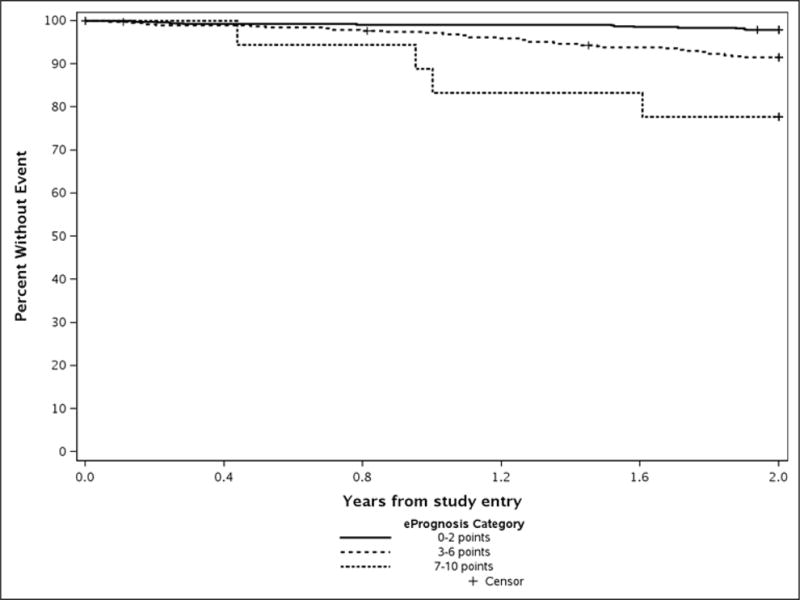
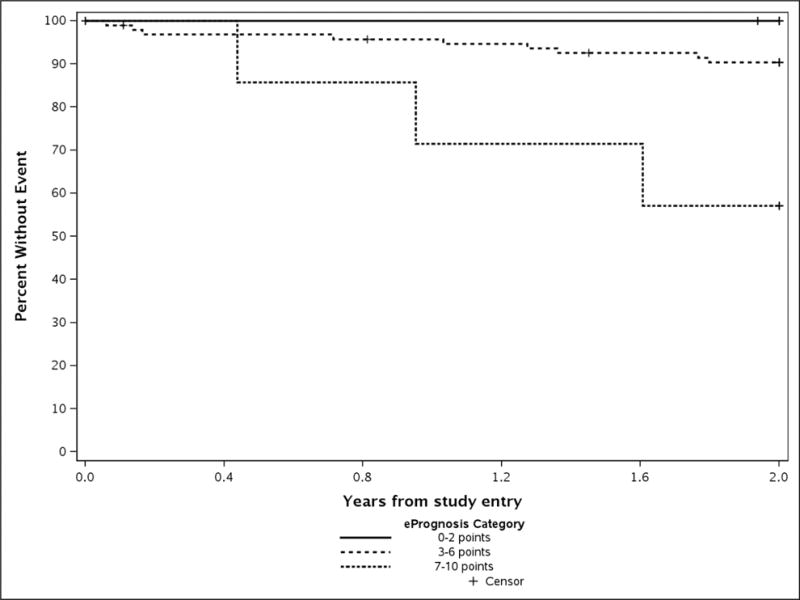
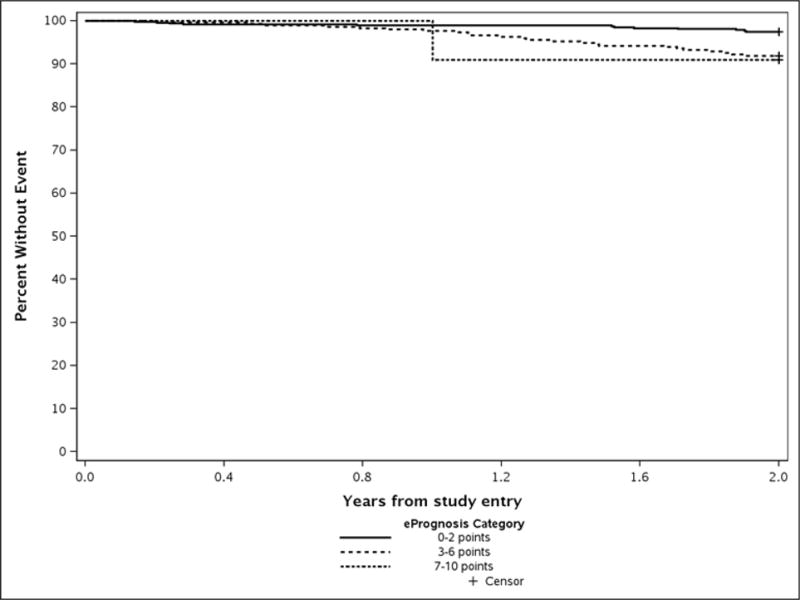
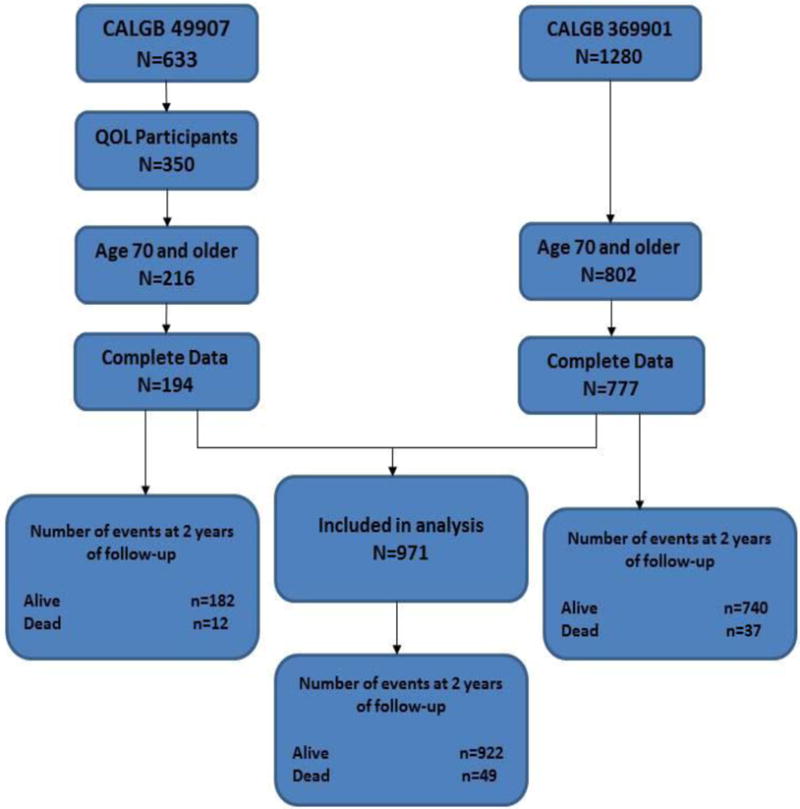
Methods: Secondary analyses were performed of data from two parallel breast cancer studies (CALGB/Alliance 49907/NCT000224102 and CALGB/Alliance 369901/NCT00068328). We included patients (n = 971) who were age 70 years and older with complete baseline quality of life data (194 from 49907; 777 from 369901). Estimated versus observed all-cause two-year mortality rates were compared. ePrognosis score was calculated based on age, sex, and daily function (derived from EORTC QLQ-C30). ePrognosis scores range from 0 to 10, with higher scores indicating worse prognosis based on mortality of community-dwelling elders and were categorized into three groups (0-2, 3-6, 7-10). Observed mortality rates were estimated using Kaplan-Meier methods.
Results: Patient mean age was 75.8 years (range 70-91) and 73% had stage I-IIA disease. Most patients were classified by ePrognosis as good prognosis (n = 562, 58% 0-2) and few (n = 18, 2% 7-10) poor prognosis. Two-year observed mortality rates were significantly lower than ePrognosis estimates for patients scoring 0-2 (2% vs 5%, p = 0.001) and 3-6 (8% vs 12%, p = 0.01). The same trend was seen with scores of 7-10 (23% vs 36%, p = 0.25).
Conclusions: ePrognosis tool only modestly overestimates mortality rate in older breast cancer patients enrolled in two cooperative group studies. This tool, which estimates non-cancer mortality risk based on readily available clinical information may inform adjuvant therapy decisions but should be validated in non-clinical trial populations.
Keywords: Breast cancer; Elderly; Survival estimates; ePrognosis.
Conflict of interest statement
None of the authors has potential conflicts of interest or specific financial interests relevant to the subject of their manuscript.
Figures
Similar articles
-
Comorbidity, chemotherapy toxicity, and outcomes among older women receiving adjuvant chemotherapy for breast cancer on a clinical trial: CALGB 49907 and CALGB 361004 (alliance).J Oncol Pract. 2014 Sep;10(5):e285-92. doi: 10.1200/JOP.2014.001388. Epub 2014 Jul 29. J Oncol Pract. 2014. PMID: 25074878 Free PMC article. Clinical Trial.
-
The Use of Hormone Therapy Alone Versus Hormone Therapy and Radiation Therapy for Breast Cancer in Elderly Women: A Population-Based Study.Int J Radiat Oncol Biol Phys. 2017 Jul 15;98(4):829-839. doi: 10.1016/j.ijrobp.2017.02.094. Epub 2017 Mar 1. Int J Radiat Oncol Biol Phys. 2017. PMID: 28602413
-
Quality of life of older patients with early-stage breast cancer receiving adjuvant chemotherapy: a companion study to cancer and leukemia group B 49907.J Clin Oncol. 2011 Mar 10;29(8):1022-8. doi: 10.1200/JCO.2010.29.9859. Epub 2011 Feb 7. J Clin Oncol. 2011. PMID: 21300923 Free PMC article. Clinical Trial.
-
Breast cancer treatment in women over the age of 80: A tailored approach.Maturitas. 2018 Apr;110:29-32. doi: 10.1016/j.maturitas.2018.01.014. Epub 2018 Jan 27. Maturitas. 2018. PMID: 29563032 Review.
-
The EORTC QLQ-C30 Summary Score as Prognostic Factor for Survival of Patients with Cancer in the "Real-World": Results from the Population-Based PROFILES Registry.Oncologist. 2020 Apr;25(4):e722-e732. doi: 10.1634/theoncologist.2019-0348. Epub 2019 Oct 31. Oncologist. 2020. PMID: 32297435 Free PMC article. Review.
Cited by
-
The Evolving Complexity of Treating Hormone Receptor-Positive, Human Epidermal Growth Factor Receptor-2 (HER2)-Negative Breast Cancer: Special Considerations in Older Breast Cancer Patients-Part II: Metastatic Disease.Drugs Aging. 2020 May;37(5):349-358. doi: 10.1007/s40266-020-00758-x. Drugs Aging. 2020. PMID: 32227289 Free PMC article. Review.
-
Impact of Comorbidities and Age on Cause-Specific Mortality in Postmenopausal Patients with Breast Cancer.Oncologist. 2019 Jul;24(7):e467-e474. doi: 10.1634/theoncologist.2018-0010. Epub 2019 Jan 3. Oncologist. 2019. PMID: 30606886 Free PMC article. Clinical Trial.
-
Patient-reported outcomes in older breast cancer survivors with and without prior chemotherapy treatment.Cancer Med. 2023 Sep;12(17):17740-17752. doi: 10.1002/cam4.6394. Epub 2023 Aug 8. Cancer Med. 2023. PMID: 37551136 Free PMC article.
-
Use of Surveillance Mammography Among Older Breast Cancer Survivors by Life Expectancy.J Clin Oncol. 2017 Sep 20;35(27):3123-3130. doi: 10.1200/JCO.2016.72.1209. Epub 2017 Jul 27. J Clin Oncol. 2017. PMID: 28749724 Free PMC article.
-
Randomized Trial of Standard Adjuvant Chemotherapy Regimens Versus Capecitabine in Older Women With Early Breast Cancer: 10-Year Update of the CALGB 49907 Trial.J Clin Oncol. 2019 Sep 10;37(26):2338-2348. doi: 10.1200/JCO.19.00647. Epub 2019 Jul 24. J Clin Oncol. 2019. PMID: 31339827 Free PMC article. Clinical Trial.
References
-
- Hurria A. Management of elderly patients with cancer. J Natl Compr Canc Netw. 2013;11(5 Suppl):698–701. - PubMed
-
- Muss HB, Berry DA, Cirrincione CT, Theodoulou M, Mauer AM, Kornblith AB, Partridge AH, Dressler LG, Cohen HJ, Becker HP, Kartcheske PA, Wheeler JD, Perez EA, Wolff AC, Gralow JR, Burstein HJ, Mahmood AA, Magrinat G, Parker BA, Hart RD, Grenier D, Norton L, Hudis CA, Winer EP. Adjuvant chemotherapy in older women with early-stage breast cancer. N Engl J Med. 2009;360(20):2055–2065. doi:360/20/2055 [pii] 10.1056/NEJMoa0810266. - PMC - PubMed
MeSH terms
Grants and funding
- U10 CA035279/CA/NCI NIH HHS/United States
- U10 CA033601/CA/NCI NIH HHS/United States
- U10 CA180836/CA/NCI NIH HHS/United States
- U10 CA180857/CA/NCI NIH HHS/United States
- UG1 CA232760/CA/NCI NIH HHS/United States
- U54 CA132378/CA/NCI NIH HHS/United States
- UG1 CA189823/CA/NCI NIH HHS/United States
- U10 CA084131/CA/NCI NIH HHS/United States
- K05 CA096940/CA/NCI NIH HHS/United States
- U19 CA079689/CA/NCI NIH HHS/United States
- R35 CA197289/CA/NCI NIH HHS/United States
- U10 CA003927/CA/NCI NIH HHS/United States
- U10 CA047577/CA/NCI NIH HHS/United States
- U54 CA137788/CA/NCI NIH HHS/United States
- U10 CA032291/CA/NCI NIH HHS/United States
- R01 CA124924/CA/NCI NIH HHS/United States
- R01 CA127617/CA/NCI NIH HHS/United States
- U10 CA007968/CA/NCI NIH HHS/United States
- U10 CA031946/CA/NCI NIH HHS/United States
- U10 CA180821/CA/NCI NIH HHS/United States
- U10 CA077597/CA/NCI NIH HHS/United States
- UG1 CA189850/CA/NCI NIH HHS/United States
- U10 CA041287/CA/NCI NIH HHS/United States
- U10 CA047559/CA/NCI NIH HHS/United States
- R01 CA129769/CA/NCI NIH HHS/United States
- U10 CA180790/CA/NCI NIH HHS/United States
- U10 CA180867/CA/NCI NIH HHS/United States
- U10 CA180838/CA/NCI NIH HHS/United States
LinkOut - more resources
Full Text Sources
Other Literature Sources
Medical
