


Seasonal variation in Internet searches for vitamin D
- PMID: 28283938
- PMCID: PMC5346128
- DOI: 10.1007/s11657-017-0322-7
Seasonal variation in Internet searches for vitamin D
Abstract
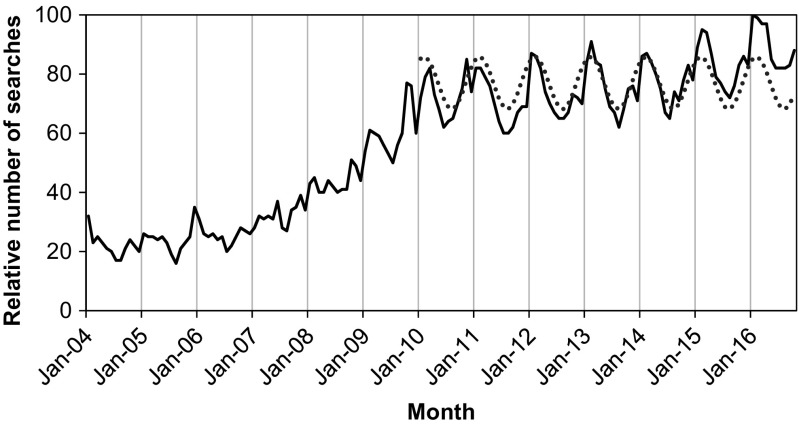
Internet search rates for "vitamin D" were explored using Google Trends. Search rates increased from 2004 until 2010 and thereafter displayed a seasonal pattern peaking in late winter. This knowledge could help guide the timing of public health interventions aimed at managing vitamin D deficiency.
Purpose: The Internet is an important source of health information. Analysis of Internet search activity rates can provide information on disease epidemiology, health related behaviors and public interest. We explored Internet search rates for vitamin D to determine whether this reflects the increasing scientific interest in this topic.
Methods: Google Trends is a publically available tool that provides data on Internet searches using Google. Search activity for the term "vitamin D" from 1st January 2004 until 31st October 2016 was obtained. Comparison was made to other bone and nutrition related terms.
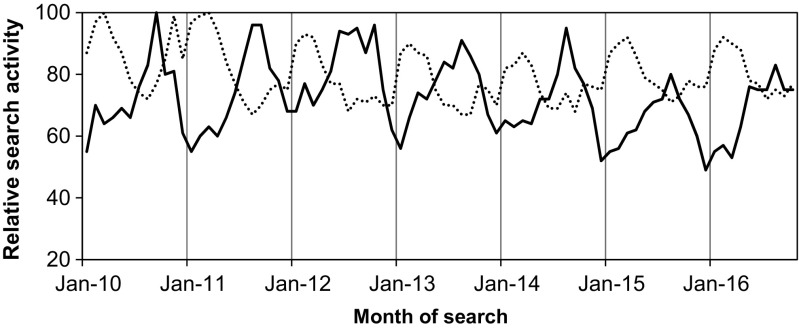
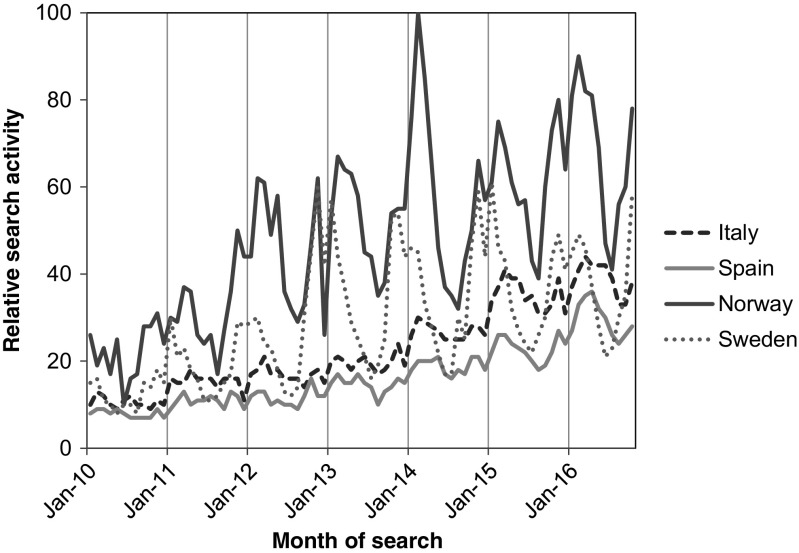
Results: Worldwide, searches for "vitamin D" increased from 2004 until 2010 and thereafter a statistically significant (p < 0.001) seasonal pattern with a peak in February and nadir in August was observed. This seasonal pattern was evident for searches originating from both the USA (peak in February) and Australia (peak in August); p < 0.001 for both. Searches for the terms "osteoporosis", "rickets", "back pain" or "folic acid" did not display the increase observed for vitamin D or evidence of seasonal variation.
Conclusion: Public interest in vitamin D, as assessed by Internet search activity, did increase from 2004 to 2010, likely reflecting the growing scientific interest, but now displays a seasonal pattern with peak interest during late winter. This information could be used to guide public health approaches to managing vitamin D deficiency.
Keywords: Epidemiology; Google Trends; Internet; Vitamin D.
Conflict of interest statement
None.
Figures
References
-
- US National Library of Medicine National Institutes of Health. Pubmed.gov (2016) https://www.ncbi.nlm.nih.gov/pubmed/?term=vitamin+D. Accessed 20/11/2016
MeSH terms
Substances
Grants and funding
- 17702/VAC_/Versus Arthritis/United Kingdom
- MC_U147585827/MRC_/Medical Research Council/United Kingdom
- 21231/VAC_/Versus Arthritis/United Kingdom
- 21231/ARC_/Arthritis Research UK/United Kingdom
- 201222/Z/16/Z/WT_/Wellcome Trust/United Kingdom
- MC_U147585819/MRC_/Medical Research Council/United Kingdom
- 17702/ARC_/Arthritis Research UK/United Kingdom
- MC_UP_A620_1014/MRC_/Medical Research Council/United Kingdom
- HTA/10/33/04/DH_/Department of Health/United Kingdom
- MC_U147585824/MRC_/Medical Research Council/United Kingdom
- 10/33/04/DH_/Department of Health/United Kingdom
- MC_UU_12011/1/MRC_/Medical Research Council/United Kingdom
LinkOut - more resources
Full Text Sources
Other Literature Sources
Medical
