


History of Overweight/Obesity as Predictor of Care Received at 1-year Follow-Up in Adolescents With Anorexia Nervosa or Atypical Anorexia Nervosa
- PMID: 28284563
- PMCID: PMC8375315
- DOI: 10.1016/j.jadohealth.2017.01.001
History of Overweight/Obesity as Predictor of Care Received at 1-year Follow-Up in Adolescents With Anorexia Nervosa or Atypical Anorexia Nervosa
Abstract
Purpose: Previous research has indicated that patients with anorexia nervosa (AN) or atypical AN with premorbid history of overweight/obesity have greater weight loss and longer illness duration than patients with no such history. However, little is known about the association of premorbid overweight/obesity and receiving inpatient medical care during treatment for an eating disorder.
Methods: Using logistic regression, we sought to determine if history of overweight/obesity was associated with receiving inpatient medical care in a sample of 522 patients (mean age 15.5 years, 88% female) with AN/atypical AN.
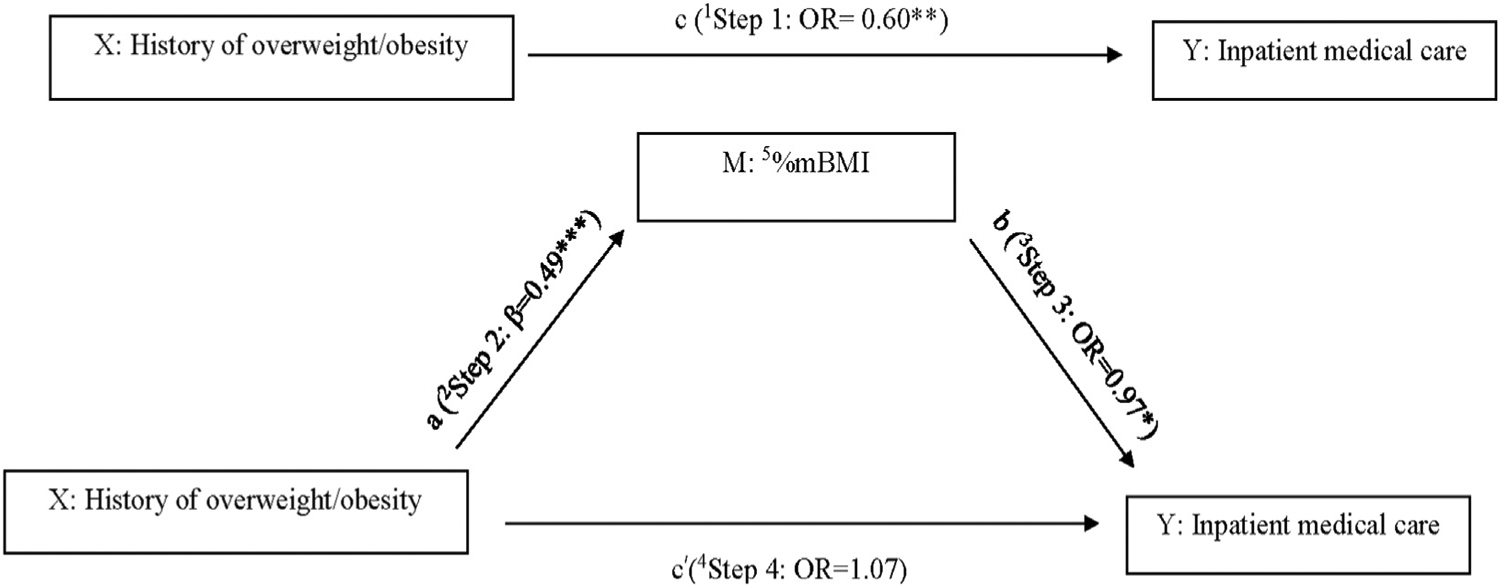
Results: Binary results demonstrated greater percent weight loss (27.4% vs. 16.2%) and higher percent median body mass index (%mBMI, 99.8% vs. 85.2%) at presentation in those with a history of overweight/obesity (p < .001) but no difference in duration of illness (p = .09). In models adjusted for demographics and percent weight loss, history of overweight/obesity was associated with lower odds of receiving inpatient medical care (odds ratio .60 [95% confidence interval: .45-.80]) at 1-year follow-up. However, these associations were no longer significant after adjusting for %mBMI. Mediation results suggest that %mBMI fully mediates the relationship between history of overweight/obesity and inpatient medical care, in that those with a history of overweight/obesity are less likely to receive care due to presenting at a higher weight.
Conclusions: Our findings suggest that, despite greater degree of weight loss and no difference in duration of illness, participants with a history of overweight/obesity are less likely to receive inpatient medical care.
Keywords: Adolescents; Anorexia nervosa; Atypical anorexia nervosa; Eating disorder; Inpatient medical care; Obesity; Overweight; Percent median body mass index; Percent weight loss.
Copyright © 2017 Society for Adolescent Health and Medicine. Published by Elsevier Inc. All rights reserved.
Conflict of interest statement
Figures
References
-
- Neumark-Sztainer D, Wall M, Story M, Sherwood NE. Five-year longitudinal predictive factors for disordered eating in a population-based sample of overweight adolescents: Implications for prevention and treatment. Int J Eat Disord 2009;42:664–72. - PubMed
-
- Lebow J, Sim LA, Kransdorf LN. Prevalence of a history of overweight and obesity in adolescents with restrictive eating disorders. J Adolesc Health 2015;56:19–24. - PubMed
-
- Whitelaw M, Gilbertson H, Lee KJ, Sawyer SM. Restrictive eating disorders among adolescent inpatients. Pediatrics 2014;134:e758–64. - PubMed
MeSH terms
Grants and funding
LinkOut - more resources
Full Text Sources
Other Literature Sources
Medical
