


Activities, function, and health-related quality of life (HRQOL) of older adults with cancer
- PMID: 28285980
- PMCID: PMC5502196
- DOI: 10.1016/j.jgo.2017.02.009
Activities, function, and health-related quality of life (HRQOL) of older adults with cancer
Abstract
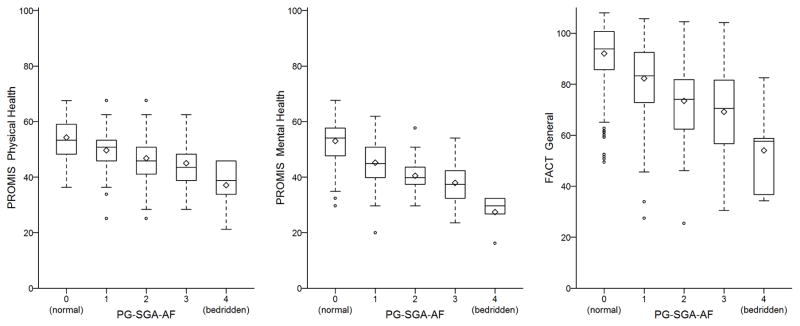
Objective: This study aims to (1) describe the activities, function, and health-related quality of life (HRQOL) of a large sample of older adults (age ≥65) with cancer, (2) identify the associations with demographics, cancer type, comorbid conditions, and ability to participate in activities and functional status.
Materials and methods: The Health Registry/Cancer Survivorship Cohort is an institutional database designed to aid cancer survivorship research. The registry includes three measures of patient-reported HRQOL: FACT-G and PROMIS® Global measures for physical and mental health. Other measures included in the registry are cancer type, date from diagnosis, number of comorbid conditions and specific conditions and their limitations in daily activity, and self-reported daily activity/function.
Results: Our sample consists of 768 older adults with cancer, mean age 72years, 60% female, and 90% White. Mean scores for HRQOL: FACT-G (85, range: 25-108), PROMIS-physical (48, range: 16-67) and, PROMIS-mental (51, range: 21-67). In multivariable models, Black race, one or more comorbid conditions, and Gastrointestinal cancer (p<.05), and patient- reported decreased levels of activities/function were all independently associated with poor HRQOL (p<.0001).
Conclusions: Older Black adults with cancer, those that have high comorbidity burden, with gastrointestinal cancers and those that report decreased ability to participate in daily activities/function reported poorer HRQOL. As geriatric oncology moves towards trying to identify who may need supportive services, this study demonstrated that a one question patient-reported level of activities and functional ability were independently associated with physical, mental, and cancer-specific HRQOL.
Keywords: Activities; Functional status; Health-related quality of life; Neoplasm; Older adults; Supportive services.
Copyright © 2017 Elsevier Ltd. All rights reserved.
References
-
- Smith BD, Smith GL, Hurria A, Hortobagyi GN, Buchholz TA. Future of cancer incidence in the United States: burdens upon an aging, changing nation. Journal of clinical oncology: official journal of the American Society of Clinical Oncology. 2009;27(17):2758–2765. doi: 10.1200/JCO.2008.20.8983. - DOI - PubMed
-
- Jolly TA, Deal AM, Nyrop KA, Williams GR, Pergolotti M, Wood WA, Alston SM, Gordon BB, Dixon SA, Moore SG, Taylor WC, Messino M, Muss HB. Geriatric Assessment-Identified Deficits in Older Cancer Patients With Normal Performance Status. Oncologist. 2015 doi: 10.1634/theoncologist.2014-0247. - DOI - PMC - PubMed
-
- Muss HB, Berry DA, Cirrincione C, Budman DR, Henderson IC, Citron ML, Norton L, Winer EP, Hudis CA. Toxicity of older and younger patients treated with adjuvant chemotherapy for node-positive breast cancer: the Cancer and Leukemia Group B Experience. Journal of clinical oncology: official journal of the American Society of Clinical Oncology. 2007;25(24):3699–3704. doi: 10.1200/JCO.2007.10.9710. - DOI - PubMed
-
- Braithwaite D, Satariano WA, Sternfeld B, Hiatt RA, Ganz PA, Kerlikowske K, Moore DH, Slattery ML, Tammemagi M, Castillo A, Melisko M, Esserman L, Weltzien EK, Caan BJ. Long-term prognostic role of functional limitations among women with breast cancer. J Natl Cancer Inst. 2010;102(19):1468–1477. doi: 10.1093/jnci/djq344. - DOI - PMC - PubMed
MeSH terms
Grants and funding
LinkOut - more resources
Full Text Sources
Other Literature Sources
Research Materials
