. 2017 Jun:54:1-9.
doi: 10.1016/j.neurobiolaging.2017.02.005. Epub 2017 Feb 16.

Two distinct classes of degenerative change are independently linked to clinical progression in mild cognitive impairment

Affiliations

Two distinct classes of degenerative change are independently linked to clinical progression in mild cognitive impairment

Jean-Philippe Coutu et al. Neurobiol Aging. 2017 Jun.

Abstract

We previously demonstrated 2 statistically distinct factors of degeneration in Alzheimer's disease: one strongly related to white matter damage and age interpreted as "age- and vascular-related", and the other related to cortical atrophy thought to represent "neurodegenerative changes associated with Alzheimer's disease". Those factors are now replicated in a distinct cross-sectional data set of 364 participants from the Alzheimer's Disease Neuroimaging Initiative and their interpretation is improved using correlations with CSF biomarkers. Furthermore, we now show that changes in both factors over 2 years are independently associated with decline in Mini-Mental State Examination score in a longitudinal subset of 116 individuals with mild cognitive impairment. Progression in the "age- and vascular-related" factor was greater for individuals with 2 APOE ε4 alleles and linked to a greater attributable change in Mini-Mental State Examination than the "neurodegenerative" factor. These results suggest benefits of targeting white matter and vascular health to complement interventions focused on the neurodegenerative aspect of the disease, even in individuals with little discernable vascular comorbidity.

Keywords: Alzheimer's disease; CSF biomarkers; Cognitive decline; Longitudinal cohort study; Mild cognitive impairment; Small-vessel disease; White matter.


Conflict of interest statement

Disclosure: The authors have no actual or potential conflicts of interest relevant to this study.

Figures

Figure 1
Figure 1
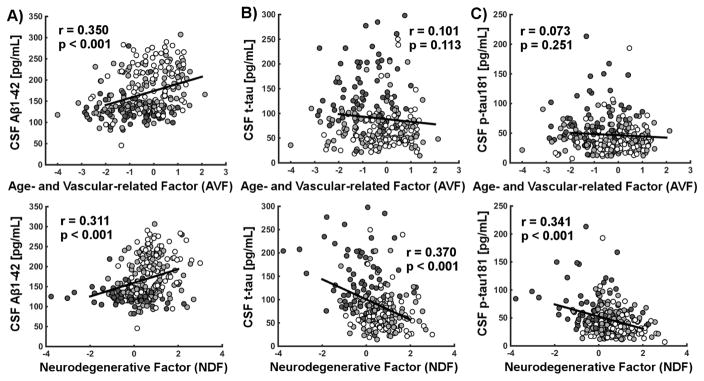
Scatterplots of the associations between factor scores and CSF A) 1–42, B) t-tau and C) p-tau181 are presented in the cross-sectional dataset. Pearson’s correlation coefficients and associated p- values are shown. Controls, individuals with mild cognitive impairment and Alzheimer’s disease are shown respectively in white, light gray and dark gray. All significant relationships remain significant when correcting for all covariates as detailed in the models, but uncorrected data is presented here to further support the hypothesis that CSF biomarkers are related to the factor scores.
Figure 2
Figure 2
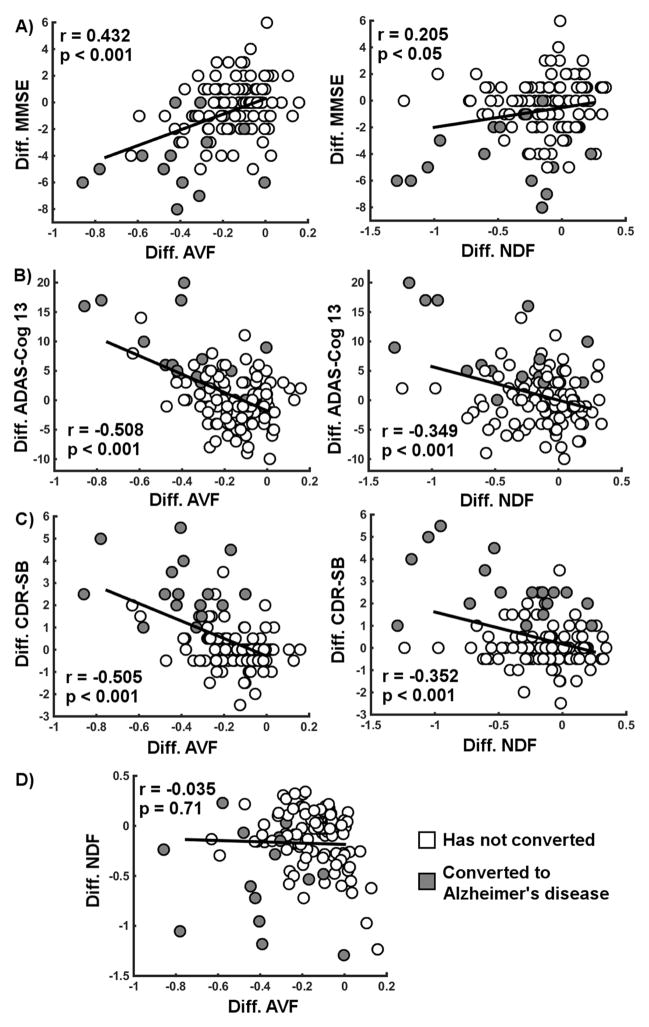
Longitudinal difference in clinical scales over two years related to the change in factor scores. Clinical scales included the A) Mini-Mental State Examination (MMSE), the B) Alzheimer’s Disease Assessment Scale (ADAS-Cog 13-item scale) and the C) Clinical Dementia Rating – Sum of Boxes (CDR-SB). D) The correlation between the difference in ‘age- and vascular-related’ factor (AVF) and the difference in ‘neurodegenerative’ factor (NDF) is also shown. Pearson’s correlation coefficients and associated p-values are shown. Individuals with MCI who converted to AD during the two-year follow-up are shown in gray while those who did not convert are shown in white. Difference defined as value at follow-up minus value at baseline. All significant relationships remain significant when correcting for all covariates as detailed in the models, but uncorrected data is presented here to further support the hypothesis that longitudinal cognitive decline is related to a change in the factor scores.
Figure 3
Figure 3
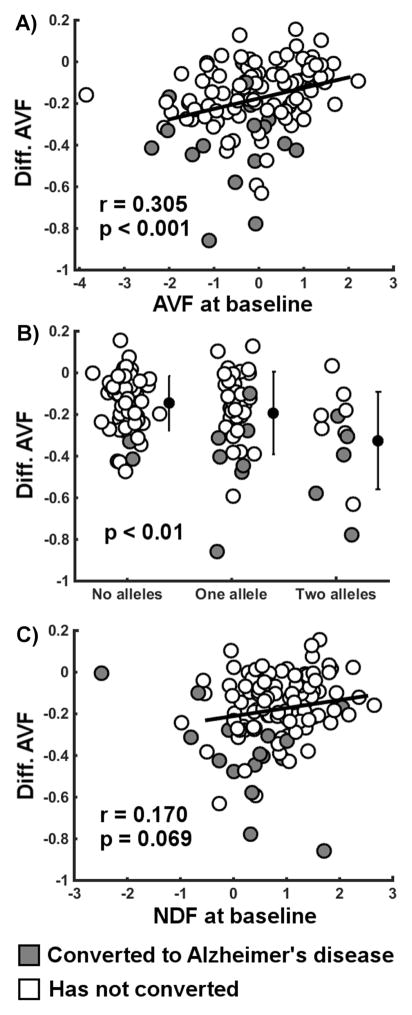
Longitudinal difference in ‘age- and vascular-related’ factor (AVF) over two years related to its determinants. Determinants included the A) AVF factor score at baseline, B) number of APOE ε4 alleles and C) ‘neurodegenerative factor’ factor (NDF) score at baseline. Pearson’s correlation coefficients (r) and associated p-values are shown. The ANOVA p-value is also shown for the relationship with the number of APOE ε4 alleles. Individuals with MCI who converted to AD during the two-year follow-up are shown in gray while those who did not convert are shown in white. Difference defined as value at follow-up minus value at baseline. Covariates were not included to show the uncorrected data in addition to the models accounting for covariates.

References

    1. Atiya M, Hyman BT, Albert MS, Killiany R. Structural magnetic resonance imaging in established and prodromal Alzheimer disease: a review. Alzheimer Dis Assoc Disord. 2003;17:177–95. doi: 10.1097/00002093-200307000-00010. - DOI - PubMed
    1. Attems J, Jellinger KA. The overlap between vascular disease and Alzheimer’s disease – lessons from pathology. BMC Med. 2014;12:206. doi: 10.1186/s12916-014-0206-2. - DOI - PMC - PubMed
    1. Bakkour A, Morris JC, Dickerson BC. The cortical signature of prodromal AD: regional thinning predicts mild AD dementia. Neurology. 2009;72:1048–55. doi: 10.1212/01.wnl.0000340981.97664.2f. - DOI - PMC - PubMed
    1. Burn J, Dennis M, Bamford J, Sandercock P, Wade D, Warlow C. Long-term risk of recurrent stroke after a first-ever stroke. The Oxfordshire Community Stroke Project Stroke. 1994;25:333–337. doi: 10.1161/01.STR.25.2.333. - DOI - PubMed
    1. Burton EJ, McKeith IG, Burn DJ, Firbank MJ, O’Brien JT. Progression of white matter hyperintensities in Alzheimer disease, dementia with lewy bodies, and Parkinson disease dementia: a comparison with normal aging. Am J Geriatr Psychiatry. 2006;14:842–849. doi: 10.1097/01.JGP.0000236596.56982.1c. - DOI - PubMed

Publication types