. 2017 Mar;44(3):674-686.
doi: 10.1111/jbi.12913. Epub 2017 Jan 2.

Biogeography and molecular diversity of coral symbionts in the genus Symbiodinium around the Arabian Peninsula

Affiliations

Biogeography and molecular diversity of coral symbionts in the genus Symbiodinium around the Arabian Peninsula

Maren Ziegler et al. J Biogeogr. 2017 Mar.

Abstract

Aim: Coral reefs rely on the symbiosis between scleractinian corals and intracellular, photosynthetic dinoflagellates of the genus Symbiodinium making the assessment of symbiont diversity critical to our understanding of ecological resilience of these ecosystems. This study characterizes Symbiodinium diversity around the Arabian Peninsula, which contains some of the most thermally diverse and understudied reefs on Earth.

Location: Shallow water coral reefs throughout the Red Sea (RS), Sea of Oman (SO), and Persian/Arabian Gulf (PAG).

Methods: Next-generation sequencing of the ITS2 marker gene was used to assess Symbiodinium community composition and diversity comprising 892 samples from 46 hard and soft coral genera.

Results: Corals were associated with a large diversity of Symbiodinium, which usually consisted of one or two prevalent symbiont types and many types at low abundance. Symbiodinium communities were strongly structured according to geographical region and to a lesser extent by coral host identity. Overall symbiont communities were composed primarily of species from clade A and C in the RS, clade A, C, and D in the SO, and clade C and D in the PAG, representing a gradual shift from C- to D-dominated coral hosts. The analysis of symbiont diversity in an Operational Taxonomic Unit (OTU)-based framework allowed the identification of differences in symbiont taxon richness over geographical regions and host genera.

Main conclusions: Our study represents a comprehensive overview over biogeography and molecular diversity of Symbiodinium in the Arabian Seas, where coral reefs thrive in one of the most extreme environmental settings on the planet. As such our data will serve as a baseline for further exploration into the effects of environmental change on host-symbiont pairings and the identification and ecological significance of Symbiodinium types from regions already experiencing 'Future Ocean' conditions.

Keywords: ITS2; Persian/Arabian Gulf; Red Sea; Sea of Oman; coral reef; ecosystem; next‐generation sequencing; symbiosis.


Figures
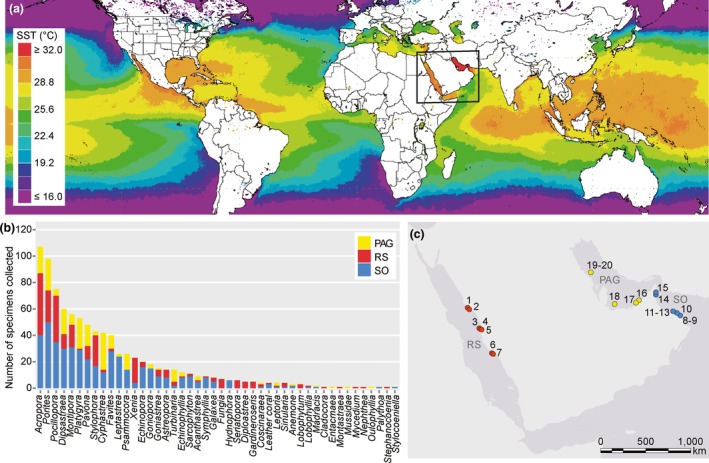
Figure 1
Figure 1
Overview of study locations and coral sampling. (a) Summer sea surface temperatures (SST) mark the region around the Arabian Peninsula as comparably warm (monthly averages from 07/2012–09/2012 derived from satellite data sets of the NASA Giovanni online data system, Ocean Colour Radiometry, MODIS‐Aqua 4 km, black rectangle denotes sampling region). (b) Cumulative number of coral samples per genus collected from the Red Sea (RS, red), the Sea of Oman (SO, blue), and the Persian/Arabian Gulf (PAG, yellow), total n = 892. (c) Sampling sites around the Arabian Peninsula; samples from the Red Sea were collected at Yanbu Ayona (1, 36 samples), Yanbu 23 (2, 31 samples), Shib Nazar (3, 43 samples), Al Fahal (4, 42 samples), Inner Fasr (5, 31 samples), Abu Lath Shallow Reef (6, 40 samples), and Al Lith South Reef (7, 33 samples). Collection sites in the Sea of Oman included Bandar Al Khayran (8, 90 samples), Shiekh Al Sifah (9, 87 samples), Fahal Island (10, 62 samples), Daymaniyat Islands (11–13, 35, 36, and 58 samples), Al Aqah (14, 34 samples), Dibba Rock (15, 37 samples), and in the Persian/Arabian Gulf Ras Ghanada (16, 26 samples), Saadiyat (17, 42 samples), Al Yassat (18, 33 samples), Subri (19, 73 samples), and Chandelier (20, 23 samples). [Colour figure can be viewed at wileyonlinelibrary.com]
Figure 2
Figure 2
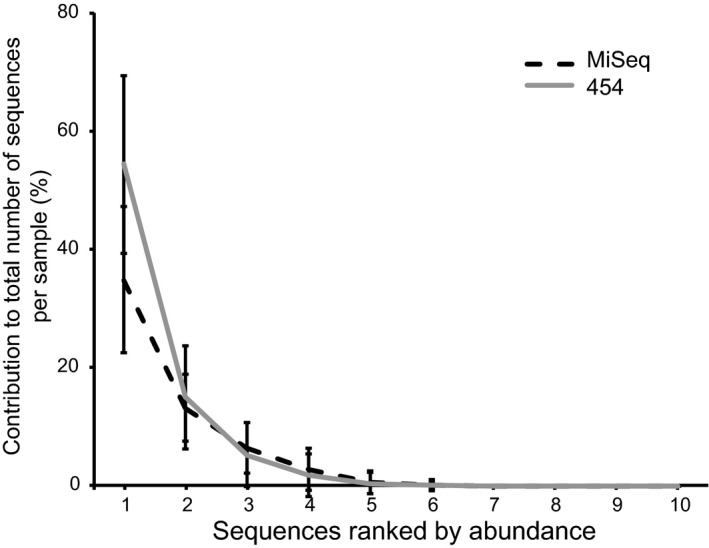
ITS2 sequence diversity contribution of the 10 most abundant ITS2 variants to total sequence composition in each coral sample from the seas around the Arabian Peninsula. Corals are dominated by the one or two most‐abundant ITS2 variant(s), error bars = SD.
Figure 3
Figure 3
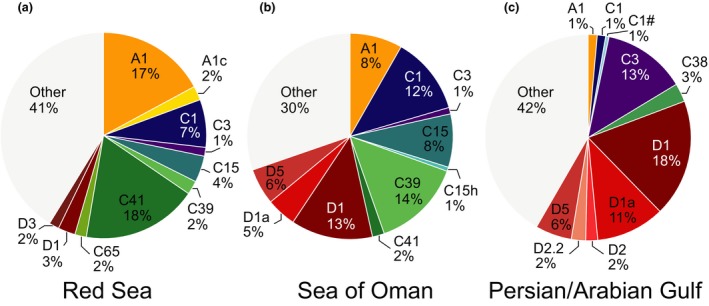
Signatures of ten most abundant Symbiodinium ITS2 types in each region. Overview is based on 892 samples comprising 46 hard and soft coral genera. (a) Red Sea (256 samples, 35 genera), (b) Sea of Oman (439 samples, 33 genera), (c) Persian/Arabian Gulf (197 samples, 24 genera). [Colour figure can be viewed at wileyonlinelibrary.com]
Figure 4
Figure 4
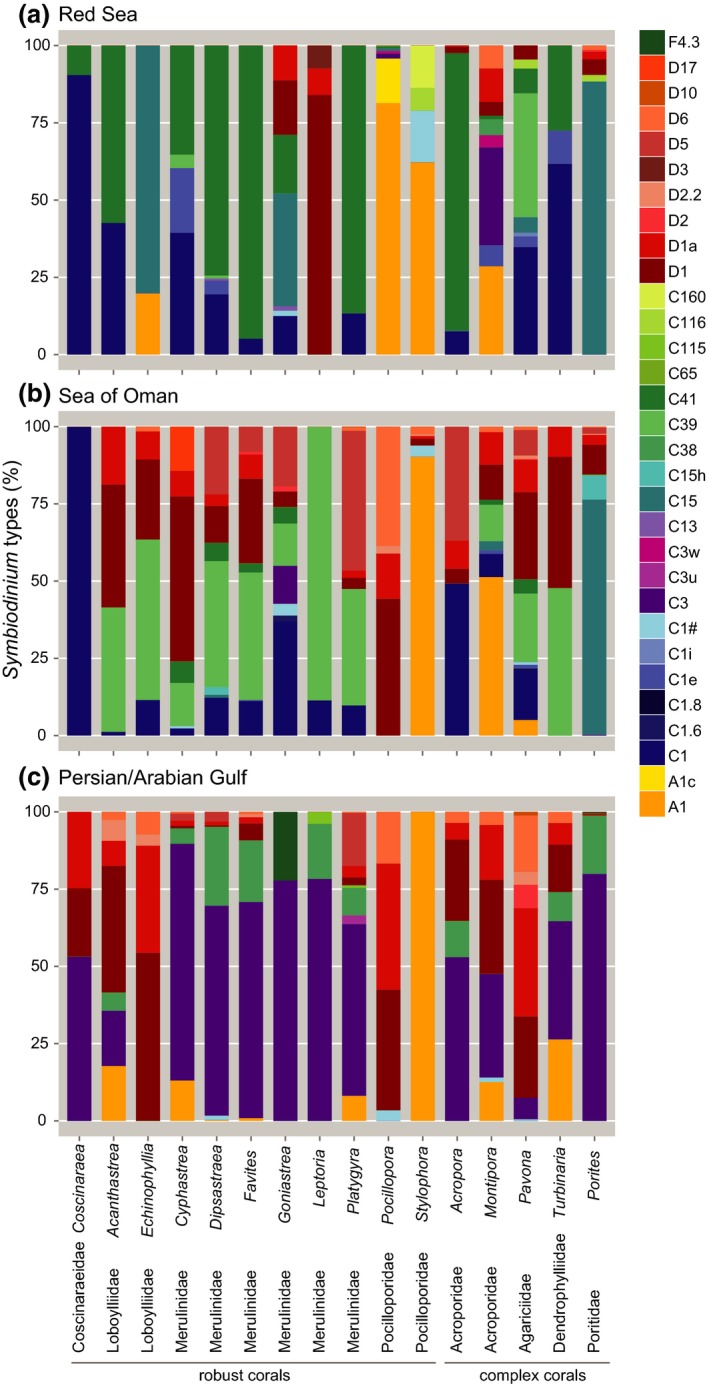
Symbiodinium ITS2 type‐based diversity associated with coral genera from the Arabian Peninsula. (a) the Red Sea, (b) the Sea of Oman, and (c) the Persian/Arabian Gulf. Only those sequences were included that represented ≥ 5% in abundance in at least one sample. Only coral host genera are displayed for which samples were available from all three regions. [Colour figure can be viewed at wileyonlinelibrary.com]
Figure 5
Figure 5
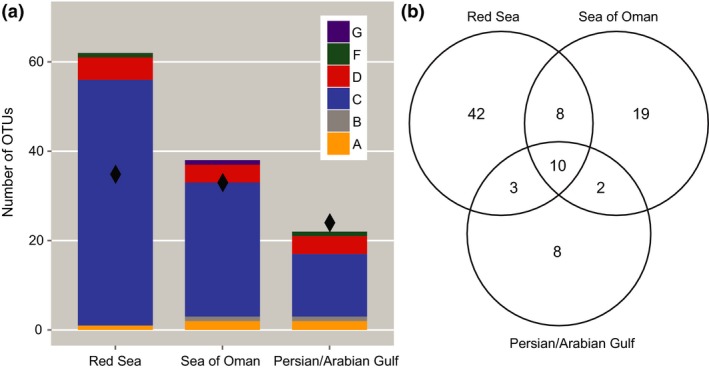
Symbiodinium OTU diversity in coral hosts around the Arabian Peninsula. (a) Stackplot illustrating OTU‐based clade diversity/composition over the total number of coral genera samples in each region (black diamonds) (b) Venn diagram showing number of Symbiodinium OTUs found in the Red Sea, the Sea of Oman, and the Persian/Arabian Gulf as well as number of OTUs that are shared between them. [Colour figure can be viewed at wileyonlinelibrary.com]
Figure 6
Figure 6
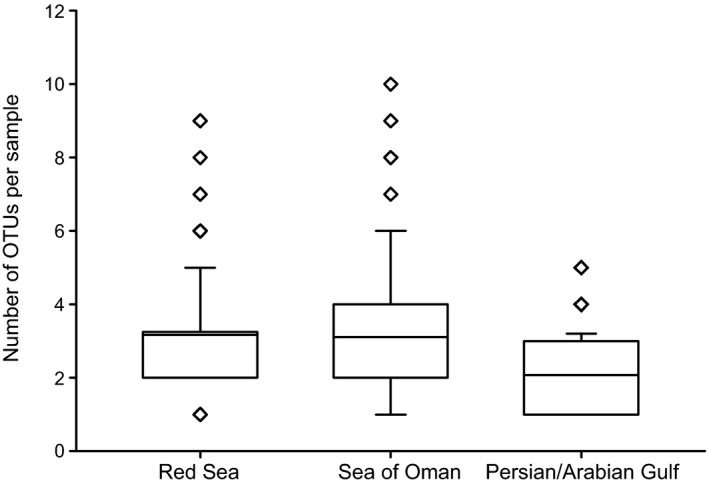
Box plot displaying the average number of OTUs per specimen collected from seven coral genera (Acropora, Dipsastraea, Montipora, Pavona, Pocillopora, Porites, Stylophora) in the Red Sea (n = 166), the Sea of Oman (= 140), and the Persian/Arabian Gulf (n = 87). Center lines show the means; box limits indicate the 25th and 75th percentiles; whiskers extend to 5th and 95th percentiles, outliers are represented by diamonds.

References

    1. Arif, C. , Daniels, C. , Bayer, T. , Banguera‐Hinestroza, E. , Barbrook, A. , Howe, C.J. , LaJeunesse, T.C. & Voolstra, C.R. (2014) Assessing Symbiodinium diversity in scleractinian corals via next‐generation sequencing‐based genotyping of the ITS2 rDNA region. Molecular Ecology, 23, 4418–4433. - PMC - PubMed
    1. Baillie, B.K. , Belda‐Baillie, C.A. & Maruyama, T. (2000) Conspecificity and Indo‐Pacific distribution of Symbiodinium genotypes (Dinophyceae) from giant clams. Journal of Phycology, 36, 1153–1161.
    1. Baker, A.C. , Starger, C.J. , McClanahan, T.R. & Glynn, P.W. (2004) Corals’ adaptive response to climate change. Nature, 430, p. 741. - PubMed
    1. Baker, D.M. , Andras, J.P. , Jordan‐Garza, A.G. & Fogel, M.L. (2013) Nitrate competition in a coral symbiosis varies with temperature among Symbiodinium clades. The ISME Journal, 7, 1248–1251. - PMC - PubMed
    1. Bauman, A.G. , Feary, D.A. , Heron, S.F. , Pratchett, M.S. & Burt, J.A. (2013) Multiple environmental factors influence the spatial distribution and structure of reef communities in the northeastern Arabian Peninsula. Marine Pollution Bulletin, 72, 302–312. - PubMed

LinkOut - more resources