


Regulation of inflammation and tumorigenesis by the TIPE family of phospholipid transfer proteins
- PMID: 28287114
- PMCID: PMC5518821
- DOI: 10.1038/cmi.2017.4
Regulation of inflammation and tumorigenesis by the TIPE family of phospholipid transfer proteins
Erratum in
-
Regulation of inflammation and tumorigenesis by the TIPE family of phospholipid transfer proteins.Cell Mol Immunol. 2017 Dec;14(12):1026. doi: 10.1038/cmi.2017.127. Epub 2017 Nov 27. Cell Mol Immunol. 2017. PMID: 29176741 Free PMC article.
Abstract
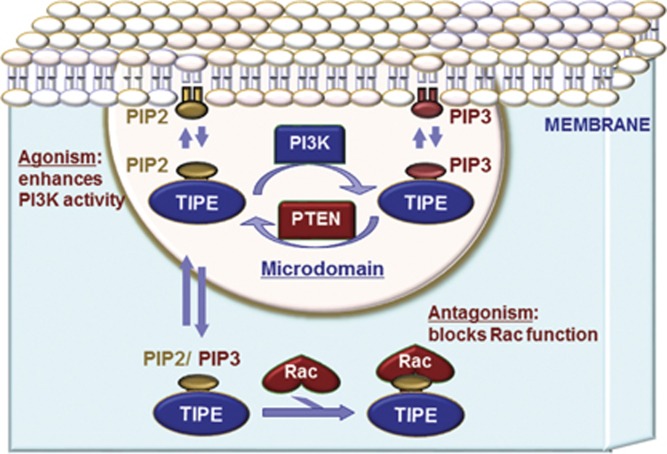
The TIPE (tumor necrosis factor-α-induced protein 8-like) family are newly described regulators of immunity and tumorigenesis consisting of four highly homologous mammalian proteins: TNFAIP8 (tumor necrosis factor-α-induced protein 8), TIPE1 (TNFAIP8-like 1, or TNFAIP8L1), TIPE2 (TNFAIP8L2) and TIPE3 (TNFAIP8L3). They are the only known transfer proteins of the lipid secondary messengers PIP2 (phosphatidylinositol 4,5-bisphosphate) and PIP3 (phosphatidylinositol 3,4,5-trisphosphate). Cell-surface receptors, such as G-protein-coupled receptors and receptor tyrosine kinases, regulate inflammation and cancer via several signaling pathways, including the nuclear factor (NF)-κB and phosphoinositide-3 kinase (PI3K) pathways, the latter of which is upstream of both Akt and STAT3 activation. An expression analysis in humans demonstrated that the TIPE family is dysregulated in cancer and inflammation, and studies both in mice and in vitro have demonstrated that this family of proteins plays a critical role in tumorigenesis and inflammatory responses. In this review, we summarize the current literature for all four family members, with a special focus on the phenotypic manifestations present in the various knockout murine strains, as well as the related cell signaling that has been elucidated to date.
Conflict of interest statement
The authors declare no conflict of interest.
Figures
References
-
- Balkwill F, Mantovani A. Cancer and inflammation: implications for pharmacology and therapeutics. Clin Pharmacol Therapeut 2010; 87: 401–406. - PubMed
-
- Ben-Neriah Y, Karin M. Inflammation meets cancer, with NF-[kappa]B as the matchmaker. Nat Immunol 2011; 12: 715–723. - PubMed
-
- DiDonato JA, Mercurio F, Karin M. NF-κB and the link between inflammation and cancer. Immunol Rev 2012; 246: 379–400. - PubMed
Publication types
MeSH terms
Substances
Grants and funding
LinkOut - more resources
Full Text Sources
Other Literature Sources
Miscellaneous
