


Overweight and obesity in Mexican children and adolescents during the last 25 years
- PMID: 28287630
- PMCID: PMC5380891
- DOI: 10.1038/nutd.2016.52
Overweight and obesity in Mexican children and adolescents during the last 25 years
Erratum in
-
Overweight and obesity in Mexican children and adolescents during the last 25 years.Nutr Diabetes. 2017 Jun 5;7(6):e280. doi: 10.1038/nutd.2017.29. Nutr Diabetes. 2017. PMID: 28581504 Free PMC article.
Abstract
Background/objective: The objective of the study was to provide current estimates of the prevalence and trends of overweight and obesity (OW+OB) in Mexican children and adolescents.
Subjects/methods: Body mass index objectively measured was analyzed for 37 147 children and adolescents aged 0-19 years obtained in 2012 as part of the National Health and Nutrition Survey (ENSANUT-2012), a nationally representative sample of the Mexican population. In addition, data from previous National Nutrition Surveys obtained in 1988, 1999 and 2006 were compared with analyze trends over a 24-year period (1988-2012) for children <5 years of age and adolescents and over a 13-year period (1999-2012) for school-age children. World Health Organization Child Growth Standard was used to define OW+OB.
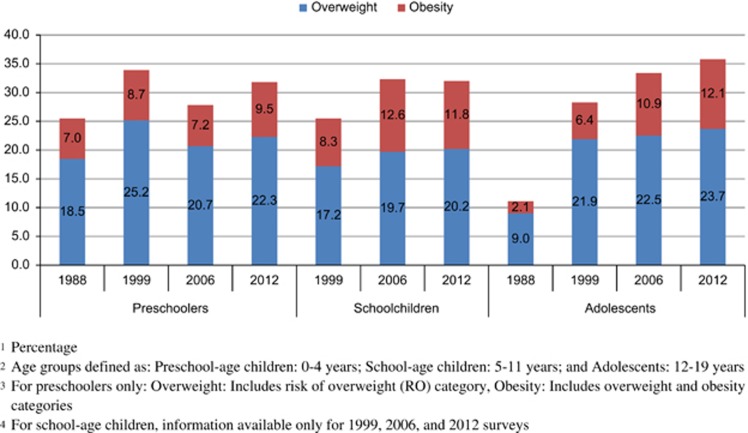
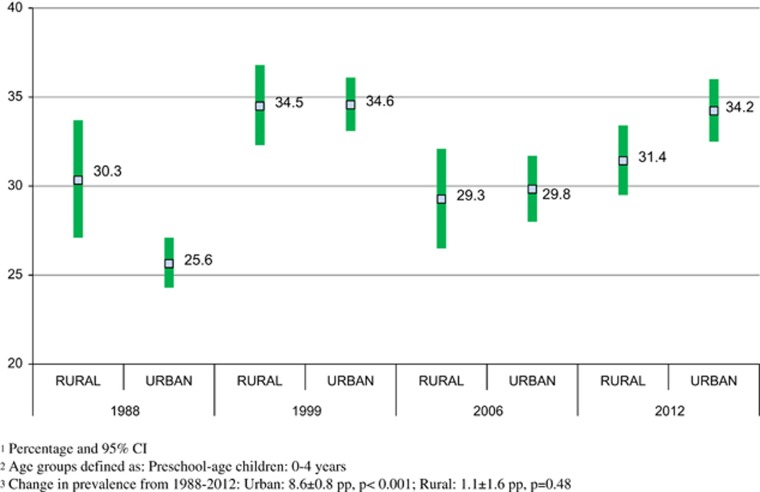
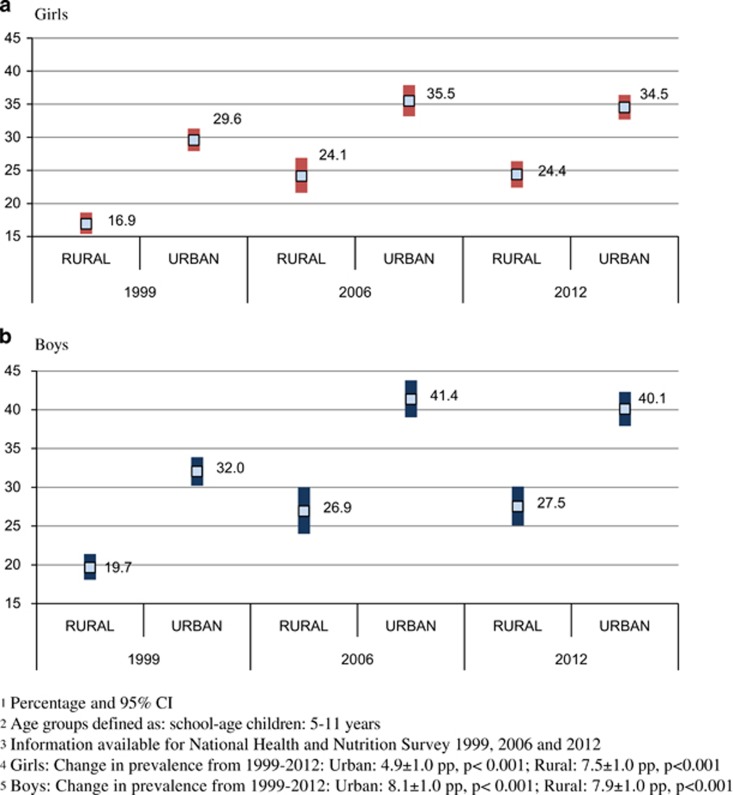
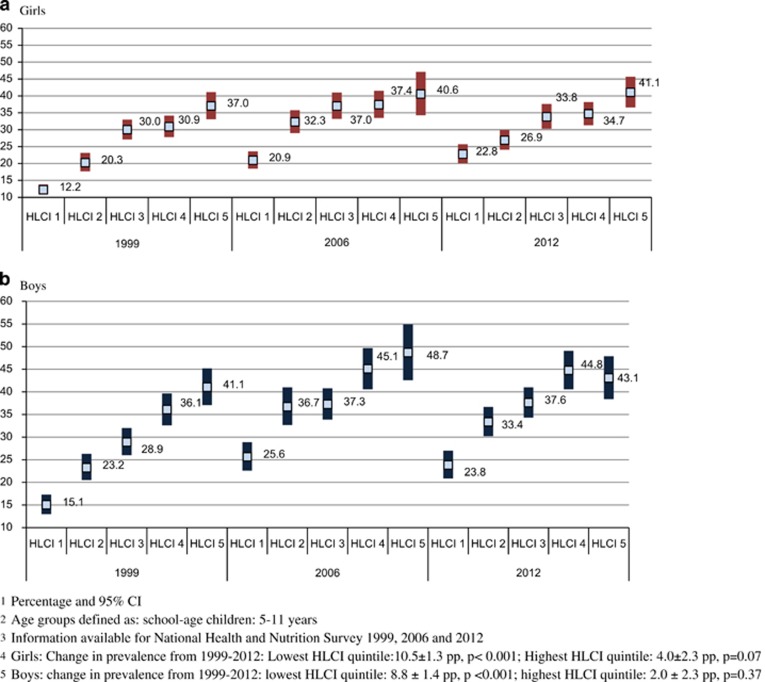
Results: In 2012, 33.5% of children <5 years of age (both sexes) were at risk of overweight or were overweight (OW); 32% and 36.9% of girls and boys 5-11 years of age were OW+OB, respectively, and 35.8% and 34.1% of female and male adolescents were OW+OB, respectively. Statistically significant trends were documented for all age groups during the study period. Overall change in the combined prevalence in preschool children was 6.3±1.0 percentage points (pp; P<0.001; 0.26 pp per year) in the last 24 years, showing the highest increase between 1988 and 1999, whereas for school-age girls (from 1999 to 2012) and adolescent females (from 1988 to 2012), OW+OB increased across all periods at a declining trend, with an overall change of 0.5 and 1.0 pp per year, respectively. Changes in the prevalence of OW+OB were highest among children and adolescents in the lowest quintile of the household living condition index.
Conclusions: Prevalence of OW+OB among children and adolescents increased significantly during the last 13-24 years. The rate of increase has declined in the last 6 years in all age groups. Changes in prevalence of OW+OB presented here suggest that, in Mexico, the burden of obesity is shifting toward the groups with lower socioeconomic level.
Conflict of interest statement
The authors declare no conflict of interest.
Figures
References
-
- Organizacion Mundial de la Salud. Sobrepeso y obesidad infantiles. Organizacion Mundial de la Salud, 2013. Available at http://www.who.int/dietphysicalactivity/childhood/es (accessed on December 2015).
-
- Dietz W. Health consequences of obesity in youth: childhood predictors of adult disease. Pediatrics 1998; 101: 518–525. - PubMed
-
- World Health OrganizationJoint WHO/FAO Expert Consultation on Diet, Nutrition and the Prevention of Chronic Disease 2002. WHO Technical Report Series 916: Geneva, 2003. - PubMed
-
- Chizuru N, Uauy R, Kumanyika S, Shetty P. The Joint WHO/FAO Expert Consultation on diet, nutrition and the prevention of chronic diseases: process, product and policy implications. Public Health Nutr 2004; 7: 245–250. - PubMed
-
- Lobstein T, Baur L, Uauy R. Obesity in children and young people: a crisis in public health. Obes Rev 2004; 5: 4–85. - PubMed
MeSH terms
LinkOut - more resources
Full Text Sources
Other Literature Sources
Medical
Molecular Biology Databases
Miscellaneous
