


Time required to initiate outbreak and pandemic observational research
- PMID: 28288355
- PMCID: PMC7126421
- DOI: 10.1016/j.jcrc.2017.02.009
Time required to initiate outbreak and pandemic observational research
Abstract
Purpose: Observational research focused upon emerging infectious diseases such as Ebola virus, Middle East respiratory syndrome, and Zika virus has been challenging to quickly initiate. We aimed to determine the duration of start-up procedures and barriers encountered for an observational study focused upon such infectious outbreaks.
Materials and methods: At 1 pediatric and 5 adult intensive care units, we measured durations from protocol receipt to a variety of outbreak research milestones, including research ethics board (REB) approval, data sharing agreement (DSA) execution, and patient study screening initiation.
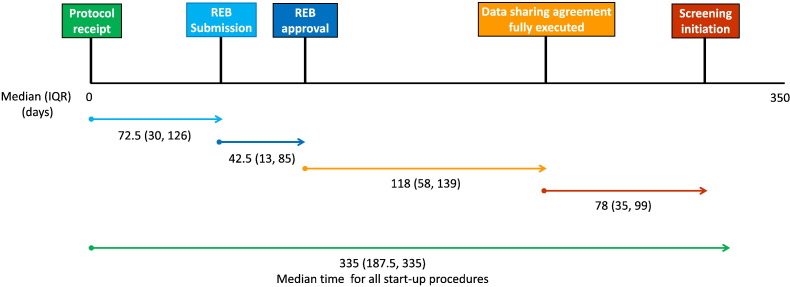
Results: The median (interquartile range) time from site receipt of the protocol to REB submission was 73 (30-126) days; to REB approval, 158 (42-188) days; to DSA completion, 276 (186-312) days; and to study screening initiation, 293 (269-391) days. The median time from REB submission to REB approval was 43 (13-85) days. The median time for all start-up procedures was 335 (188-335) days.
Conclusions: There is a lengthy start-up period required for outbreak-focused research. Completing DSAs was the most time-consuming step. A reactive approach to newly emerging threats such as Ebola virus, Middle East respiratory syndrome, and Zika virus will likely not allow sufficient time to initiate research before most outbreaks are advanced.
Keywords: Canada; Critical; Intensive care; Outbreak; Pandemic; Research.
Copyright © 2017 The Authors. Published by Elsevier Inc. All rights reserved.
Figures
Comment in
-
Global research preparedness for outbreak-related critical illness.J Crit Care. 2017 Aug;40:272. doi: 10.1016/j.jcrc.2017.03.024. Epub 2017 Apr 1. J Crit Care. 2017. PMID: 28390754 Free PMC article. No abstract available.
-
Comment on Rishu et al. Time required to initiate outbreak and pandemic observational research.J Crit Care. 2017 Aug;40:271. doi: 10.1016/j.jcrc.2017.03.019. Epub 2017 Mar 27. J Crit Care. 2017. PMID: 28438372 No abstract available.
References
-
- Eastman N., Philips B., Rhodes A. Triaging for adult critical care in the event of overwhelming need. Intensive Care Med. 2010;36(6):1076–1082. - PubMed
-
- Fowler R.A., Lapinsky S.E., Hallett D., Detsky A.S., Sibbald W.J., Slutsky A.S. Critically ill patients with severe acute respiratory syndrome. JAMA. 2003;290(3):367–373. - PubMed
Publication types
MeSH terms
LinkOut - more resources
Full Text Sources
Other Literature Sources
