


Genetic diversity of a New Zealand multi-breed sheep population and composite breeds' history revealed by a high-density SNP chip
- PMID: 28288558
- PMCID: PMC5348757
- DOI: 10.1186/s12863-017-0492-8
Genetic diversity of a New Zealand multi-breed sheep population and composite breeds' history revealed by a high-density SNP chip
Abstract
Background: Knowledge about the genetic diversity of a population is a crucial parameter for the implementation of successful genomic selection and conservation of genetic resources. The aim of this research was to establish the scientific basis for the implementation of genomic selection in a composite Terminal sheep breeding scheme by providing consolidated linkage disequilibrium (LD) measures across SNP markers, estimating consistency of gametic phase between breed-groups, and assessing genetic diversity measures, such as effective population size (Ne), and population structure parameters, using a large number of animals (n = 14,845) genotyped with a high density SNP chip (606,006 markers). Information generated in this research will be useful for optimizing molecular breeding values predictions and managing the available genetic resources.
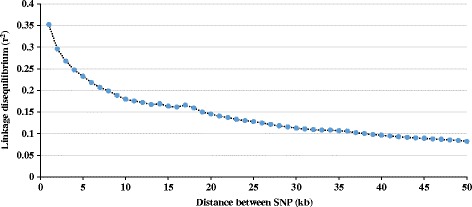
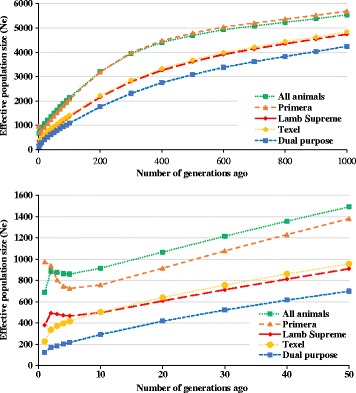
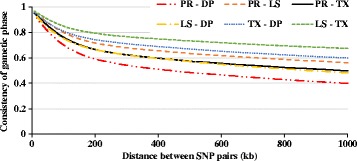
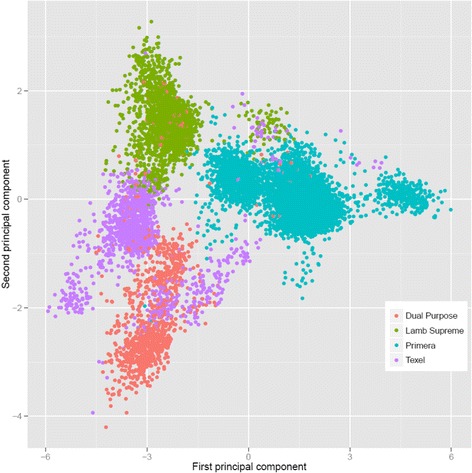
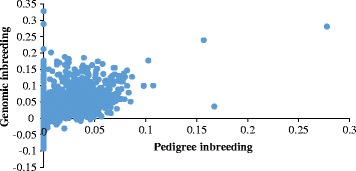
Results: Overall, as expected, levels of pairwise LD decreased with increasing distance between SNP pairs. The mean LD r2 between adjacent SNP was 0.26 ± 0.10. The most recent effective population size for all animals (687) and separately per breed-groups: Primera (974), Lamb Supreme (380), Texel (227) and Dual-Purpose (125) was quite variable. The genotyped animals were outbred or had an average low level of inbreeding. Consistency of gametic phase was higher than 0.94 for all breed pairs at the average distance between SNP on the chip (~4.74 kb). Moreover, there was not a clear separation between the breed-groups based on principal component analysis, suggesting that a mixed-breed training population for calculation of molecular breeding values would be beneficial.
Conclusions: This study reports, for the first time, estimates of linkage disequilibrium, genetic diversity and population structure parameters from a genome-wide perspective in New Zealand Terminal Sire composite sheep breeds. The levels of linkage disequilibrium indicate that genomic selection could be implemented with the high density SNP panel. The moderate to high consistency of gametic phase between breed-groups and overlapping population structure support the pooling of the animals in a mixed training population for genomic predictions. In addition, the moderate to high Ne highlights the need to genotype and phenotype a large training population in order to capture most of the haplotype diversity and increase accuracies of genomic predictions. The results reported herein are a first step toward understanding the genomic architecture of a Terminal Sire composite sheep population and for the optimal implementation of genomic selection and genome-wide association studies in this sheep population.
Keywords: Consistency of gametic phase; Crossbreeding; Effective population size; Linkage disequilibrium; Population structure; Sheep.
Figures
References
-
- Blair H. Ram breeding in New Zealand two decades after the introduction of exotic sheep breeds. In: Proceedings of the Association for the Advancement of Animal Breeding and Genetics, Perth, Australia. 2011;407–410.
-
- Beef and Lamb New Zealand. 2016. Compendium of New Zealand Farm Facts 2016. http://www.beeflambnz.com/Documents/Information/Compendium%20of%20New%20.... Accessed 19 May 2016.
-
- FarmIQ. Release of a high-density SNP genotyping chip for the sheep genome http://www.farmiq.co.nz/whatsnew/news/release-high-density-snp-genotypin.... Accessed in 15 May 2015.
Publication types
MeSH terms
Substances
LinkOut - more resources
Full Text Sources
Other Literature Sources
Research Materials
