


Interleukin 6 Inhibition and Coronary Artery Disease in a High-Risk Population: A Prospective Community-Based Clinical Study
- PMID: 28288972
- PMCID: PMC5524026
- DOI: 10.1161/JAHA.116.005038
Interleukin 6 Inhibition and Coronary Artery Disease in a High-Risk Population: A Prospective Community-Based Clinical Study
Abstract
Background: Atherosclerosis is a chronic inflammatory disease, with interleukin 6 (IL-6) as a major player in inflammation cascade. IL-6 blockade may reduce cardiovascular risk, but current treatments to block IL-6 also induce dyslipidemia, a finding with an uncertain prognosis.
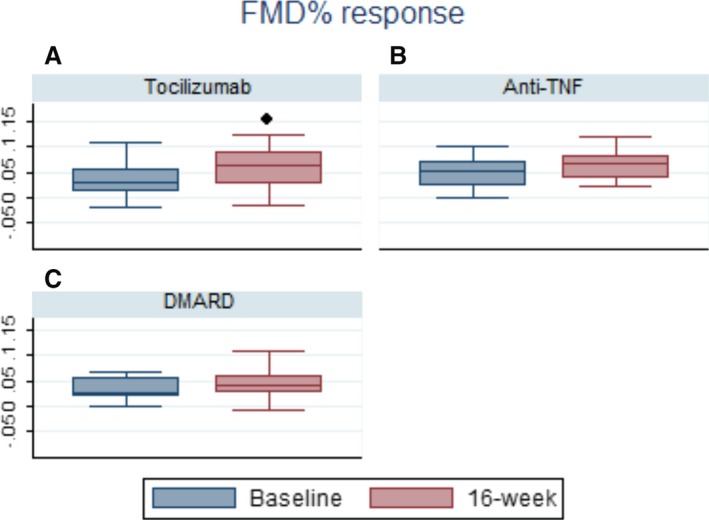
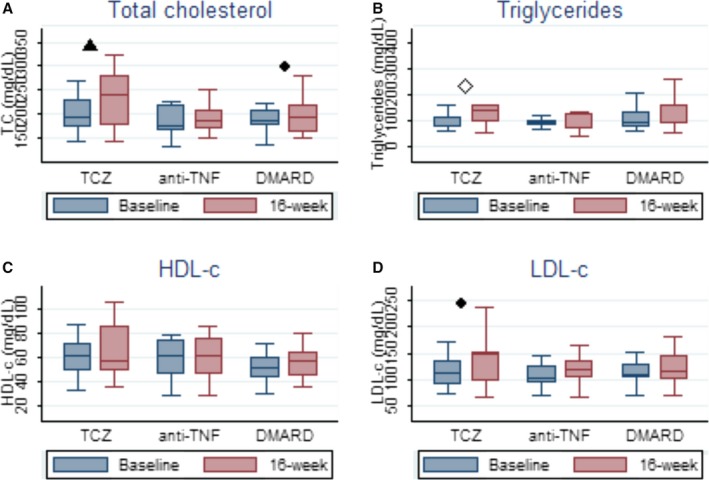
Methods and results: We aimed to determine the endothelial function responses to the IL-6-blocking agent tocilizumab, anti-tumor necrosis factor α, and synthetic disease-modifying antirheumatic drug therapies in patients with rheumatoid arthritis in a 16-week prospective study. Sixty consecutive patients with rheumatoid arthritis were enrolled. Tocilizumab and anti-tumor necrosis factor α therapy were started in 18 patients each while 24 patients were treated with synthetic disease-modifying antirheumatic drugs. Forty patients completed the 16-week follow-up period. The main outcome was flow-mediated dilation percentage variation before and after therapy. In the tocilizumab group, flow-mediated dilation percentage variation increased statistically significantly from a pre-treatment mean of (3.43% [95% CI, 1.28-5.58] to 5.96% [95% CI, 3.95-7.97]; P=0.03). Corresponding changes were 4.78% (95% CI, 2.13-7.42) to 6.75% (95% CI, 4.10-9.39) (P=0.09) and 2.87% (95% CI, -2.17 to 7.91) to 4.84% (95% CI, 2.61-7.07) (P=0.21) in the anti-tumor necrosis factor α and the synthetic disease-modifying antirheumatic drug groups, respectively (both not statistically significant). Total cholesterol increased significantly in the tocilizumab group from 197.5 (95% CI, 177.59-217.36) to 232.3 (201.62-263.09) (P=0.003) and in the synthetic disease-modifying antirheumatic drug group from 185.8 (95% CI, 169.76-201.81) to 202.8 (95% CI, 176.81-228.76) (P=0.04), but not in the anti-tumor necrosis factor α group. High-density lipoprotein did not change significantly in any group.
Conclusions: Endothelial function is improved by tocilizumab in a high-risk population, even as it increases total cholesterol and low-density lipoprotein levels.
Keywords: dyslipidemia; endothelial function; inflammation; tocilizumab.
© 2017 The Authors. Published on behalf of the American Heart Association, Inc., by Wiley Blackwell.
Figures
References
-
- Ross R. Atherosclerosis—an inflammatory disease. N Engl J Med. 1999;340:115–126. - PubMed
-
- Sattar N, McCarey DW, Capell H, McInnes IB. Explaining how “high‐grade” systemic inflammation accelerates vascular risk in rheumatoid arthritis. Circulation. 2003;108:2957–2963. - PubMed
-
- McInnes IB, Thompson L, Giles JT, Bathon JM, Salmon JE, Beaulieu AD, Codding CE, Carlson TH, Delles C, Lee JS, Sattar N. Effect of interleukin‐6 receptor blockade on surrogates of vascular risk in rheumatoid arthritis: MEASURE, a randomised, placebo‐controlled study. Ann Rheum Dis. 2013;1–9. - PMC - PubMed
-
- Ridker PM, Danielson E, Fonseca FAH, Genest J, Gotto AM, Kastelein JJP, Koenig W, Libby P, Lorenzatti AJ, MacFadyen JG, Nordestgaard BG, Shepherd J, Willerson JT, Glynn RJ; JUPITER Study Group. Rosuvastatin to prevent vascular events in men and women with elevated C‐reactive protein. N Engl J Med. 2008;359:2195–2207. - PubMed
Publication types
MeSH terms
Substances
LinkOut - more resources
Full Text Sources
Other Literature Sources
Medical
