The PCORI Engagement Rubric: Promising Practices for Partnering in Research
- PMID: 28289118
- PMCID: PMC5348236
- DOI: 10.1370/afm.2042
The PCORI Engagement Rubric: Promising Practices for Partnering in Research
Abstract
Purpose: Engaging patients, caregivers, and other health care stakeholders as partners in planning, conducting, and disseminating research is a promising way to improve clinical decision making and outcomes. Many researchers, patients, and other stakeholders, however, lack clarity about when and how to engage as partners within the clinical research process. To address the need for guidance on creating meaningful stakeholder partnerships in patient-centered clinical comparative effectiveness research, the Patient-Centered Outcomes Research Institute (PCORI) developed the PCORI Engagement Rubric (Rubric).
Methods: PCORI developed the Rubric drawing from a synthesis of the literature, a qualitative study with patients, a targeted review of engagement plans from PCORI-funded project applications, and a moderated discussion and review with PCORI's Advisory Panel on Patient Engagement.
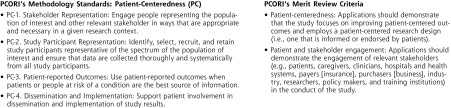
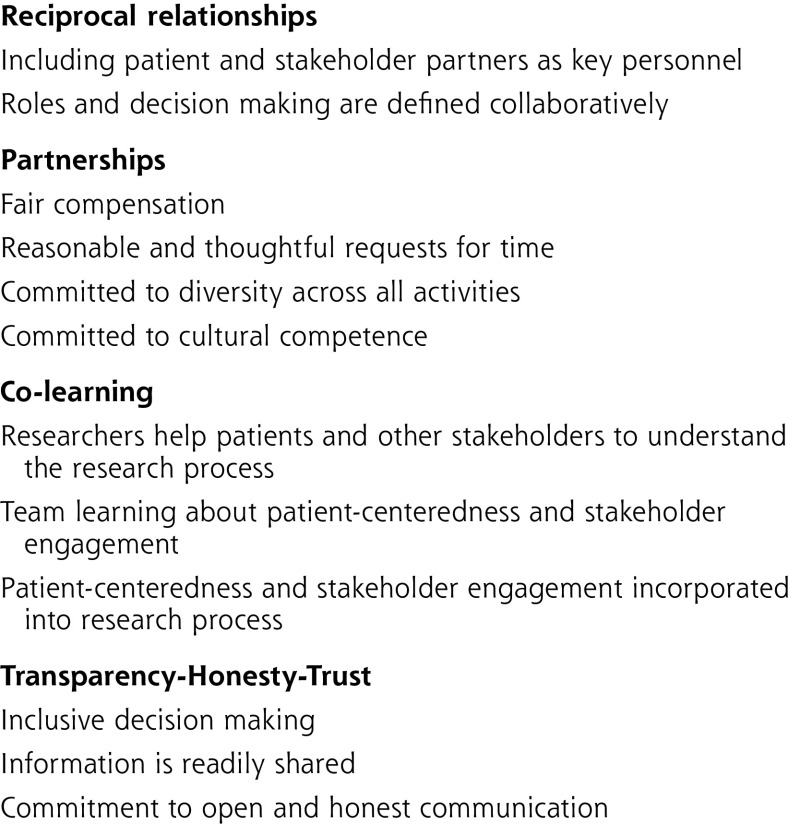
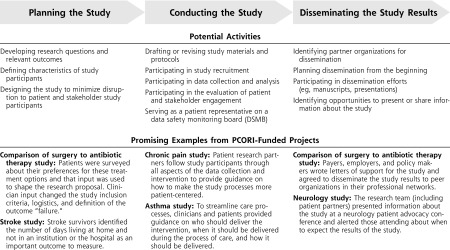
Results: The Rubric provides a framework for operationalizing engagement to incorporate patients and other stakeholders in all phases of research. It includes: principles of engagement; definitions of stakeholder types; key considerations for planning, conducting, and disseminating engaged research; potential engagement activities; and examples of promising practices from PCORI-funded projects.
Conclusions: PCORI designed the Rubric to illustrate opportunities for engagement to researchers interested in applying for PCORI funding and to patients and other stakeholders interested in greater involvement in research. By encouraging PCORI applicants, awardees, and others to apply the rubric, PCORI hopes to shift the research paradigm from one of conducting research on patients as subjects to a pursuit carried out in collaboration with patients and other stakeholders to better reflect the values, preferences, and outcomes that matter to the patient community.
Keywords: patient engagement; patient outcomes; patient-centered.
© 2017 Annals of Family Medicine, Inc.
Figures
References
-
- Domecq JP, Prutsky G, Elraiyah T, et al. Patient engagement in research: A systematic review. BMC Health Serv Res. [Online] 2014;14:89 http://bmchealthservres.biomedcentral.com/articles/10.1186/1472-6963-14-89 Accessed Feb 21, 2017. - DOI - PMC - PubMed
-
- Esmail L, Moore E, Rein A. Evaluating patient and stakeholder engagement in research: moving from theory to practice. J Comp Eff Res. 2015;4(2):133–145. - PubMed
-
- Compilation of Patient Protection and Affordable Care Act: Extracted sections concerning patient-centered outcomes research and the authorization of the Patient-Centered Outcomes Research Institute (PCORI). Amended May 1, 2010. Subtitle D of Title VI-Sec.,6301. Enacted March 23, 2010. http://www.pcori.org/sites/default/files/PCORI_Authorizing_Legislation.pdf Accessed Nov 1, 2016.
-
- Vetter J. Introduction: lay participation in the history of scientific observation. Sci Context. 2011;24(2):127–141. - PubMed
MeSH terms
LinkOut - more resources
Full Text Sources
Other Literature Sources