


Fast and specific detection of Pseudomonas Aeruginosa from other pseudomonas species by PCR
- PMID: 28289359
- PMCID: PMC5347312
Fast and specific detection of Pseudomonas Aeruginosa from other pseudomonas species by PCR
Abstract
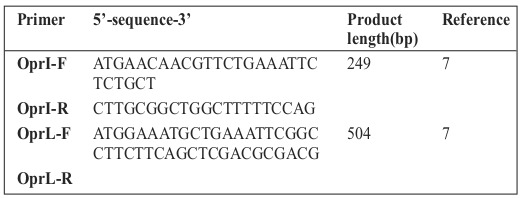
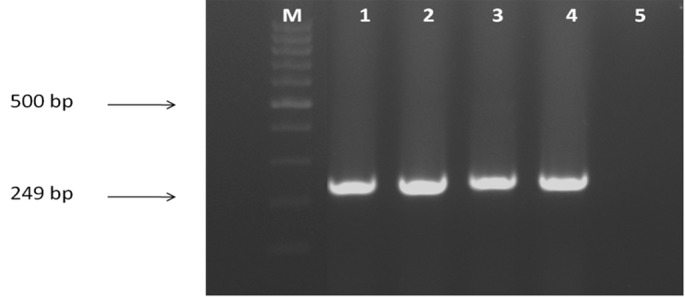
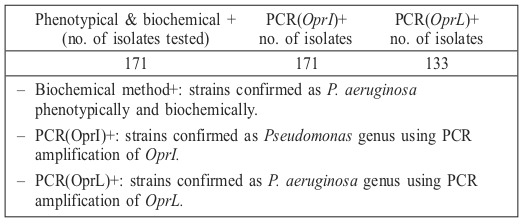
Pseudomonas aeruginosa is an important life-threatening nosocomial pathogen that plays a prominent role in wound infections of burned patients. We designed this study to identify the isolates of P. aeruginosa recovered from burned patients at the genus and species level through primers targeting oprI and oprL genes, and analyzed their antimicrobial resistance pattern. Over a 2-month period, wound samples were taken from burned patients and plated on MacConkey agar. All suspected colonies were primarily screened for P. aeruginosa by a combination of phenotypic tests. Molecular identifications of colonies were done using specific primers for oprI and oprL genes. Bacterial isolates were recovered from burn wound infections. Based on phenotypical identification tests, 138 (34%) P. aeruginosa isolates were identified; whereas by molecular techniques, just 128 P. aeruginosa yielded amplicon of oprL gene using species-specific primers, verifying the identity of P. aeruginosa; the others yielded amplicon of oprI gene using genus-specific primers, confirming the identity of fluorescent pseudomonads. This study indicates that molecular detection of P. aeruginosa in burn patients employing the OprL gene target is a useful technique for the early and precise detection of P. aeruginosa. PCR detection should be carried out as well as phenotypic testing for the best aggressive antibiotic treatment of P. aeruginosa strains at an earlier stage. It also has significant benefits on clinical outcomes.
Pseudomonas æruginosa (PA) est une bactérie nosocomiale potentiellement mortelle jouant un rôle majeur dans l’infection cutanée des brûlés. Nous avons étudié les PA (genre, espèce) isolés de patients brûlés, avec une PCR utilisant les gènes d’amorçage oprI et oprL, et avons analysé leurs profils de résistance. Des échantillons cutanés ont été prélevés chez des patients brûlés pendant une durée de 2 mois, et ensemencés sur gélose Mc Conkey. L’identification de PA a été faite selon les critères phénotypiques usuels. L’étude moléculaire a été réalisée par PCR utilisant les gènes d’amorçage oprI et oprL. Les identifications phénotypiques ont retrouvé 138 PA quand l’amplification d’oprI, spécifique de PA était positive 128 fois. Les 10 autres souches étaient des Pseudomonas fluorescents, caractérisés par l’amplification d’oprL. Cette étude montre que l’identification rapide de PA sur des échantillons de patients brûlés peut se faire par amplification du gène oprL et pourrait être utilisée concomitamment à la recherche des gènes codant les résistances bactériennes pour une adaptation plus rapide de l’antibiothérapie. On observe une amélioration du pronostic.
Keywords: OprI; OprL; Pseudomonas aeruginosa; burned patients.
Figures
References
-
- Lyczak JB, Cannon CL, Pier GB. Establishment of Pseudomonas aeruginosa infection: lessons from a versatile opportunist. Microbes and Infection. 2000;2:1051–1060. - PubMed
-
- Kodaka H, Iwata M, Yumoto S, Kashitani F. Evaluation of a new agar medium containing cetrimide, kanamycin and nalidixic acid for isolation and enhancement of pigment production of Pseudomonas aeruginosa in clinical samples. J Basic Microbiol. 2003;43:407–413. - PubMed
-
- Wellinghausen N, Kothe JK, Wirths B, Sigge A, Poppert S. Superiority of molecular techniques for identification of Gram negative, oxidasepositive rods, including morphologically non typical Pseudomonas aeruginosa, from patients with cystic fibrosis. J Clin Microbiol. 2005;43:4070–4075. - PMC - PubMed
LinkOut - more resources
Full Text Sources
Other Literature Sources