


PCSK9 inhibitors: A new era of lipid lowering therapy
- PMID: 28289523
- PMCID: PMC5329749
- DOI: 10.4330/wjc.v9.i2.76
PCSK9 inhibitors: A new era of lipid lowering therapy
Abstract
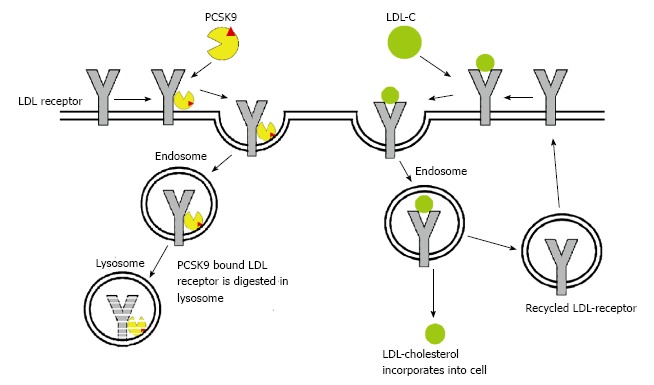
Hyperlipidemia is a well-established risk factor for developing cardiovascular disease (CVD). The recent American College of Cardiology and American Heart Association guidelines on lipid management emphasize treatment of individuals at increased risk for developing CVD events with 3-hydroxy-3-methylglutaryl coenzyme A reductase inhibitors (statins) at doses proven to reduce CVD events. However, there are limited options for patients who are either intolerant to statin therapy, develop CVD despite being on maximally tolerated statin therapy, or have severe hypercholesterolemia. Recently the Food and Drug Administration approved two novel medications for low-density lipoprotein (LDL)-cholesterol reduction: Evolocumab and Alirocumab. These agents target and inactivate proprotein convertase subtilsin-kexin type 9 (PCSK9), a hepatic protease that attaches and internalizes LDL receptors into lysosomes hence promoting their destruction. By preventing LDL receptor destruction, LDL-C levels can be lowered 50%-60% above that achieved by statin therapy alone. This review explores PCSK-9 biology and the mechanisms available to alter it; clinical trials targeting PCSK9 activity, and the current state of clinically available inhibitors of PCSK9.
Keywords: Hyperlipidemia; Proprotein convertase subtilsin-kexin type 9; Statins.
Conflict of interest statement
Conflict-of-interest statement: All authors report no conflicts of interest.
Figures
References
-
- Stone NJ, Robinson JG, Lichtenstein AH, Bairey Merz CN, Blum CB, Eckel RH, Goldberg AC, Gordon D, Levy D, Lloyd-Jones DM, et al. 2013 ACC/AHA guideline on the treatment of blood cholesterol to reduce atherosclerotic cardiovascular risk in adults: a report of the American College of Cardiology/American Heart Association Task Force on Practice Guidelines. J Am Coll Cardiol. 2014;63:2889–2934. - PubMed
-
- Brugts JJ, Yetgin T, Hoeks SE, Gotto AM, Shepherd J, Westendorp RG, de Craen AJ, Knopp RH, Nakamura H, Ridker P, et al. The benefits of statins in people without established cardiovascular disease but with cardiovascular risk factors: meta-analysis of randomised controlled trials. BMJ. 2009;338:b2376. - PMC - PubMed
-
- Shelness GS, Sellers JA. Very-low-density lipoprotein assembly and secretion. Curr Opin Lipidol. 2001;12:151–157. - PubMed
-
- Goldstein JL, Brown MS, Anderson RG, Russell DW, Schneider WJ. Receptor-mediated endocytosis: concepts emerging from the LDL receptor system. Annu Rev Cell Biol. 1985;1:1–39. - PubMed
Publication types
LinkOut - more resources
Full Text Sources
Other Literature Sources
Miscellaneous
