Review
. 2017 Mar 9;2(5):e91327.
doi: 10.1172/jci.insight.91327.

Discerning functional hierarchies of microRNAs in pulmonary hypertension

Review

Discerning functional hierarchies of microRNAs in pulmonary hypertension

Vinny Negi et al. JCI Insight. .

Abstract

Pulmonary hypertension (PH) is a multifaceted vascular disease where development and severity are determined by both genetic and environmental factors. Over the past decade, there has been an acceleration of the discovery of molecular effectors that mediate PH pathogenesis, including large numbers of microRNA molecules that are expressed in pulmonary vascular cell types and exert system-wide regulatory functions in all aspects of vascular health and disease. Due to the inherent pleiotropy, overlap, and redundancy of these molecules, it has been challenging to define their integrated effects on overall disease manifestation. In this review, we summarize our current understanding of the roles of microRNAs in PH with an emphasis on potential methods to discern the hierarchical motifs governing their multifunctional and interconnected activities. Deciphering this higher order of regulatory structure will be crucial for overcoming the challenges of developing these molecules as biomarkers or therapeutic targets, in isolation or combination.


Conflict of interest statement

Conflict of interest: The authors have declared that no conflict of interest exists.

Figures
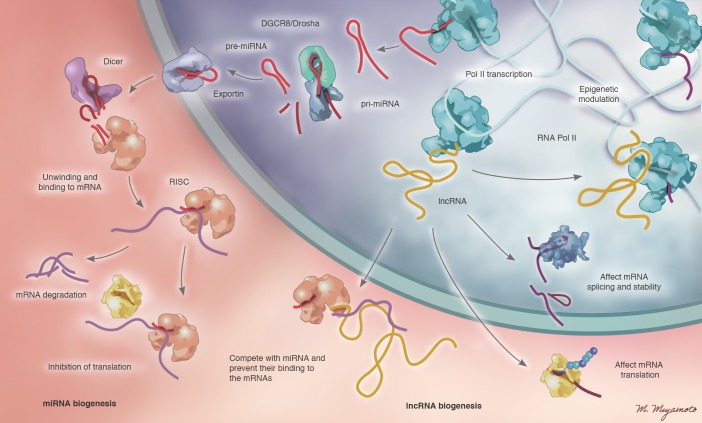
Figure 1
Figure 1. Biogenesis and functions of miRNAs and lncRNAs in PH.
(Left) miRNAs are transcribed from the genome in the form of long primary miRNAs (pri-miRNAs), which are then processed by the Drosha/DGCR8 enzyme complex into smaller precursor miRNAs (pre-miRNAs). These small pre-miRNAs are exported into the cytoplasm in an energy-dependent process. In the cytoplasm, pre-miRNAs are acted upon by Dicer to form mature miRNAs. Mature, active miRNAs interact with the RISC (RNA-induced silencing complex), leading to unwinding of duplex miRNAs and binding to the complementary sequence in the 3′ untranslated region. Binding of miRNAs to mRNAs can lead to inhibition of translation or mRNA degradation. (Right) Alternatively, after transcription, lncRNAs can interact with DNA or protein molecules directly, often affecting chromatin structure. lncRNAs have also been described to complex with RNAs, such as mRNAs, to influence posttranscriptional splicing and translation or miRNAs to influence target transcript engagement. Illustrated by Mao Miyamoto.
Figure 2
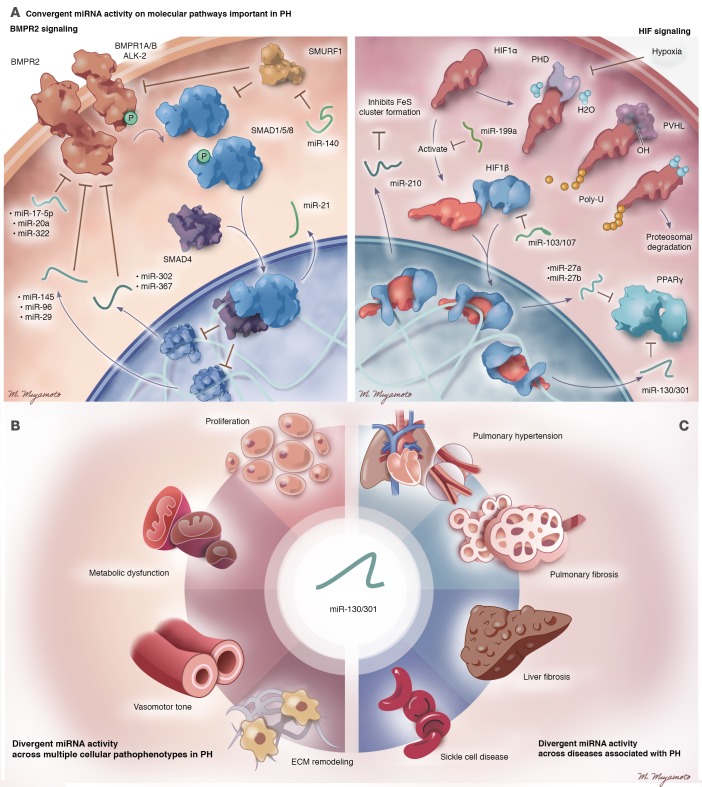
Figure 2. A conceptual schematic to categorize the activities of miRNAs in PH.
Currently identified miRNAs that control PH often congregate into higher-order regulatory motifs consistent with convergent or divergent activity across molecular pathways, cellular pathophenotypes, and associated diseases. Representative examples of each category are shown. Such conceptual and often overlapping annotations may be helpful as roadmaps in deciphering the hierarchies of function among sets of miRNAs, their downstream target pathways, and resultant pulmonary vascular phenotypes. (A) Convergent miRNA activity on single molecular pathways. Related cohorts of miRNAs exist with convergent activity on BMPR2 signaling (left panel) and HIF signaling (right panel). (B) Divergent miRNA activity across multiple cellular pathophenotypes. The miR-130/301 family acts as a system-level regulator of proliferation, vasomotor tone, vascular stiffness, and metabolism across three different pulmonary vascular cell types. (C) Divergent miRNA activity across associated disease. The miR-130/301 family controls manifestations of PH, pulmonary fibrosis, liver fibrosis, and sickle cell disease. Illustrated by Mao Miyamoto.
Figure 3
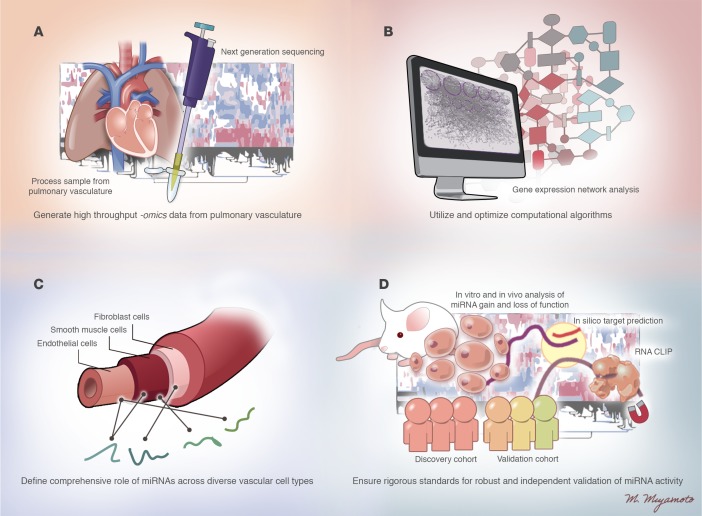
Figure 3. Technical and conceptual challenges for further interrogation of miRNA biology in PH.
Current technical and conceptual challenges are listed for addressing the complexity of miRNA activity in PH and ensuring successful development of miRNA-based diagnostics and therapeutics. (A) Generation of high throughput –omics data from the pulmonary vasculature, accounting for spatial (cell type specific) and temporal (time dependent) events in PH progression. (B) Utilization and optimization of computational algorithms for reliable in silico processing and analysis of forthcoming “big data.” (C) Definition of the comprehensive roles of miRNAs across diverse vascular cell types to explore further the RNA-dependent control of vascular crosstalk. (D) Establishment of rigorous standards for robust and independent validation of miRNA activity in PH. Illustrated by Mao Miyamoto.

References

    1. Chan SY, Loscalzo J. Pathogenic mechanisms of pulmonary arterial hypertension. J Mol Cell Cardiol. 2008;44(1):14–30. doi: 10.1016/j.yjmcc.2007.09.006. - DOI - PMC - PubMed
    1. Simonneau G, et al. Updated clinical classification of pulmonary hypertension. J Am Coll Cardiol. 2013;62(25 Suppl):D34–D41. - PubMed
    1. Perrin S, et al. New pharmacotherapy options for pulmonary arterial hypertension. Expert Opin Pharmacother. 2015;16(14):2113–2131. doi: 10.1517/14656566.2015.1074177. - DOI - PubMed
    1. Eddy SR. Non-coding RNA genes and the modern RNA world. Nat Rev Genet. 2001;2(12):919–929. doi: 10.1038/35103511. - DOI - PubMed
    1. Wang X, et al. Long noncoding RNA expression profiles of hypoxic pulmonary hypertension rat model. Gene. 2016;579(1):23–28. doi: 10.1016/j.gene.2015.12.044. - DOI - PubMed

Publication types