. 2017 Mar 14:8:14750.
doi: 10.1038/ncomms14750.

An immortalized adult human erythroid line facilitates sustainable and scalable generation of functional red cells

Affiliations

An immortalized adult human erythroid line facilitates sustainable and scalable generation of functional red cells

Kongtana Trakarnsanga et al. Nat Commun. .

Abstract

With increasing worldwide demand for safe blood, there is much interest in generating red blood cells in vitro as an alternative clinical product. However, available methods for in vitro generation of red cells from adult and cord blood progenitors do not yet provide a sustainable supply, and current systems using pluripotent stem cells as progenitors do not generate viable red cells. We have taken an alternative approach, immortalizing early adult erythroblasts generating a stable line, which provides a continuous supply of red cells. The immortalized cells differentiate efficiently into mature, functional reticulocytes that can be isolated by filtration. Extensive characterization has not revealed any differences between these reticulocytes and in vitro-cultured adult reticulocytes functionally or at the molecular level, and importantly no aberrant protein expression. We demonstrate a feasible approach to the manufacture of red cells for clinical use from in vitro culture.


Conflict of interest statement

The authors declare no competing financial interests.

Figures
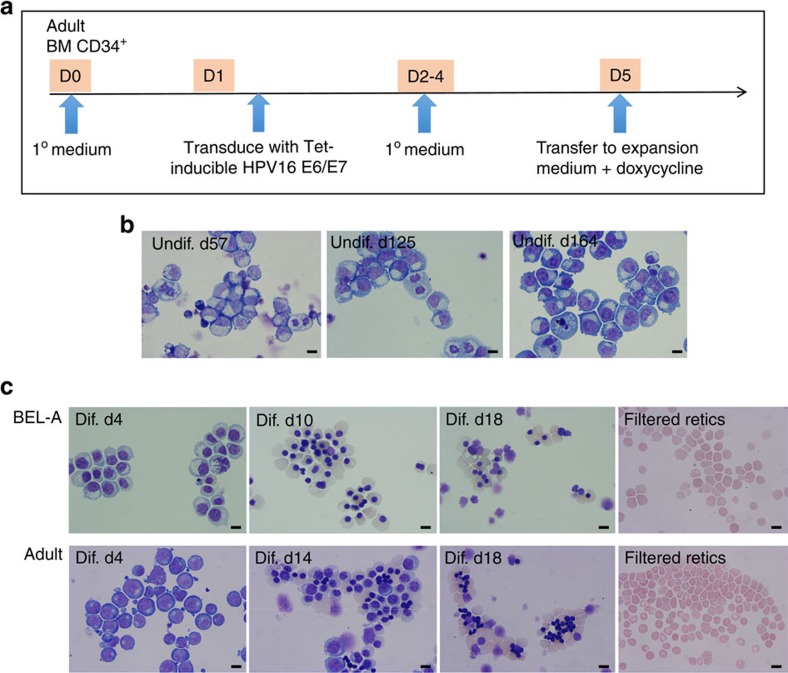
Figure 1
Figure 1. Generation of immortalized adult erythroid cell line.
Human adult bone marrow CD34+ cells were recovered from frozen primary erythroid culture medium for 24 h, before transduction with Tet-inducible HPV16 E6/E7 construct. Cells were transferred to StemSpan expansion medium with doxycycline on day 5 in culture and maintained in expansion medium thereafter. (a) Schematic of experimental approach. (b) Representative cytospins illustrating similar morphology of cells maintained proliferating in continuous culture on days 57, 125 and 164. (c) Representative cytospin images showing morphology of cells on days 4, 10 and 18 following transfer to erythroid differentiation medium and of reticulocytes isolated by filtration. Cytospins of erythroid cells differentiated from adult peripheral blood CD34+ at comparative stages of differentiation are included for comparison. Cells were stained with May–Grunwald Giemsa reagent and analysed by light microscopy. Scale bars 10 μm.
Figure 2
Figure 2. Characterization of BEL-A line.
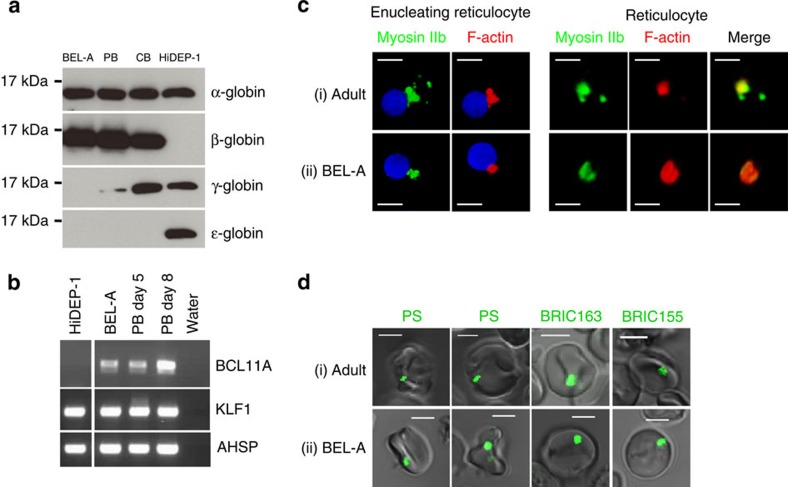
(a) Western blots of late stage BEL-A, HiDEP-1 and erythroid cells differentiated from adult PB and cord blood CD34+ cells (at days 18, 12, 19 and 18 in culture, respectively) incubated with antibodies to α-, β-, γ- and ɛ-globin. (b) Expression of BCL11A and KLF1 transcripts in expanding BEL-A and HiDEP-1 cells and erythroid cells differentiated from adult PB CD34+ cells at days 5 and 8 in culture by RT-PCR. Transcripts for AHSP were included as a positive control. (c) Erythroid cells differentiated from adult peripheral blood CD34+ cells (i) and BEL-A cells (ii) were fixed, permeabilized and dual stained for F-actin (red) and myosin IIb (green). Single cells showing F-actin and myosin IIb localization in an enucleating cell, and in a reticulocyte are shown in three dimension. (d) Filtered adult reticulocytes (i) and BEL-A reticulocytes (ii) were live imaged after staining for phosphatidylserine (PS), glycophorin A intracellular domain (BRIC163) and band 3 intracellular domain (BRIC155) (all green). Scale bars 5 μm.
Figure 3
Figure 3. Lentiviral manipulation of BEL-A line protein expression.
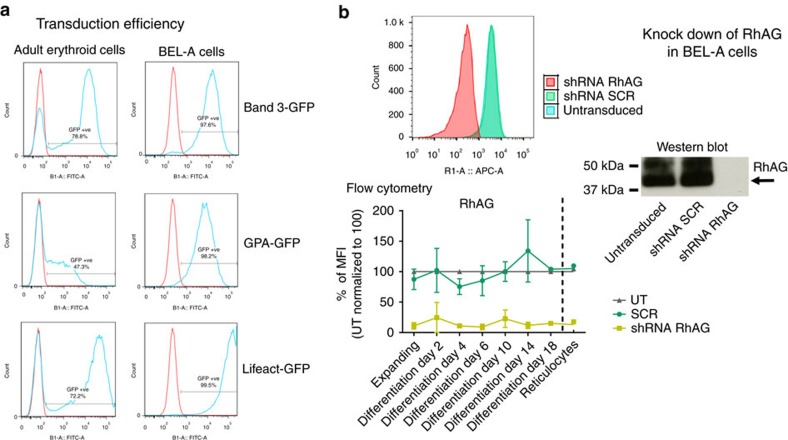
(a) BEL-A cells and pro-erythroblasts differentiated from adult peripheral blood CD34+ cells transduced with GPA-GFP, band 3-GFP and Lifeact-GFP, using identical cell numbers and virus batches. Transduction efficiency (shown on graphs) for each gene was measured 72 h post transduction by flow cytometry using the same voltage settings for both cell types. (b) Levels of RhAG measured by flow cytometry and western blot following knock down of RhAG by shRNA. A non-targeting scramble shRNA (SCR) was included as a control. The trace for untransduced cells (blue) is masked by that for SCR (green). Transduced cells were expanded for 7 days before transfer to differentiation medium. Data shown are mean±s.d. n=2. Western blot was performed with cells at day 8 of differentiation using a RhAG polyclonal antibody.

References

    1. Fujimi A. et al.. Ex vivo large-scale generation of human red blood cells from cord blood CD34+ cells by co-culturing with macrophages. Int. J. Hematol. 87, 339–350 (2008). - PubMed
    1. Giarratana M. C. et al.. Ex vivo generation of fully mature human red blood cells from hematopoietic stem cells. Nat. Biotechnol. 23, 69–74 (2005). - PubMed
    1. Griffiths R. E. et al.. Maturing reticulocytes internalize plasma membrane in glycophorin A-containing vesicles that fuse with autophagosomes before exocytosis. Blood 119, 6296–6306 (2012). - PMC - PubMed
    1. Olivier E. N., Qiu C., Velho M., Hirsch R. E. & Bouhassira E. E. Large-scale production of embryonic red blood cells from human embryonic stem cells. Exp. Hematol. 34, 1635–1642 (2006). - PubMed
    1. Trakarnsanga K. et al.. Qualitative and quantitative comparison of the proteome of erythroid cells differentiated from human iPSCs and adult erythroid cells by multiplex TMT labelling and NanoLC-MS/MS. PLoS ONE 9, e100874 (2014). - PMC - PubMed

Publication types