


Thirty-day Readmission Rates in an HIV-infected Cohort From Rio de Janeiro, Brazil
- PMID: 28291051
- PMCID: PMC5484736
- DOI: 10.1097/QAI.0000000000001352
Thirty-day Readmission Rates in an HIV-infected Cohort From Rio de Janeiro, Brazil
Abstract
Background: The 30-day readmission rate is an indicator of the quality of hospital care and transition to the outpatient setting. Recent studies suggest HIV infection might increase the risk of readmission although estimates of 30-day readmission rates are unavailable among HIV-infected individuals living in middle/low-income settings. Additionally, factors that may increase readmission risk in HIV-infected populations are poorly understood.
Methods: Thirty-day readmission rates were estimated for HIV-infected adults from the Instituto Nacional de Infectologia Evandro Chagas/Fiocruz cohort in Rio de Janeiro, Brazil, from January 2007 to December 2013. Cox regression models were used to evaluate factors associated with the risk of 30-day readmission.
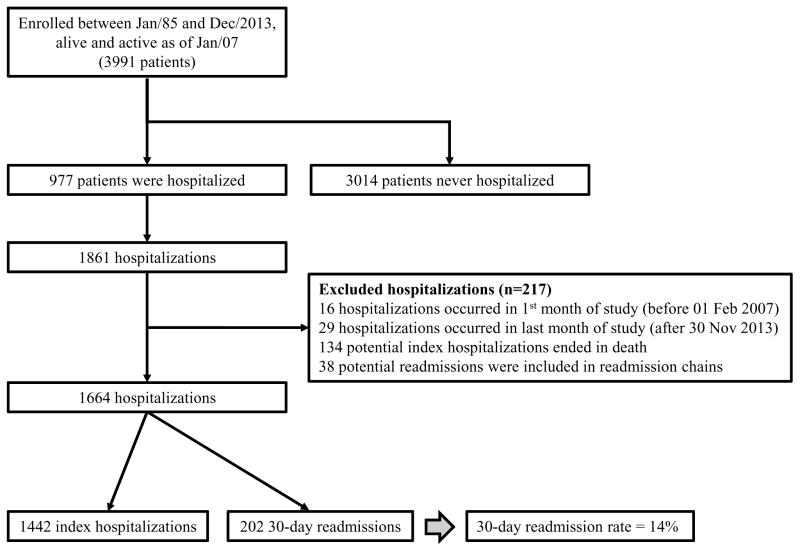
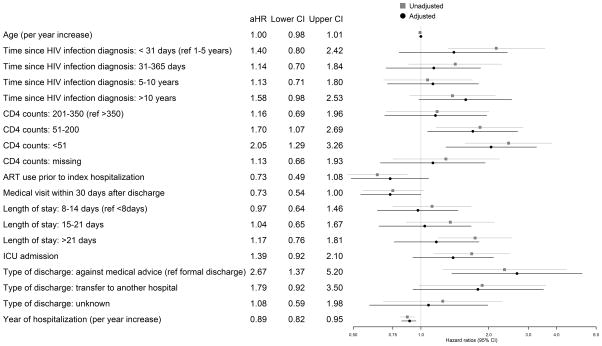
Results: Between January 2007 and December 2013, 3991 patients were followed and 1861 hospitalizations were observed. The estimated 30-day readmission rate was 14% (95% confidence interval: 12.3 to 15.9). Attending a medical visit within 30 days after discharge (adjusted hazard ratio [aHR] = 0.73, P = 0.048) and being hospitalized in more recent calendar years (aHR = 0.89, P = 0.002) reduced the risk of 30-day readmission. In contrast, low CD4 counts (51-200 cells/mm³: aHR = 1.70, P = 0.024 and ≤ 50 cells/mm³: aHR = 2.05, P = 0.003), time since HIV infection diagnosis ≥10 years (aHR = 1.58, P = 0.058), and leaving hospital against medical advice (aHR = 2.67, P = 0.004) increased the risk of 30-day readmission.
Conclusions: Patients with advanced HIV/AIDS are most at risk of readmission and should be targeted with prevention strategies to reduce this risk. Efforts to reduce discharge against medical advice and to promote early postdischarge medical visit would likely reduce 30-day readmission rates in our population.
Conflict of interest statement
The authors declare no competing interests.
Figures
References
-
- Hansen LO, Young RS, Hinami K, Leung A, Williams MV. Interventions to reduce 30-day rehospitalization: a systematic review. Ann Intern Med. 2011;155(8):520–528. - PubMed
-
- Brasil. Agência Nacional de Saúde Suplementar - ANS. Fichas Técnicas e Nota técnica n° 34/DIDES. [Accessed February 2, 2017];Indicadores do Fator de Qualidade. 2015 Dez; http://www.ans.gov.br/images/stories/Plano_de_saude_e_Operadoras/Area_do....
-
- Jencks SF, Williams MV, Coleman EA. Rehospitalizations among patients in the Medicare fee-for-service program. N Engl J Med. 2009;360(14):1418–1428. - PubMed
Publication types
MeSH terms
Grants and funding
LinkOut - more resources
Full Text Sources
Other Literature Sources
Medical
Research Materials
