


A standard database for drug repositioning
- PMID: 28291243
- PMCID: PMC5349249
- DOI: 10.1038/sdata.2017.29
A standard database for drug repositioning
Abstract
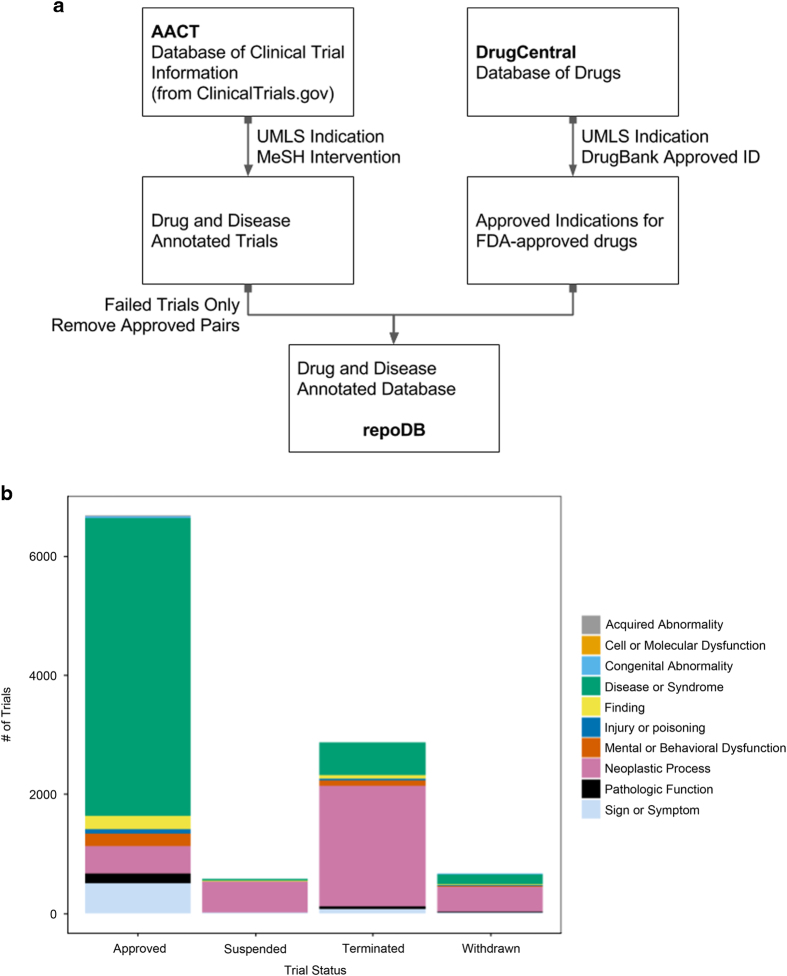
Drug repositioning, the process of discovering, validating, and marketing previously approved drugs for new indications, is of growing interest to academia and industry due to reduced time and costs associated with repositioned drugs. Computational methods for repositioning are appealing because they putatively nominate the most promising candidate drugs for a given indication. Comparing the wide array of computational repositioning methods, however, is a challenge due to inconsistencies in method validation in the field. Furthermore, a common simplifying assumption, that all novel predictions are false, is intellectually unsatisfying and hinders reproducibility. We address this assumption by providing a gold standard database, repoDB, that consists of both true positives (approved drugs), and true negatives (failed drugs). We have made the full database and all code used to prepare it publicly available, and have developed a web application that allows users to browse subsets of the data (http://apps.chiragjpgroup.org/repoDB/).
Conflict of interest statement
The authors declare no competing financial interests.
Figures
References
Data Citations
-
- Brown A. S. 2017. Figshare. http://dx.doi.org/10.6084/m9.figshare.c.3462048 - DOI
References
-
- Shameer K., Readhead B. & Dudley J. T. Computational and experimental advances in drug repositioning for accelerated therapeutic stratification. Curr. Top. Med. Chem. 15, 5–20 (2015). - PubMed
-
- Lamb J. et al. The Connectivity Map: using gene-expression signatures to connect small molecules, genes, and disease. Science 313, 1929–1935 (2006). - PubMed
Publication types
MeSH terms
Grants and funding
LinkOut - more resources
Full Text Sources
Other Literature Sources
