


Dosimetric benefits of intensity-modulated radiotherapy and volumetric-modulated arc therapy in the treatment of postoperative cervical cancer patients
- PMID: 28291936
- PMCID: PMC5689869
- DOI: 10.1002/acm2.12003
Dosimetric benefits of intensity-modulated radiotherapy and volumetric-modulated arc therapy in the treatment of postoperative cervical cancer patients
Abstract
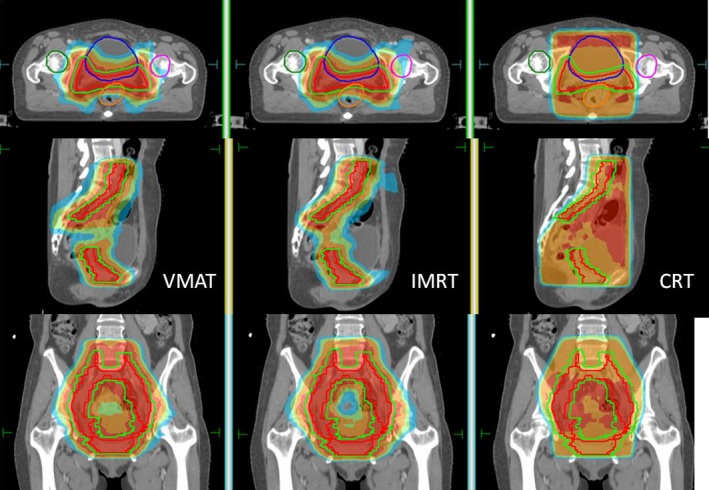
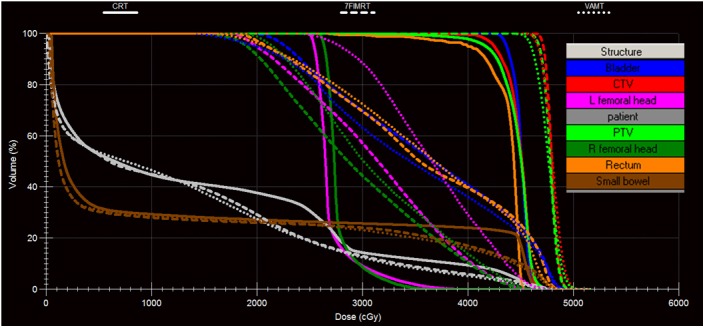
As the advantage of using complex volumetric-modulated arc therapy (VMAT) in the treatment of gynecologic cancer has not yet been fully determined, the purpose of this study was to investigate the dosimetric advantages of VMAT by comparing directly with whole pelvic conformal radiotherapy (CRT) and intensity-modulated radiotherapy (IMRT) in the treatment of 15 postoperative cervical cancer patients. Four-field CRT, seven-field IMRT, and two-arc VMAT plans were generated for each patient with identical objective functions to achieve clinically acceptable dose distribution. Target coverage and OAR sparing differences were investigated through dose-volume histogram (DVH) analysis. Nondosimtric differences between IMRT and VMAT were also compared. Target coverage presented by V95% were 88.9% ± 3.8%, 99.9% ± 0.07%, and 99.9% ± 0.1% for CRT, IMRT, and VMAT, respectively. Significant differences on conformal index (CI) and conformal number (CN) were observed with CIs of 0.37 ± 0.07, 0.55 ± 0.04, 0.61 ± 0.04, and CNs of 0.33 ± 0.06, 0.55 ± 0.04, 0.60 ± 0.04 for CRT, IMRT, and VMAT, respectively. IMRT and VMAT decreased the dose to bladder and rectum significantly compared with CRT. No significant differences on the Dmean, V45, and V30 of small bowel were observed among CRT, IMRT, and VMAT. However, VMAT (10.4 ± 4.8 vs. 19.8 ± 11.0, P = 0.004) and IMRT (12.3 ± 5.0 vs. 19.8 ± 11.0, P = 0.02) decreased V40, increased the Dmax of small bowel and the irradiation dose to femoral heads compared with CRT. VMAT irradiated less dose to bladder, rectum, small bowel and larger volume of health tissue with a lower dose (V5 and V10) compared with IMRT, although the differences were not statistical significant. In conclusion, VMAT and IMRT showed significant dosimetric advantages both on target coverage and OAR sparing compared with CRT in the treatment of postoperative cervical cancer. However, no significant difference between IMRT and VMAT was observed except for slightly better dose conformity, slightly less MU, and significant shorter delivery time achieved for VMAT.
Keywords: cervical cancer; intensity‐modulated radiotherapy; volumetric‐modulated arc therapy; whole pelvic conformal radiotherapy.
© 2016 The Authors. Journal of Applied Clinical Medical Physics published by Wiley Periodicals, Inc. on behalf of American Association of Physicists in Medicine.
Figures
References
-
- Jemal A, Bray F, Center MM, Ferlay J, Ward E, Forman D. Global cancer statistics. CA Cancer J Clin. 2011;61:69–90. - PubMed
-
- Morris M, Eifel PJ, Lu J, et al. Pelvic radiation with concurrent chemotherapy compared with pelvic and para‐aortic radiation for high‐risk cervical cancer. N Engl J Med. 1999;340:1137–1143. - PubMed
-
- Keys HM, Bundy BN, Stehman FB, et al. Cisplatin, radiation, and adjuvant hysterectomy compared with radiation and adjuvant hysterectomy for bulky stage IB cervical carcinoma. N Engl J Med. 1999;340:1154–1161. - PubMed
-
- Scholten AN, van Putten WL, Beerman H, et al. Postoperative radiotherapy for stage 1 endometrial carcinoma: long‐term outcome of the randomized PORTEC trial with central pathology review. Int J Radiat Oncol Biol Phys. 2005;63:834–838. - PubMed
-
- Nout RA, Smit VT, Putter H, et al. Vaginal brachytherapy versus pelvic external beam radiotherapy for patients with endometrial cancer of high‐intermediate risk (PORTEC‐2): an open‐label, non‐inferiority, randomised trial. Lancet. 2010;375:816–823. - PubMed
MeSH terms
LinkOut - more resources
Full Text Sources
Medical
Research Materials
