Effect of United States buckwheat honey on antibiotic-resistant hospital acquired pathogens
- PMID: 28292167
- PMCID: PMC5326189
- DOI: 10.11604/pamj.2016.25.212.10414
Effect of United States buckwheat honey on antibiotic-resistant hospital acquired pathogens
Abstract
Introduction: Due to an upsurge in antibiotic-resistant infections and lack of therapeutic options, new approaches are needed for treatment. Honey may be one such potential therapeutic option. We investigated the susceptibility of hospital acquired pathogens to four honeys from Wisconsin, United States, and then determined if the antibacterial effect of each honey against these pathogens is primarily due to the high sugar content.
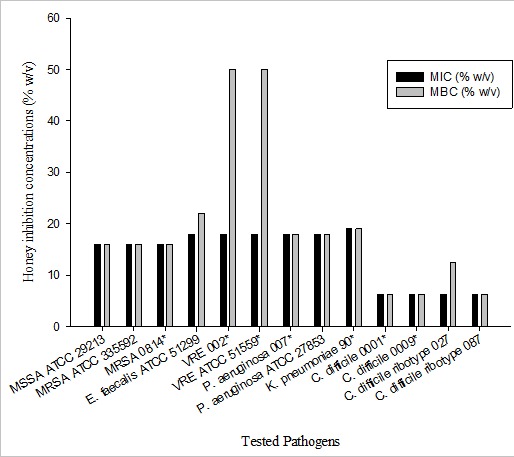
Methods: Thirteen pathogens including: four Clostridium difficile, two Methicillin-resistant Staphylococcus aureus, two Pseudomonas aeruginosa, one Methicillin-Susceptible Staphylococcus aureus, two Vancomycin-resistance Enterococcus, one Enterococcus faecalis and one Klebsiella pneumoniae were exposed to 1-50% (w/v) four Wisconsin honeys and Artificial honey to determine their minimum inhibitory concentration (MIC) and minimum bactericidal concentration (MBC) using the broth dilution method.
Results: Buckwheat honey predominantly exhibited a bactericidal mode of action against the tested pathogens, and this varied with each pathogen. C. difficile isolates were more sensitive to the Wisconsin buckwheat honey as compared to the other pathogens. Artificial honey at 50% (w/v) failed to kill any of the pathogens. The high sugar content of Wisconsin buckwheat honey is not the only factor responsible for its bactericidal activity.
Conclusion: Wisconsin buckwheat honey has the potential to be an important addition to therapeutic armamentarium against resistant pathogens and should be investigated further.
Keywords: Buckwheat honey; antibiotic-resistant; nosocomial pathogen; susceptibility.
Conflict of interest statement
The authors declare no competing interests.
Figures
References
-
- World Health Organization. WHO’s first global report on antibiotic resistance reveals serious, worldwide threat to public health. http://www.who.int/mediacentre/news/releases/2014/amr-report/en/. Accessed 29 June 2015.
-
- The Centers for Disease Control and Prevention. Antibiotic Resistance Threats in the United States. 2013. http://www.cdc.gov/drugresistance/threat-report-2013/. Accessed 29 June 2015.
-
- Spellberg B, Guidos R, Gilbert D, Bradley J, Boucher HW, Scheld WM, et al. The epidemic of antibiotic-resistant infections: a call to action for the medical community from the Infectious Diseases Society of America. Clin Infect Dis. 2008 Jan 15;46(2):155–64. - PubMed
-
- van den Berg AJJ, van den Worm E, van Ufford HCQ, Halkes SBA, Hoekstra MJ, Beukelman CJ. An in vitro examination of the antioxidant and anti-inflammatory properties of buckwheat honey. J Wound Care. 2008 Apr;17(4):172–4. 176–8. - PubMed
Publication types
MeSH terms
Substances
LinkOut - more resources
Full Text Sources
Other Literature Sources
Medical
Molecular Biology Databases