Review
. 2017 Apr:45:47-54.
doi: 10.1016/j.ceb.2017.02.011. Epub 2017 Mar 11.

Canonical and noncanonical functions of ULK/Atg1

Affiliations
Review

Canonical and noncanonical functions of ULK/Atg1

Bo Wang et al. Curr Opin Cell Biol. 2017 Apr.

Abstract

Mammalian Unc-51-like kinases 1 and 2 (ULK1 and ULK2) belong to the ULK/Atg1 family of serine/threonine kinases, which are conserved from yeast to mammals. Although ULK/Atg1 is best known for regulating flux through the autophagy pathway, it has evolutionarily conserved noncanonical functions in protein trafficking that are essential for maintaining cellular homeostasis. As a direct target of energy- and nutrient-sensing kinases, ULK/Atg1 is positioned to regulate the distribution and use of cellular resources in response to metabolic cues. In this review, we provide an overview of the molecular mechanisms through which ULK/Atg1 carries out its canonical and noncanonical functions and the signaling pathways that link its function to metabolism. We also highlight potential contributions of ULK/Atg1 in human diseases, including cancer and neurodegeneration.


Figures

Figure 1
Figure 1
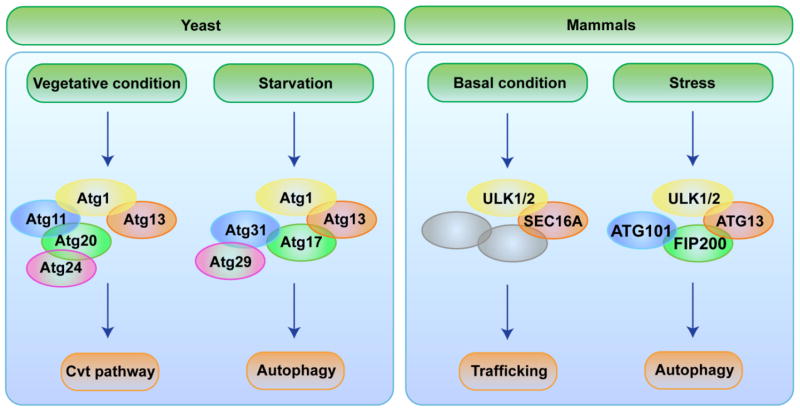
ULK/Atg1 redirects machinery used under vegetative conditions for stress-induced autophagy. In yeast, the binding of Atg1 to Atg13 and the Atg11–Atg20–Atg24 complex facilitates the Cvt pathway under nutrient-rich conditions. Upon starvation, Atg1 forms an alternative complex that includes, Atg13 and Atg17–Atg29–Atg31 to induce autophagy. Depending on the stimulus, the cellular machineries involved in membrane nucleation and cargo sequestration are directed to the cargo or PAS by ULK/ATG1. Similarly, in mammals, ULK/ATG1 may exist in different complexes depending on the metabolic status of the cell. For example, the ULK/ATG1–SEC16A complex regulates ER-to-Golgi trafficking under normal growth conditions, while the ULK/ATG1–ATG13–FIP200–Atg101 complex induces autophagy in response to stress. It remains to be seen whether the redirection of COPII components that occurs in response to autophagy-inducing stimuli depends on ULK/ATG1.
Figure 2
Figure 2
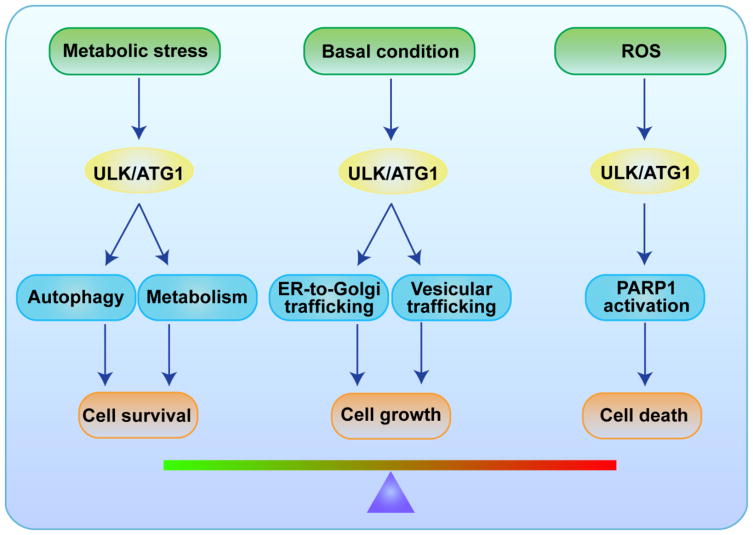
ULK/ATG1 dictates cell fate under different physiologic states. Under normal physiological conditions, such as embryonic development, ULK/ATG1-mediated vesicular trafficking, which appears to be autophagy independent, promotes normal growth (i.e., axonal extension). Upon stress, the cell secures its energy supply by redirecting ULK/ATG1 to the autophagy and glycolysis pathways. When challenged with excessive ROS, the cell actively transports ULK/ATG1 into the nucleus, where the kinase initiates PARP1-mediated necrotic cell death.

References

    1. Mizushima N, Levine B, Cuervo AM, Klionsky DJ. Autophagy fights disease through cellular self-digestion. Nature. 2008;451:1069–1075. - PMC - PubMed
    1. Feng Y, He D, Yao Z, Klionsky DJ. The machinery of macroautophagy. Cell Res. 2014;24:24–41. - PMC - PubMed
    1. Noda NN, Fujioka Y. Atg1 family kinases in autophagy initiation. Cell Mol Life Sci. 2015;72:3083–3096. - PMC - PubMed
    1. Egan DF, Chun MG, Vamos M, Zou H, Rong J, Miller CJ, Lou HJ, Raveendra-Panickar D, Yang CC, Sheffler DJ, et al. Small Molecule Inhibition of the Autophagy Kinase ULK1 and Identification of ULK1 Substrates. Mol Cell. 2015;59:285–297. This paper reported the optimal substrate motif of ULK1, which was identified by screening a peptide library. Additionally, the authors identified 15 novel phosphorylation sites on autophagy proteins, of which Ser249 of VPS34 was one. A selective inhibitor of ULK1, SBI-0206965, was developed and combined with mTOR inhibition to sensitize tumor cells to apoptosis. - PMC - PubMed
    1. Petherick KJ, Conway OJ, Mpamhanga C, Osborne SA, Kamal A, Saxty B, Ganley IG. Pharmacological inhibition of ULK1 kinase blocks mammalian target of rapamycin (mTOR)-dependent autophagy. J Biol Chem. 2015;290:11376–11383. - PMC - PubMed

MeSH terms

Substances