Association between concurrent use of prescription opioids and benzodiazepines and overdose: retrospective analysis
- PMID: 28292769
- PMCID: PMC5421443
- DOI: 10.1136/bmj.j760
Association between concurrent use of prescription opioids and benzodiazepines and overdose: retrospective analysis
Abstract
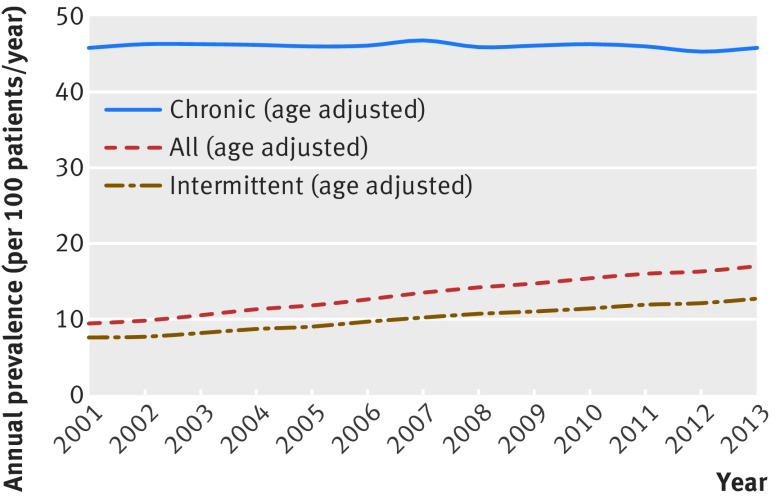
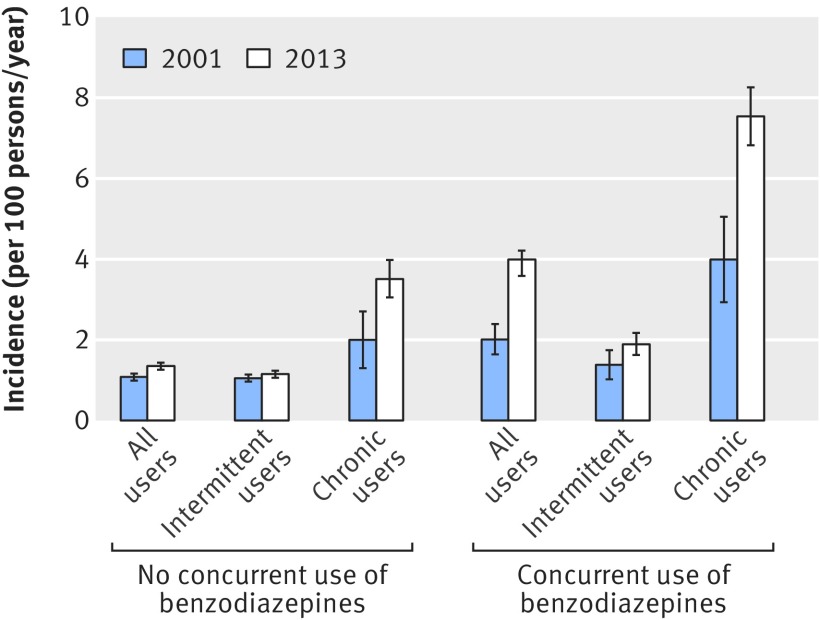
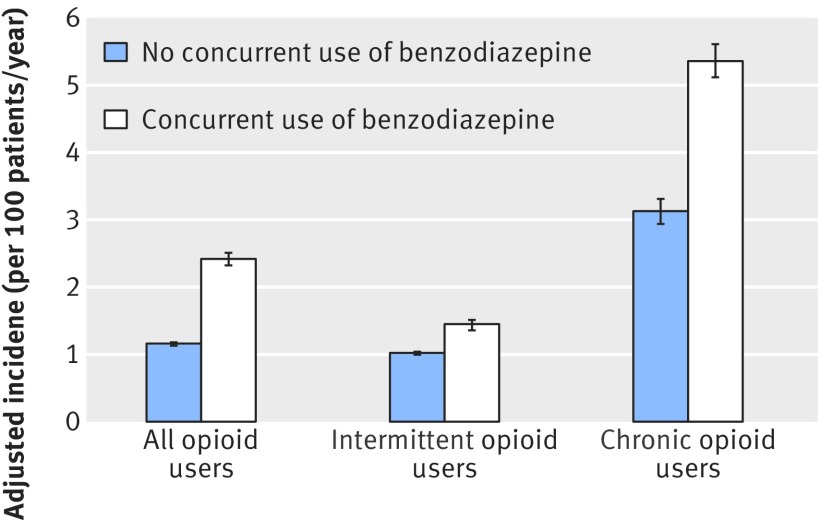
Objectives To identify trends in concurrent use of a benzodiazepine and an opioid and to identify the impact of these trends on admissions to hospital and emergency room visits for opioid overdose.Design Retrospective analysis of claims data, 2001-13.Setting Administrative health claims database.Participants 315 428 privately insured people aged 18-64 who were continuously enrolled in a health plan with medical and pharmacy benefits during the study period and who also filled at least one prescription for an opioid.Interventions Concurrent benzodiazepine/opioid use, defined as an overlap of at least one day in the time periods covered by prescriptions for each drug. Main outcome measures Annual percentage of opioid users with concurrent benzodiazepine use; annual incidence of visits to emergency room and inpatient admissions for opioid overdose.Results 9% of opioid users also used a benzodiazepine in 2001, increasing to 17% in 2013 (80% relative increase). This increase was driven mainly by increases among intermittent, as opposed to chronic, opioid users. Compared with opioid users who did not use benzodiazepines, concurrent use of both drugs was associated with an increased risk of an emergency room visit or inpatient admission for opioid overdose (adjusted odds ratio 2.14, 95% confidence interval 2.05 to 2.24; P<0.001) among all opioid users. The adjusted odds ratio for an emergency room visit or inpatient admission for opioid overdose was 1.42 (1.33 to 1.51; P<0.001) for intermittent opioid users and 1.81 (1.67 to 1.96; P<0.001) chronic opioid users. If this association is causal, elimination of concurrent benzodiazepine/opioid use could reduce the risk of emergency room visits related to opioid use and inpatient admissions for opioid overdose by an estimated 15% (95% confidence interval 14 to 16).Conclusions From 2001 to 2013, concurrent benzodiazepine/opioid use sharply increased in a large sample of privately insured patients in the US and significantly contributed to the overall population risk of opioid overdose.
Published by the BMJ Publishing Group Limited. For permission to use (where not already granted under a licence) please go to http://group.bmj.com/group/rights-licensing/permissions.
Conflict of interest statement
Competing interests: All authors have completed the ICMJE uniform disclosure form at
Figures
Comment in
-
The growing problem of co-treatment with opioids and benzodiazepines.BMJ. 2017 Mar 14;356:j1224. doi: 10.1136/bmj.j1224. BMJ. 2017. PMID: 28292825 Free PMC article.
References
-
- Rudd RA, Aleshire N, Zibbell JE, Gladden RM. Increases in Drug and Opioid Overdose Deaths--United States, 2000-2014. MMWR Morb Mortal Wkly Rep 2016;64:1378-82. 10.15585/mmwr.mm6450a3 pmid:26720857. - DOI - PubMed
-
- Leider HL, Dhaliwal J, Davis EJ, Kulakodlu M, Buikema AR. Healthcare costs and nonadherence among chronic opioid users. Am J Manag Care 2011;17:32-40.pmid:21348566. - PubMed
-
- Centers for Disease Control and Prevention (CDC). Vital signs: overdoses of prescription opioid pain relievers---United States, 1999--2008. MMWR Morb Mortal Wkly Rep 2011;60:1487-92.pmid:22048730. - PubMed
-
- Bohnert AS, Valenstein M, Bair MJ, et al. Association between opioid prescribing patterns and opioid overdose-related deaths. JAMA 2011;305:1315-21. 10.1001/jama.2011.370 pmid:21467284. - DOI - PubMed
-
- Overdose Death Rates National Institute on Drug Abuse. http://www.drugabuse.gov/related-topics/trends-statistics/overdose-death....
MeSH terms
Substances
LinkOut - more resources
Full Text Sources
Other Literature Sources
Medical