


Glucocorticoid receptor expression in 20 solid tumor types using immunohistochemistry assay
- PMID: 28293120
- PMCID: PMC5345989
- DOI: 10.2147/CMAR.S124475
Glucocorticoid receptor expression in 20 solid tumor types using immunohistochemistry assay
Abstract
Background: Glucocorticoid receptor (GR) activity plays a role in many aspects of human physiology and may play a crucial role in chemotherapy resistance in a wide variety of solid tumors. A novel immunohistochemistry (IHC) based assay has been previously developed and validated in order to assess GR immunoreactivity in triple-negative breast cancer. The current study investigates the standardized use of this validated assay to assess GR expression in a broad range of solid tumor malignancies.
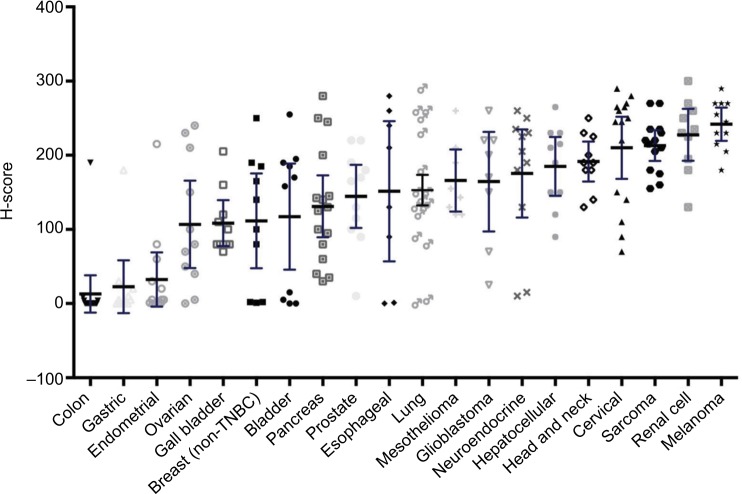
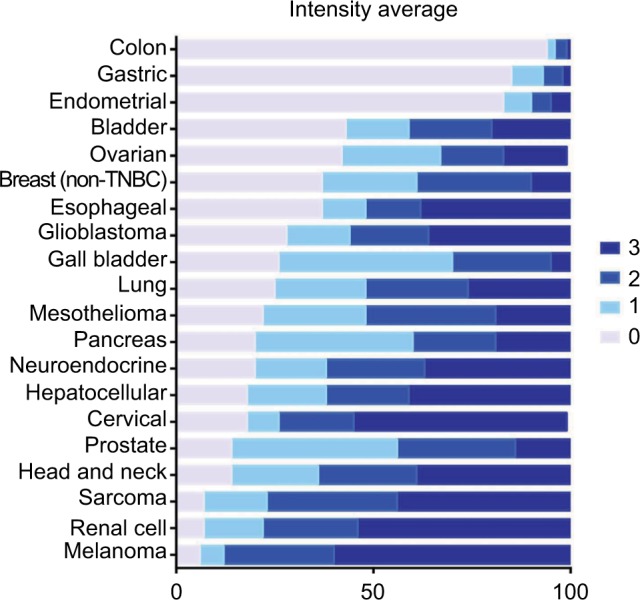
Methods: Archived formalin-fixed paraffin-embedded tumor bank samples (n=236) from 20 different solid tumor types were analyzed immunohistochemically. Nuclear staining was reported based on the H-score method using differential intensity scores (0, 1+, 2+, or 3+) with the percent stained (out of at least 100 carcinoma cells) recorded at each intensity.
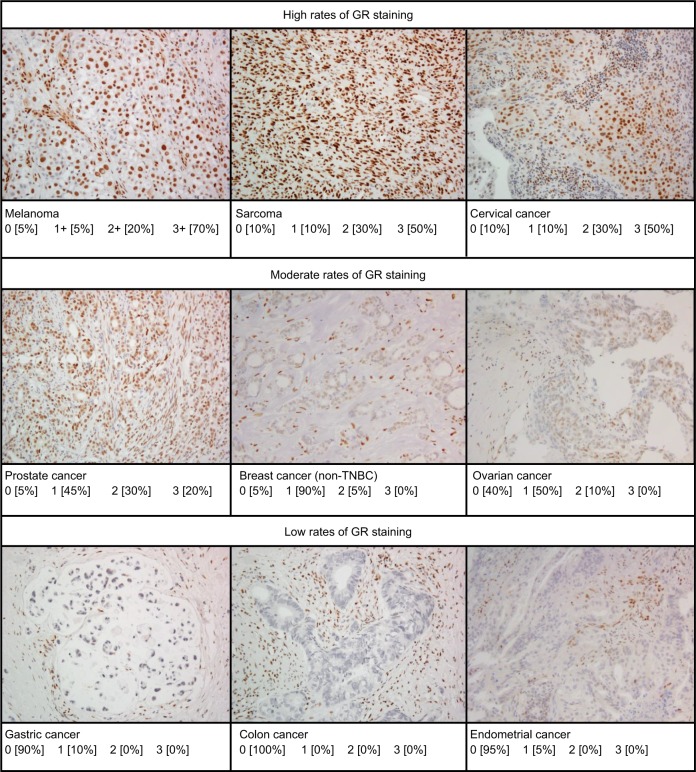
Results: GR was expressed in all tumor types that had been evaluated. Renal cell carcinoma, sarcoma, cervical cancer, and melanoma were those with the highest mean H-scores, indicating high levels of GR expression. Colon, endometrial, and gastric cancers had lower GR staining percentages and intensities, resulting in the lowest mean H-scores.
Conclusion: A validated IHC assay revealed GR immunoreactivity in all solid tumor types studied and allowed for standardized comparison of reactivity among the different malignancies.
Impact: Baseline expression levels of GR may be a useful biomarker when pharmaceutically targeting GR in research or clinical setting.
Keywords: glucocorticoid receptor expression; immunohistochemistry; solid tumors.
Conflict of interest statement
Disclosure TSB and DPN are employees of Corcept Therapeutics, Menlo Park, CA, USA. Corcept Therapeutics sponsored the research reported here. TIM and FJL are employees of QualTek Molecular Laboratories, contracted to perform the assays. The authors report no other conflicts of interest in this work.
Figures
References
-
- Sapolsky RM, Romero LM, Munck AU. How do glucocorticoids influence stress responses? Integrating permissive, suppressive, stimulatory, and preparative actions. Endocr Rev. 2000;21(1):55–89. - PubMed
-
- Rhen T, Cidlowski JA. Antiinflammatory aciton of glucocorticoids—New mechanisms for old drugs. N Engl J Med. 2005;353(16):1711–1723. - PubMed
-
- Cole TJ, Blendy JA, Monaghan AP, et al. Targeted disruption of the glucocorticoid receptor gene blocks adrenergic chromaffin cell development and severely retards lung maturation. Genes Dev. 1995;9:1608–1621. - PubMed
-
- Baschant U, Tuckermann J. The role of the glucocorticoid receptor in inflammation and immunity. J Steroid Biochem Mol Biol. 2010;120:69–75. - PubMed
LinkOut - more resources
Full Text Sources
Other Literature Sources
Medical
