Review
. 2017 Feb 28:5:14.
doi: 10.3389/fcell.2017.00014. eCollection 2017.

Sonic Hedgehog Signaling in Limb Development

Affiliations
Review

Sonic Hedgehog Signaling in Limb Development

Cheryll Tickle et al. Front Cell Dev Biol. .

Abstract

The gene encoding the secreted protein Sonic hedgehog (Shh) is expressed in the polarizing region (or zone of polarizing activity), a small group of mesenchyme cells at the posterior margin of the vertebrate limb bud. Detailed analyses have revealed that Shh has the properties of the long sought after polarizing region morphogen that specifies positional values across the antero-posterior axis (e.g., thumb to little finger axis) of the limb. Shh has also been shown to control the width of the limb bud by stimulating mesenchyme cell proliferation and by regulating the antero-posterior length of the apical ectodermal ridge, the signaling region required for limb bud outgrowth and the laying down of structures along the proximo-distal axis (e.g., shoulder to digits axis) of the limb. It has been shown that Shh signaling can specify antero-posterior positional values in limb buds in both a concentration- (paracrine) and time-dependent (autocrine) fashion. Currently there are several models for how Shh specifies positional values over time in the limb buds of chick and mouse embryos and how this is integrated with growth. Extensive work has elucidated downstream transcriptional targets of Shh signaling. Nevertheless, it remains unclear how antero-posterior positional values are encoded and then interpreted to give the particular structure appropriate to that position, for example, the type of digit. A distant cis-regulatory enhancer controls limb-bud-specific expression of Shh and the discovery of increasing numbers of interacting transcription factors indicate complex spatiotemporal regulation. Altered Shh signaling is implicated in clinical conditions with congenital limb defects and in the evolution of the morphological diversity of vertebrate limbs.

Keywords: Sonic hedgehog; chick; digits; limb; mouse; positional information.


Figures
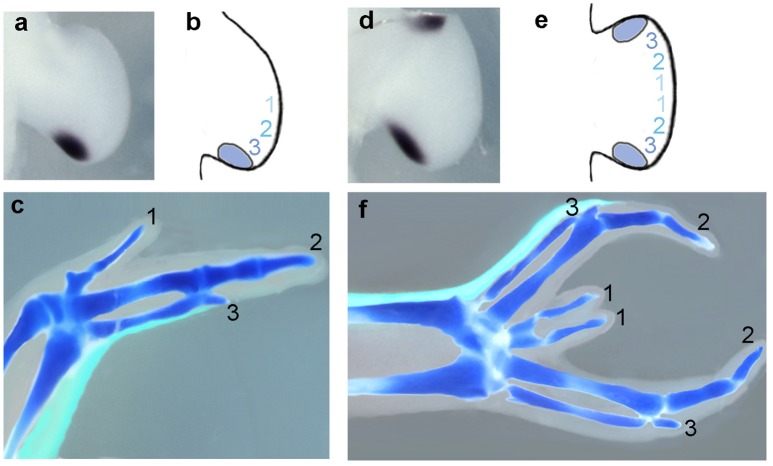
Figure 1
Figure 1
Shh as a morphogen in the chick wing bud. (a) Sonic hedgehog (Shh) expression in the polarizing region at the posterior margin of the early chick wing bud (Riddle et al., 1993). (b) A gradient of Shh in the chick wing bud (blue shaded numbers) specifies antero-posterior positional values for three digits (1, 2, and 3) in cells adjacent to polarizing region over 12 h. (c) Chick wing digit skeleton with polarizing region descendants fate-mapped by GFP-expression (green) (Towers et al., 2011). Digits form in tissue adjacent to descendants of the polarizing region that form narrow strip of cells along posterior wing margin. (d) Chick wing bud with anterior polarizing region graft expresses Shh at both anterior and posterior margins (Towers et al., 2011). (e) Mirror-image symmetrical positional values specified as in (b) as a result of Shh being produced by both graft and host. (f) Chick wing digit skeleton pattern with grafted polarizing region (d) and progeny fate mapped by GFP expression (Towers et al., 2011). Six digits form in an anterior to posterior pattern 3-2-1-1-2-3 and grafted polarizing region descendants form narrow strip of cells along anterior wing margin. In all cases, data shown is representative of data in the original cited papers.
Figure 2
Figure 2
Comparison of models of Shh function in chick and mouse limbs. (A) Chick wing promotion model. Positional values of digits 1, 2, and 3 specified adjacent to polarizing region (blue shading) and promoted over 12 h through a series of increasingly posterior positional values by a concentration gradient of paracrine Shh signaling (graded blue shading—note coloring of polarizing region also shows strength of Shh expression. Shh terminated at around 60 h as digit condensations form by self-organization (black numbers). Colors of developing digits indicate a different positional value that cells were specified with. (B) Chick leg promotion model. Positional values of digits 1, 2, and 3 specified as (A) but polarizing region cells promoted through progressively anterior positional values over 16 h in response to time of autocrine Shh signaling (red numbers) and form digit 4. Shh terminated at around 60 h. (C) Mouse limb temporal expansion. Positional values of digits 1, 2, and 3 specified adjacent to the polarizing region by a gradient of paracrine Shh signaling over approximately 24 h– it is unclear whether promotion is involved (see A). Positional values of digits 4 and 5 specified in polarizing region sometime before Shh terminates at 60 h according to duration of autocrine Shh signaling. Shh terminates at around 60 h. (D) Mouse limb biphasic model. Positional values of digits 1, 2, 3, 4, and 5 specified by Shh, possibly by a gradient of paracrine signaling from the polarizing region in approximately 6 h. It is unclear whether promotion is involved and is possible in this time (see A), or if Shh levels can reach concentrations predicted required to specify posterior positional values. Shh signaling over the next 16 h required for specified digit progenitor cells to proliferate and form condensations in the order digit 1, 4, 2, 5, and 3 (purple numbers). (E) Mouse limb promotion model. Positional values of digits 1, 2, 3, and 4 specified as (B) and polarizing region enlarges sufficiently to give rise to digits 4 and 5 by self-organization. Note promotion model does not easily explain digit 5 patterning that requires a shorter exposure to form than digit 3 (see D). (F) Mouse limb truncated promotion model. Anterior positional values specified (1 and 2) specified by autocrine and paracrine signaling and then cells become refractory to further posterior promotion. Digits form by self-organization: 1, 2, and 3 from cells adjacent to polarizing region, digits 4 and 5 from the polarizing region.

References

    1. Ahn S., Joyner A. L. (2004). Dynamic changes in the response of cells to positive hedgehog signaling during mouse limb patterning. Cell 118, 505–516. 10.1016/j.cell.2004.07.023 - DOI - PubMed
    1. Alby C., Piquand K., Huber C., Megarbane A., Ichkou A., Legendre M., et al. . (2015). Mutations in KIAA0586 Cause Lethal Ciliopathies Ranging from a Hydrolethalus Phenotype to Short-Rib Polydactyly Syndrome. Am. J. Hum. Genet. 97, 311–318. 10.1016/j.ajhg.2015.06.003 - DOI - PMC - PubMed
    1. Allen B. L., Tenzen T., McMahon A. P. (2007). The Hedgehog-binding proteins Gas1 and Cdo cooperate to positively regulate Shh signaling during mouse development. Genes Dev. 21, 1244–1257. 10.1101/gad.1543607 - DOI - PMC - PubMed
    1. Amano T., Sagai T., Tanabe H., Mizushina Y., Nakazawa H., Shiroishi T. (2009). Chromosomal dynamics at the Shh locus: limb bud-specific differential regulation of competence and active transcription. Dev. Cell 16, 47–57. 10.1016/j.devcel.2008.11.011 - DOI - PubMed
    1. Anderson C., Williams V. C., Moyon B., Daubas P., Tajbakhsh S., Buckingham M. E., et al. . (2012). Sonic hedgehog acts cell-autonomously on muscle precursor cells to generate limb muscle diversity. Genes Dev. 26, 2103–2117. 10.1101/gad.187807.112 - DOI - PMC - PubMed
