Prevalence and Risk Factors of Urticaria With a Focus on Chronic Urticaria in Children
- PMID: 28293927
- PMCID: PMC5352572
- DOI: 10.4168/aair.2017.9.3.212
Prevalence and Risk Factors of Urticaria With a Focus on Chronic Urticaria in Children
Abstract
Purpose: Limited data is available on the prevalence and risk factors of acute and chronic urticaria in children. Our purpose was to determine the prevalence and identify the risk factors of acute and chronic urticaria in Korean children.
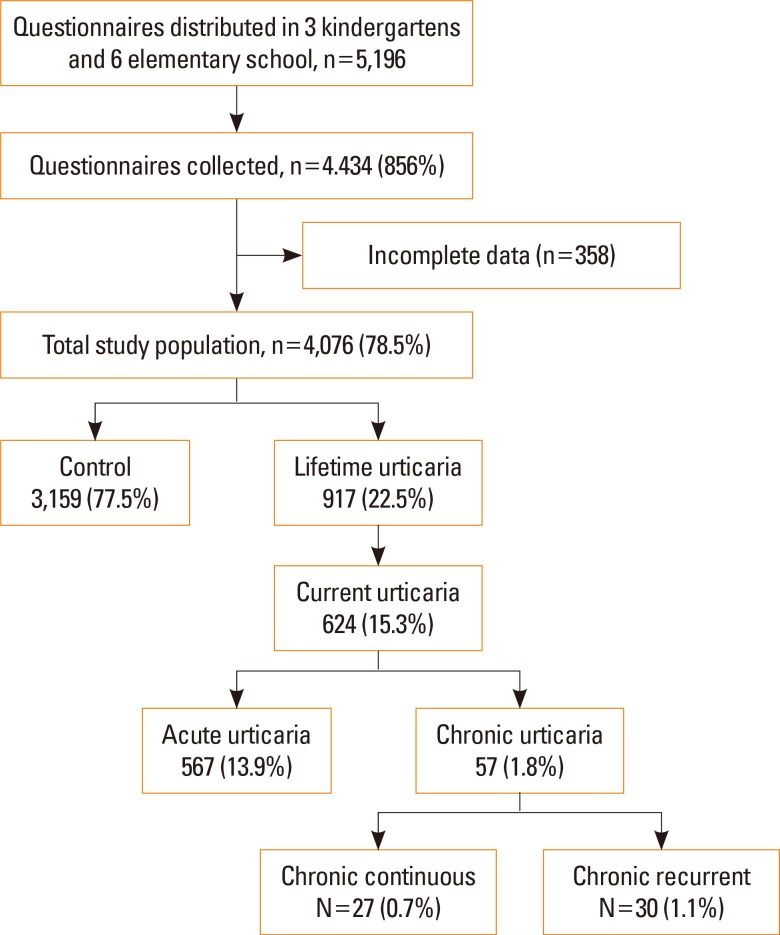
Methods: This population-based study examined 4,076 children (age 4 to 13 years) who were enrolled in the 2015 prospective Seongnam Atopy Project (SAP 2015) in Korea. The parents completed an urticaria questionnaire that included questions regarding the duration, severity, and triggering factors of urticaria. Blood sampling (n=464) was performed to measure vitamin D, total eosinophil count (TEC), and total IgE levels, and skin prick tests (n=503) were done.
Results: The prevalences of the life-time, acute, and chronic urticaria were 22.5%, 13.9%, and 1.8% (chronic continuous urticaria, 0.7%; and chronic recurrent urticaria, 1.1%), respectively. Acute urticaria was significantly associated with allergic diseases and parental history of allergy (P<0.001), but chronic urticaria was not associated with these clinical factors. There was no significant difference in the 25-hydroxyvitamin D level between subjects with chronic urticaria and controls (P=0.124). Chronic continuous urticaria was associated with living in a new residence (aOR=2.38, 95% CI=1.02-5.54, P=0.044) and belonging to a family with a high income (aOR=4.24, 95% CI=1.24-14.56, P=0.022).
Conclusions: A total of 1.8% of children were found to have chronic urticaria. Living in a new residence and belonging to a family with a high income increased the risk of chronic continuous urticaria.
Keywords: Acute urticarial; chronic urticarial; prevalence; risk factor, urticaria.
Copyright © 2017 The Korean Academy of Asthma, Allergy and Clinical Immunology · The Korean Academy of Pediatric Allergy and Respiratory Disease
Conflict of interest statement
There are no financial or other issues that might lead to conflict of interest.
Figures
References
-
- Brüske I, Standl M, Weidinger S, Klümper C, Hoffmann B, Schaaf B, et al. Epidemiology of urticaria in infants and young children in Germany--results from the German LISAplus and GINIplus Birth Cohort Studies. Pediatr Allergy Immunol. 2014;25:36–42. - PubMed
-
- Zuberbier T, Balke M, Worm M, Edenharter G, Maurer M. Epidemiology of urticaria: a representative cross-sectional population survey. Clin Exp Dermatol. 2010;35:869–873. - PubMed
-
- Bernstein JA, Lang DM, Khan DA, Craig T, Dreyfus D, Hsieh F, et al. The diagnosis and management of acute and chronic urticaria: 2014 update. J Allergy Clin Immunol. 2014;133:1270–1277. - PubMed
-
- Greaves MW. Chronic urticaria. N Engl J Med. 1995;332:1767–1772. - PubMed
-
- Church MK, Weller K, Stock P, Maurer M. Chronic spontaneous urticaria in children: itching for insight. Pediatr Allergy Immunol. 2011;22:1–8. - PubMed
LinkOut - more resources
Full Text Sources
Other Literature Sources
Miscellaneous