


Media audit reveals inappropriate promotion of products under the scope of the International Code of Marketing of Breast-milk Substitutes in South-East Asia
- PMID: 28294089
- PMCID: PMC10261673
- DOI: 10.1017/S1368980016003591
Media audit reveals inappropriate promotion of products under the scope of the International Code of Marketing of Breast-milk Substitutes in South-East Asia
Abstract
Objective: To review regulations and to perform a media audit of promotion of products under the scope of the International Code of Marketing of Breast-milk Substitutes ('the Code') in South-East Asia.
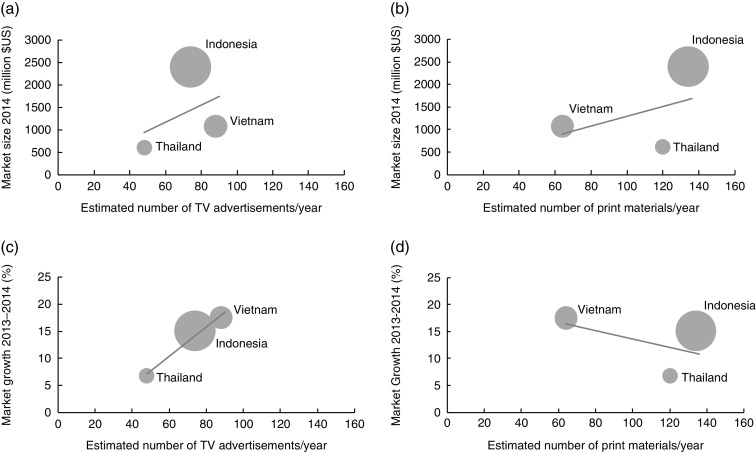
Design: We reviewed national regulations relating to the Code and 800 clips of editorial content, 387 advertisements and 217 Facebook posts from January 2015 to January 2016. We explored the ecological association between regulations and market size, and between the number of advertisements and market size and growth of milk formula.
Setting: Cambodia, Indonesia, Myanmar, Thailand and Vietnam.
Results: Regulations on the child's age for inappropriate marketing of products are all below the Code's updated recommendation of 36 months (i.e. 12 months in Thailand and Indonesia; 24 months in the other three countries) and are voluntary in Thailand. Although the advertisements complied with the national regulations on the age limit, they had content (e.g. stages of milk formula; messages about the benefit; pictures of a child) that confused audiences. Market size and growth of milk formula were positively associated with the number of newborns and the number of advertisements, and were not affected by the current level of implementation of breast-milk substitute laws and regulations.
Conclusions: The present media audit reveals inappropriate promotion and insufficient national regulation of products under the scope of the Code in South-East Asia. Strengthened implementation of regulations aligned with the Code's updated recommendation should be part of comprehensive strategies to minimize the harmful effects of advertisements of breast-milk substitutes on maternal and child nutrition and health.
Keywords: International Code of Marketing of Breast-milk Substitutes; Market size and growth; Media audit; South-East Asia.
Figures

 , milk formula (overall);
  , growing-up milk;
  , follow-on formula;
  , standard milk formula) in Indonesia (a), Thailand (b) and Vietnam (c). The market size was based on the Euromonitor report released in 2015(
43
)
, standard milk formula) in Indonesia (a), Thailand (b) and Vietnam (c). The market size was based on the Euromonitor report released in 2015(
43
)
References
-
- Victora CG, Bahl R, Barros AJD et al. (2016) Breastfeeding in the 21st century: epidemiology, mechanisms, and lifelong effect. Lancet 387, 475–490. - PubMed
-
- World Health Organization & UNICEF (2003) Global Strategy for Infant and Young Child Feeding. Geneva: WHO.
-
- Rollins NC, Bhandari N, Hajeebhoy N et al. (2016) Why invest, and what it will take to improve breastfeeding practices? Lancet 387, 491–504. - PubMed
-
- Black RE, Allen LH, Bhutta ZA et al. (2008) Maternal and child under-nutrition: global and regional exposures and health consequences. Lancet 371, 243–260. - PubMed
MeSH terms
LinkOut - more resources
Full Text Sources
Other Literature Sources
Medical
