. 2017 Apr 5;139(13):4659-4662.
doi: 10.1021/jacs.7b01459. Epub 2017 Mar 23.

Engineered Split-TET2 Enzyme for Inducible Epigenetic Remodeling

Affiliations

Engineered Split-TET2 Enzyme for Inducible Epigenetic Remodeling

Minjung Lee et al. J Am Chem Soc. .

Abstract

The Ten-eleven translocation (TET) family of 5-methylcytosine (5mC) dioxygenases catalyze the conversion of 5mC into 5-hydroxymethylcytosine (5hmC) and further oxidized species to promote active DNA demethylation. Here we engineered a split-TET2 enzyme to enable temporal control of 5mC oxidation and subsequent remodeling of epigenetic states in mammalian cells. We further demonstrate the use of this chemically inducible system to dissect the correlation between DNA hydroxymethylation and chromatin accessibility in the mammalian genome. This chemical-inducible epigenome remodeling tool will find broad use in interrogating cellular systems without altering the genetic code, as well as in probing the epigenotype-phenotype relations in various biological systems.


Conflict of interest statement

The authors declare no competing financial interest.

Figures
Scheme 1
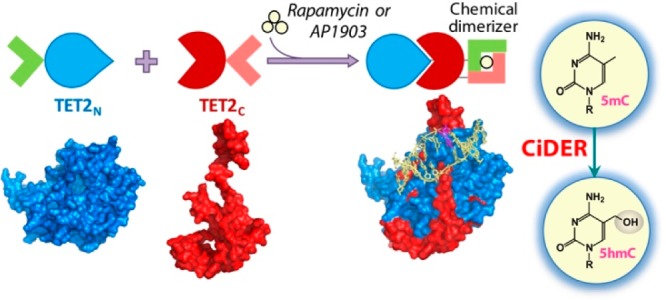
Scheme 1. Design of a Chemical-Inducible Epigenome Remodeling (CiDER) Tool Based on a Split TET2 Enzyme
FKBP12/FRB heterodimerization or FKBP-F36 V homodimerization modules are fused with two inactive fragments of a split TET2CD. Upon the addition of rapamycin or AP1903, split TET2CD fragments reassemble into a functional methylcytosine dioxygenase to catalyze the conversion of 5mC into 5hmC and further oxidized species, thus promoting DNA demethylation to remodel the epigenetic landscapes in mammalian cells.
Figure 1
Figure 1
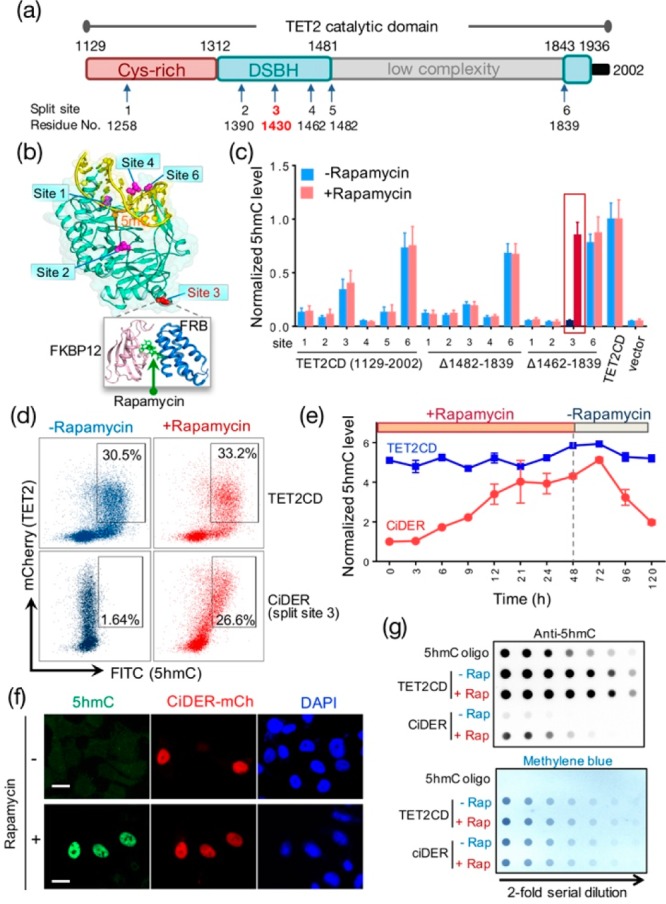
An engineered split-TET2 enzyme for inducible DNA hydroxymethylation in mammalian cells. (a) Domain architecture of the catalytic domain of TET2 (TET2CD; aa 1129–2002) and positions of selected split sites. DSBH, double stranded beta helix. (b) Split sites mapped to the 3D structure of TET2CD (PDB entry: 4NM6). A rapamycin-inducible heterodimerization module composed of FKBP12 and FRB was inserted individually into the selected split sites. (c) Screening and optimization of split-TET2CD constructs to achieve chemical-inducible 5hmC generation in HEK293T cells. The construct with insertion of FKBP12-T2A-FRB at split site 3 and deletion of the low complexity region (Δ1462–1839) stood out as the best candidate (termed “CiDER”). AP1903-incucible homodimerization of a mutant FKBP12 (F36 V) can also be engineered into this position to restore the catalytic activity of split-TET2CD (Figure S2). (d) Quantification of CiDER-mediated 5hmC production by flow cytometry. HEK293T cells transfected with mCherry (mCh)-tagged CiDER or mCh-TET2CD (positive control) were immunostained with an anti-5hmC primary antibody and an FITC-labeled secondary antibody. (e) Time course of rapamycin (200 nM)-induced production of 5hmC in HEK293T cells expressing CiDER or TET2CD (as positive control). Rapamycin was washed away 48 h after incubation with cells. (f) Representative fluorescent images of 5hmC (green), CiDER-mCh (red), and nuclear staining with DAPI (blue) in HEK293T cells before and after rapamycin (200 nM) treatment. (g) Dot-blot assay to quantify rapamycin (200 nM)-induced changes of 5hmC levels in genomic DNA purified from HEK293T cells expressing CiDER or TET2CD. A synthetic oligonucleotide with a known amount of 5hmC was used as a positive control. The loading control was shown in the bottom panel by methylene blue staining of total amounts of input DNA. See Supporting Information (Figures S1,2) for more results and sequences. n = 5. Scale bar = 10 μm.
Figure 2
Figure 2
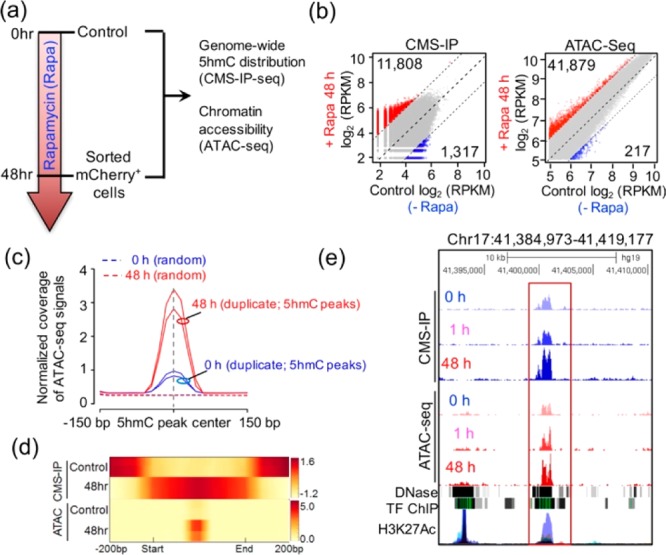
CiDER-mediated chemical inducible remodeling of epigenetic states to increase chromatin accessibility in mammalian cells. (a) Schematic of the experimental setup 0 or 48 h after 200 nM rapamycin treatment, genomic DNA samples from HEK293T cells were subjected to genome-wide 5hmC profiling and ATAC-seq to monitor chromatin accessible regions in the genome. (b) Scatter plots of differential 5hmC peaks and ATAC peaks between 0 and 48 h treatment groups. Red and blue dots represent significantly up- or down-regulated ATAC/5hmC peaks at 48 h, respectively. The gray dots represent peaks without significant changes at 48 h. (c) Normalized coverage of ATAC-seq signals (0 h and 48h; with biological duplicates) were plotted 150 bp up- and downstream of the centers of 5hmC-peaks at 0 h (control). (d) Distribution of averaged 5hmC enrichment (2 upper panels) and ATAC-seq peak enrichment (2 lower panels) at control ATAC/5hmC peaks regions in CiDER-expressing HEK293T cells at time 0 (control) or 48 h following rapamycin treatment. (e) Representative genome browser view of one HMDR in the LINC00854 locus on chromosome 17 that showed rapamycin-induced gain of 5hmC and ATAC-seq peaks, which was overlaid with traces representing DNase I hypersensitive sites, transcriptional factor binding (TF ChIP) and H3K27Ac enrichment.

References

    1. Li E.; Zhang Y. Cold Spring Harbor Perspect. Biol. 2014, 6, a019133.10.1101/cshperspect.a019133. - DOI - PMC - PubMed
    1. Tahiliani M.; Koh K. P.; Shen Y.; Pastor W. A.; Bandukwala H.; Brudno Y.; Agarwal S.; Iyer L. M.; Liu D. R.; Aravind L.; Rao A. Science 2009, 324, 930–5. 10.1126/science.1170116. - DOI - PMC - PubMed
    1. He Y. F.; Li B. Z.; Li Z.; Liu P.; Wang Y.; Tang Q.; Ding J.; Jia Y.; Chen Z.; Li L.; Sun Y.; Li X.; Dai Q.; Song C. X.; Zhang K.; He C.; Xu G. L. Science 2011, 333, 1303–7. 10.1126/science.1210944. - DOI - PMC - PubMed
    1. Ito S.; Shen L.; Dai Q.; Wu S. C.; Collins L. B.; Swenberg J. A.; He C.; Zhang Y. Science 2011, 333, 1300–3. 10.1126/science.1210597. - DOI - PMC - PubMed
    1. Spruijt C. G.; Gnerlich F.; Smits A. H.; Pfaffeneder T.; Jansen P. W.; Bauer C.; Munzel M.; Wagner M.; Muller M.; Khan F.; Eberl H. C.; Mensinga A.; Brinkman A. B.; Lephikov K.; Muller U.; Walter J.; Boelens R.; van Ingen H.; Leonhardt H.; Carell T.; Vermeulen M. Cell 2013, 152, 1146–59. 10.1016/j.cell.2013.02.004. - DOI - PubMed

Publication types

LinkOut - more resources